-
Energy
TerraPower and SK Innovation Sign Term Sheet to Pursue Joint SMR Projects
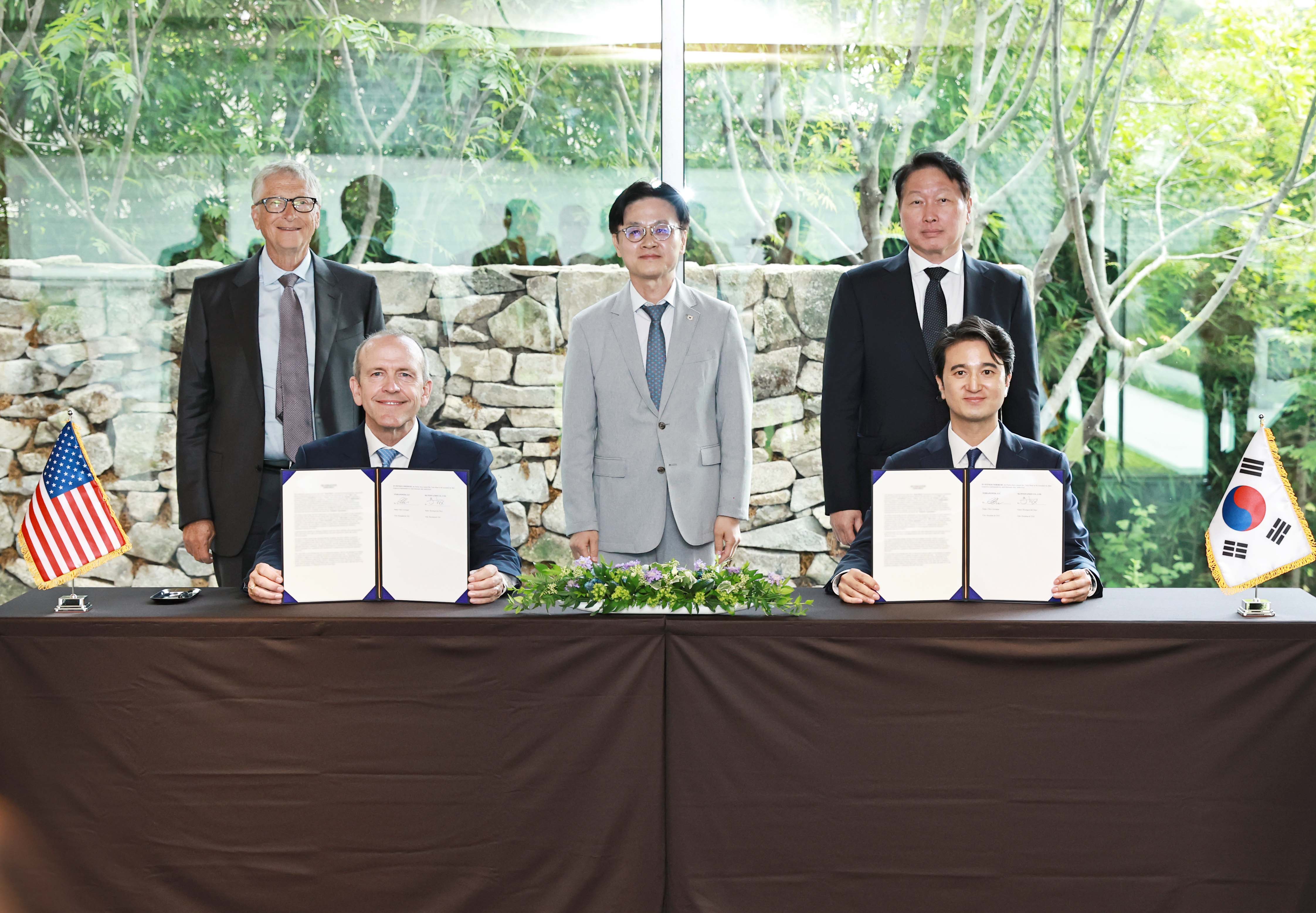
On August 14, 2026, TerraPower and SK Innovation signed in Seoul a term sheet for an agreement to pursue joint global projects. The signing was witnessed by Minister JK (Jung-Kwan) Kim of the Ministry of Trade, Industry and Resources (MOTIR), TerraPower Founder and Chairman Bill Gates, and SK Group Chairman Chey Tae-won. “With their ability to deliver projects on time and within budget, Korean companies can play a central role in turning TerraPower’s vision into reality,” said Minister Kim. date2026-08-18
-
Energy
SMR Cooperation with TerraPower Expands Export Supply Chains for Korean Nuclear Companies
On August 14, 2026, Minister JK (Jung-Kwan) Kim of the Ministry of Trade, Industry and Resources (MOTIR) met in Seoul with TerraPower Founder and Chairman Bill Gates, who arrived in Korea earlier that day. In the meeting, both Minister Kim and Chairman Gates discussed expanding Korean companies’ participation in TerraPower’s small modular reactor (SMR) projects, among other topics. Korean companies, including SK and HD Hyundai, have invested in TerraPower and established partnerships with the company. Several are also seeking roles in equipment supply, operations, construction, and other areas for projects that TerrraPower is pursuing both within the U.S. and abroad. In fact, TerraPower is building its Natrium SMR in Kemmerer, Wyoming, after receiving a construction permit from the U.S. Nuclear Regulatory Commission (NRC) in March 2026, and aims to begin commercial operation in 2031. At the meeting, Minister Kim stressed that overseas expansion requires the ability to deliver projects on time and within budget. “Korean companies have these capabilities and could play a central role in turning TerraPower’s vision into reality,” he said. He noted that making SMRs economically viable will require standardized designs to be deployed at scale. Combining TerraPower’s standard design with Korea’s reliable supply chain for high-volume production will be essential to such deployment. Minister Kim said Korea is an ideal partner because Korea boasts five decades of building and operating nuclear power plants at home and abroad, which has given Korea a “foundry-scale” ecosystem for nuclear manufacturing and construction. He added that Korea’s nuclear supply chain draws strength not only from large companies that can supply main equipment, but also from its sophisticated manufacturing ecosystem of nuclear SMEs and middle-market companies. He called for TerraPower to consider using Korea as a production hub and Korean companies as key suppliers. After the meeting, TerraPower and SK Innovation signed a term sheet for an agreement to pursue joint global projects, witnessed by Minister Kim, Chairman Gates, and SK Group Chairman Chey Tae-won. The term sheet opens opportunities for SK Innovation to help develop TerraPower’s SMR projects in the United States and other countries, and to participate in the company’s U.S. business. Demand for SMRs from big tech companies is rising rapidly as AI infrastructure expands and the number of data centers surges worldwide. More than 100 SMR designs are under development, and companies are forming cross-border alliances as they vie for a share of the emerging market. Amid these changes, Korean companies can also help diversify Korea’s nuclear exports by investing in SMR designs developed overseas, advancing projects, and engaging in overseas supply chains. With SMR supply chains still taking shape, MOTIR views this as the right opportunity for Korean companies to enter the market. The Ministry valued that the meeting not only helped large Korean companies but also nuclear SMEs and middle-market companies in their efforts to join overseas SMR supply chains. date2026-08-14
-
Energy
MOTIR and NSSC Sign MOU on Regulatory Cooperation
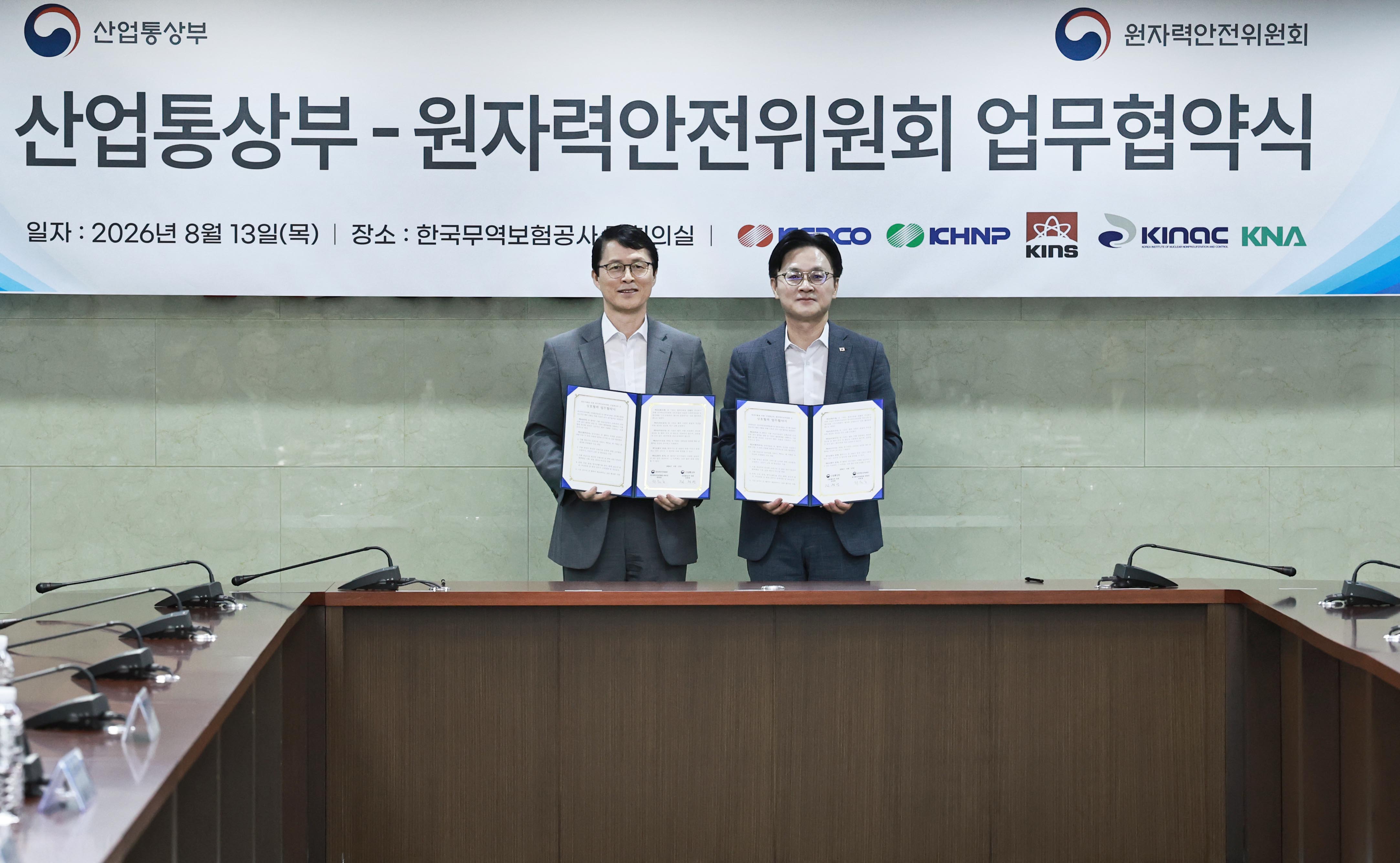
Minister JK (Jung-Kwan) Kim of the Ministry of Trade, Industry and Resources (MOTIR) and Chairperson Choi Won-ho of the Nuclear Safety and Security Commission (NSSC) signed an MOU on regulatory cooperation at the Korea Trade Insurance Corporation (K-SURE) in Seoul on August 13, 2026. Representatives from relevant organizations, including the Korea Electric Power Corporation (KEPCO), Korea Hydro & Nuclear Power (KHNP), Korea Institute of Nuclear Safety (KINS), and Korea Institute of Nuclear Nonproliferation and Control (KINAC), attended the ceremony. Minister Kim also witnessed the signing of a separate MOU among five organizations, including the Korea Nuclear Association for International Cooperation. “The agreement provides a formal basis for linking nuclear power exports with regulatory cooperation and pooling the expertise of the agencies and participating organizations,” said Minister Kim. “With NSSC, KINS, and KINAC as core Team Korea partners, we will address the diverse cooperation needs of countries introducing nuclear power, including Vietnam.” date2026-08-13
-
Energy
MOTIR and NSSC to Pair Nuclear Power Exports with Regulatory Cooperation
The Ministry of Trade, Industry and Resources (MOTIR, Minister JK Kim) and the Nuclear Safety and Security Commission (NSSC, Chairperson Choi Won-ho) signed a memorandum of understanding (MOU) on August 13, 2026, at the Korea Trade Insurance Corporation (K-SURE) in Seoul to support the successful overseas deployment of Korean-designed nuclear power plants. Amid continued global instability, including the Russia-Ukraine war and the closure of the Strait of Hormuz, and with climate action now a pressing international priority, nuclear power is drawing renewed attention for its ability to provide a reliable energy supply and contribute to carbon neutrality. As a result, plans to introduce new nuclear power plants are gaining momentum in the United States and Europe, as well as in Southeast Asian countries such as Vietnam and the Philippines. In response to these market developments, the Korean government is actively pursuing nuclear power exports, with a focus on promising Southeast Asian markets, including Vietnam. Countries introducing nuclear power for the first time must establish the necessary regulatory infrastructure alongside plant construction. This includes relevant laws, licensing procedures, technical standards, capable regulatory bodies, and a workforce specializing in nuclear safety and security. Entering these emerging markets therefore requires comprehensive cooperation that combines technology and project execution capabilities with Korea’s regulatory experience and expertise across the entire nuclear power plant lifecycle. Previously, MOTIR referred regulatory cooperation requests from potential buyer countries to NSSC, which handled them case by case with relevant technical organizations. The International Atomic Energy Agency (IAEA), however, advises buyer countries to develop their regulatory frameworks and licensing capacity before choosing a technology supplier. This has highlighted the need to link nuclear power exports with regulatory cooperation in a more systematic and sustainable manner. MOTIR and NSSC signed the MOU to jointly address potential buyer countries’ regulatory cooperation needs, providing systematic support as they establish their nuclear safety regulatory frameworks and strengthen their regulatory capacity. The two agencies will regularly share updates on overseas nuclear power projects, as well as information on each country’s regulatory environment and cooperation needs. Drawing on Korea’s experience regulating nuclear power plants from design and construction through operation, they will tailor cooperation to each potential buyer country’s circumstances and project stage. Five organizations—the Korea Electric Power Corporation (KEPCO), Korea Hydro & Nuclear Power (KHNP), Korea Nuclear Association for International Cooperation (KNA), Korea Institute of Nuclear Safety (KINS), and Korea Institute of Nuclear Nonproliferation and Control (KINAC)—also signed a separate MOU. Under the MOUs, MOTIR and NSSC will set the government’s overall direction for cooperation, while the participating organizations undertake projects tailored to each country’s needs. This is expected to integrate regulatory cooperation into overseas nuclear power projects from the outset and enable a systematic response to potential buyer countries’ regulatory needs. After the signing, MOTIR and NSSC held a consultation to share updates on major nuclear power projects in Vietnam, the Czech Republic, and the Philippines, as well as regulatory cooperation with the United Arab Emirates and the Czech Republic. They also discussed how to tailor nuclear power export and regulatory cooperation to conditions in each country. “This MOU is significant because it establishes a formal basis for systematically linking nuclear power exports with regulatory cooperation and pooling the expertise of both agencies and the date2026-08-13
-
Energy
Good-Price Gas Station Site Visit and Roundtable
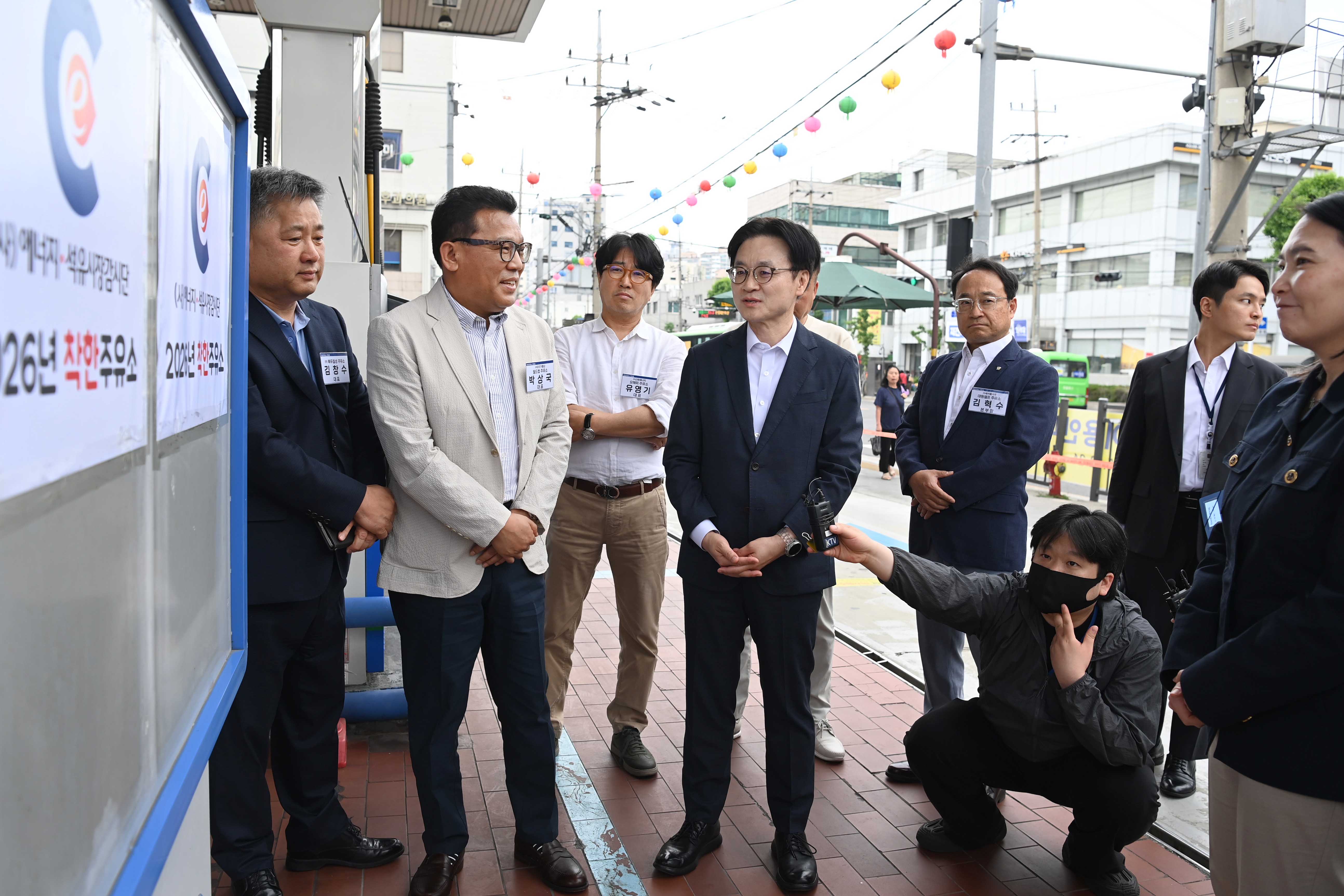
Minister JK (Jung-Kwan) Kim of the Ministry of Trade, Industry and Resources (MOTIR) visited Daewon Self-Service Gas Station, a designated Good-Price Gas Station in Guro-gu, Seoul, on May 19, 2026, and held a roundtable with operators of selected stations. Minister Kim recognized their role in stabilizing fuel prices and took note of concerns over the maximum price system for petroleum products. The roundtable was attended by representatives of Daewon Self-Service Gas Station, Tiger Trading World Cup Gas Station, Bukduchilseong Gas Station, Shinhwa Energy O Happy Gas Station and Gwanghwal Nonghyup Gas Station, among others. “Domestic fuel prices have remained stable largely thanks to the efforts of gas stations on the ground,” Minister Kim said, expressing appreciation to Good-Price Gas Stations and other operators and calling for joint efforts to navigate Middle East-related challenges. date2026-05-19
-
Energy
Minister JK Kim Visits Good-Price Gas Stations, Recognizes Efforts to Stabilize Prices
Minister JK (Jung-Kwan) Kim of the Ministry of Trade, Industry and Resources (MOTIR) visited Daewon Self-Service Gas Station, a designated Good-Price Gas Station in Guro-gu, Seoul, on May 19, 2026. He met with operators of selected stations, recognized their role in stabilizing fuel prices as Middle East-driven oil market volatility puts growing pressure on domestic prices, and took note of concerns raised by the operators over the maximum price system for petroleum products. Good-Price Gas Stations are recognized by Energy Consumer (E Consumer), a civic watchdog group that monitors energy and petroleum markets, for their contribution to fuel price stability following the March 13 launch of the maximum price system for petroleum products. The group designates stations every two weeks, selecting 10 in Seoul and Gyeonggi Province and five per region elsewhere. The 334 stations selected across four rounds sell fuel at about KRW 14 to 15 per liter below the national average, while the 24 stations selected at least twice sell at about KRW 19 to 21 less per liter. To encourage price-stabilization efforts by gas stations, MOTIR is stepping up public outreach and incentives for the Good-Price Gas Station initiative. A dedicated banner has been added to Opinet, the fuel price information service run by the Korea National Oil Corporation (KNOC), and users can now find nearby Good-Price Gas Stations on major navigation platforms, including TMAP, Naver Map and KakaoMap. Two stations have already been selected three times. Stations selected five times will be designated as “Exemplary Good-Price Gas Stations” and receive incentives, including dedicated online and offline marks and government awards. The maximum price system for petroleum products, together with E Consumer’s selection of Good-Price Gas Stations, has helped keep nationwide average pump prices stable, at around KRW 2,011 per liter for gasoline and KRW 2,006 for diesel. According to the Ministry of Finance and Economy (MOFE), the system eased upward pressure on consumer prices by 0.6 percentage point in March and 1.2 percentage points in April. In March, energy prices across the OECD rose 8.1 percent on average, while Korea's rose only 5.2 percent.. Diesel prices, which directly affect truck drivers and other transport workers, rose 26 percent in Korea from pre-conflict levels, lower than the increases of 44 percent in the United States and 37 percent in the United Kingdom. “Domestic fuel prices have remained stable largely thanks to the efforts of gas stations on the ground,” Minister Kim said. “I extend my sincere appreciation to Good-Price Gas Stations and other gas station operators, and hope the government, businesses and the public will work together to navigate the Middle East-related challenges.” He added, “I also hope the conflict in the Middle East ends as soon as possible and markets return to normal.” date2026-05-19
-
Energy
Anchor Firms and Partner Companies Team Up to Build Low-Carbon Industrial Supply Chains
The Ministry of Trade, Industry and Resources (MOTIR, Minister JK Kim) held a meeting at the Korea Chamber of Commerce and Industry (KCCI) on May 19, 2026, with consortia selected for MOTIR’s 2026 industrial supply chain carbon partnership program. As global carbon regulations increasingly target supply chains, green transformation (GX) has become critical to manufacturing competitiveness. Through the program, MOTIR will work with the lead companies of the eight consortia to help 31 partner SMEs and middle-market companies reduce emissions. Under the program, the government will cover up to 50 to 60 percent of partner companies’ costs for installing carbon-reduction equipment. It will also support consulting on emissions-reduction and product carbon footprint calculations, as well as third-party verification. Lead companies will provide cash support, help cover the required private-sector cost share through tools such as interest-free loans and interest subsidies, cover operating and management costs, and offer consulting and training to strengthen partner capabilities. The selected consortia can be grouped into four models. Hyundai Motor and Kia will use a cascading support structure, in which first-tier partner companies receive cash support and then pass support on to second-tier partner companies. Samsung Electronics, Samsung Display, LG Electronics, HL Mando and SK hynix will use overlapping partner-company networks to spread emissions-reduction results across supply chains. HD Korea Shipbuilding & Offshore Engineering will support partner companies’ operating and management costs and convert their emissions-reduction results into external projects for further use. POSCO will provide personnel and technology to help SME and middle-market customers improve process efficiency. Participating companies aim to cut greenhouse gas emissions by about 20,000 tons per year, encourage voluntary reductions throughout their supply chains, and identify and share best practices in win-win cooperation. The initiative will also help them respond promptly to tightening global carbon rules, including the EU Carbon Border Adjustment Mechanism (CBAM) and Battery Regulation, meet Science Based Targets initiative (SBTi) targets, address global customers’ supply-chain emissions requirements, secure product carbon footprint (PCF) data, and strengthen export competitiveness. “Carbon neutrality and industrial competitiveness are complementary goals that will shape the future of industry,” said Lee Min-woo, Director General for Industrial Policy at MOTIR. “Today’s supply-chain cooperation will help these industries maintain global leadership. The government and companies of all sizes should work together to navigate tightening global carbon rules and identify and scale successful green transformation models that support shared growth.” date2026-05-19
-
Energy
Korea Secures ISO Approval to Start Work on Standard for Decommissioning Nuclear Power Plants
The Korean Agency for Technology and Standards (KATS, President Kim Dae-ja) of the Ministry of Trade, Industry and Resources (MOTIR, Minister JK Kim) announced that Korea’s proposal to develop the world’s first international standard for decommissioning nuclear power plants, which was submitted in June 2023, has been approved by the International Organization for Standardization (ISO) as a new work item proposal (NP). After nearly three years of discussions by ISO Technical Committee 85 (TC 85, Nuclear energy, nuclear technologies and radiological protection), it received support from nine ISO member countries, including the United States, China and Japan. The approved proposal sets out general requirements for the decommissioning process, from basic terminology to planning, implementation and management, with Korea leading development of the standard as project leader. The draft will enter the member-country comment phase on May 19, 2026, with publication as an International Standard (IS) targeted for December 2027. KATS also plans to develop nine additional international standards in stages, covering specific technologies required for decommissioning. These will include nuclear power plant decommissioning planning, radioactive waste management, facility characterization, safety assessment, decommissioning work management, decontamination and dismantling, radiation protection and monitoring, application of clearance criteria, and site restoration. IAEA experts will also participate in the standardization process to improve alignment with international nuclear safety standards. KATS expects the Korea-led standards to serve as practical reference points for the global nuclear power plant decommissioning industry and help strengthen the competitiveness of Korean companies in overseas markets. “On nuclear power plant construction and operation, Korea has largely followed international standards,” said KATS President Kim Dae-ja. “This proposal marks a meaningful step, as Korea is now in a position to lead international standardization in decommissioning. To support the export competitiveness of K-nuclear power, we will also lead the development of de facto standards through organizations such as the American Society of Mechanical Engineers (ASME), alongside our work at ISO.” date2026-05-18
-
Energy
Korea Provides Tailored Guidance on EU CBAM Full Implementation in 2026
The Korean government held its 11th joint briefing of 2026 on the EU Carbon Border Adjustment Mechanism (CBAM) at Trade Tower in Seoul on April 21, 2026, with the participation of the Ministry of Trade, Industry and Resources (MOTIR, Minister JK Kim), the Ministry of Climate, Energy and Environment (MCEE, Minister Kim Sung-whan), the Ministry of SMEs and Startups (MSS, Minister Han Seong-sook), and the Korea Customs Service (KCS, Commissioner Lee Myeong-ku). Some 200 executives and employees from SMEs exporting CBAM-covered products attended in person, and many other companies joined online. With the EU CBAM entering full implementation in 2026, Korean exporters have moved beyond emissions reporting to a phase in which they will begin bearing carbon costs directly. As free allocation in the EU is phased out, the number of CBAM certificates required for exports to the EU is also expected to increase. Maintaining export competitiveness will increasingly depend on accurately calculating the embedded emissions of products shipped to the EU and the applicable free-allocation benchmarks for each product category. The briefing was held to share key regulatory changes following the start of the definitive period, based on the EU CBAM implementing rules released in December 2025. The briefing provided a detailed guide tailored to the full implementation, covering an overview of the system, practical compliance measures such as examples of emissions and certificate calculations, and the latest verification trends. The government also operated on-site consulting booths for pre-registered companies and provided tailored advice on company-specific issues. Park Jung-sung, Deputy Minister for Trade at MOTIR, said, “As 2026 marks the year when CBAM begins to function as a real trade barrier, it is essential that Korean companies clearly understand the revised rules that apply under full implementation.” He added, “The government will reinforce its public-private response system by using all available policy tools, including help desk services and consulting support, so that Korean companies are not placed at a disadvantage in the EU market.” The government will continue to swiftly share regulatory updates and response guidance to help minimize the burden on Korean exporters, while consulting with the relevant EU authorities on possible improvements to the system. date2026-04-21
-
Energy
Minister Kim Meets with Qatar’s Minister of State for Energy Affairs
Minister Kim Jung-kwan of the Ministry of Trade, Industry and Resources met with Saad bin Sherida Al-Kaabi, Minister of State for Energy Affairs of Qatar, on Wednesday, November 12, at the Four Seasons Hotel in Jongno-gu, Seoul, to discuss ways to strengthen bilateral cooperation with a focus on energy supply chain collaboration. Minister Kim noted that the meeting provided a meaningful opportunity to reinforce energy supply chain stability and expand practical cooperation in key sectors such as LNG, plant construction, and shipbuilding. He added that the ministry will continue to strengthen high-level dialogue channels with Qatar and pursue concrete project-based partnerships. date2025-11-14