-
Trade/Investment
Roundtable with Korean Companies in Saudi Arabia
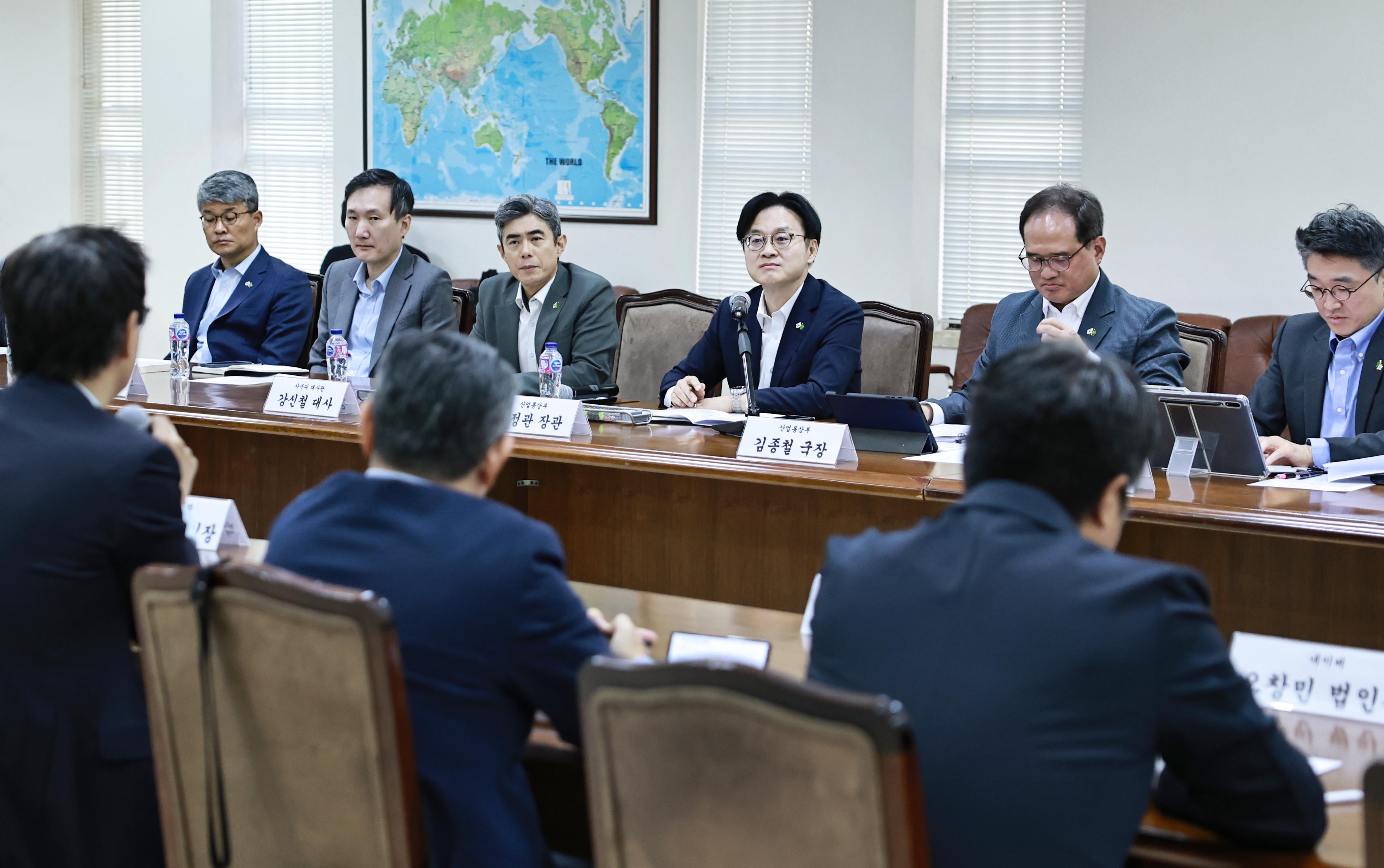
Minister JK (Jung-Kwan) Kim of the Ministry of Trade, Industry and Resources (MOTIR) chaired a roundtable with Korean companies and support organizations operating in Saudi Arabia at the Embassy of the Republic of Korea in Saudi Arabia on June 14, 2026. The meeting brought together representatives from Korea National Oil Corporation, NAVER, LG Electronics, Samsung C&T, KOTRA, and other organizations. Participants discussed key business challenges, requests, and future plans related to their operations in Saudi Arabia. Minister Kim said Korea will continue to expand economic cooperation with Saudi Arabia across manufacturing, advanced industries, and other areas, building on the practical industrial cooperation achieved so far. date2026-06-15
-
Trade/Investment
European Investor Roundtable
Minister JK (Jung-Kwan) Kim of the Ministry of Trade, Industry and Resources (MOTIR) chaired a roundtable with European investors in Brussels, Belgium, on June 10, 2026, during President Lee Jae Myung’s visit to the European Union (EU). The roundtable brought together Kang Kyung-sung, President of the Korea Trade-Investment Promotion Agency (KOTRA); Philippe van Hoof, Chairperson of the European Chamber of Commerce in Korea (ECCK); investment support organizations; and representatives from European companies and research institutes working in materials, parts, and equipment for advanced industries, quantum computing, and other promising fields. Participants discussed future investment cooperation between Korea and Europe. Minister Kim said Korea’s advanced industry supply chains and AI ecosystem will continue to create new opportunities for European companies, and that the government will support investment by improving incentives, regulations, and the investment process. date2026-06-11
-
Trade/Investment
Investment Declaration Ceremony with European High-Tech Companies
Minister JK (Jung-Kwan) Kim of the Ministry of Trade, Industry and Resources (MOTIR) received investment declarations from four European high-tech companies in Brussels, Belgium, on June 10, 2026, during President Lee Jae Myung’s visit to the European Union (EU). The four companies are Germany’s advanced materials company Orafol, France’s Quandela, Dutch company Prodrive Technologies, and Sweden’s Mycronic. Together, they reported USD 165 million in foreign direct investment in Korea across advanced materials, photonic quantum computing, advanced industry equipment modules, and display and semiconductor equipment technologies. Minister Kim said Korea’s advanced industry supply chains and AI ecosystem will continue to create new opportunities for cooperation with European companies, and that the government will support foreign investment by improving incentives, regulations, and the investment process. date2026-06-11
-
Trade/Investment
May 2026 Exports Reach Monthly Record of $87.8 Billion
The Ministry of Trade, Industry and Resources (MOTIR, Minister JK Kim) announced that in May 2026, Korea’s exports rose 53.2 percent year-on-year to USD 87.8 billion, while imports increased 20.8 percent to $60.8 billion, resulting in a $27.0 billion trade surplus. Exports in May reached a monthly record and topped $80.0 billion for the third consecutive month. Semiconductor exports rose 169.4 percent, while exports excluding semiconductors increased 16.0 percent. Average daily exports, adjusted for working days, rose 60.7 percent to $4.3 billion, exceeding $4.0 billion for the first time. By product, exports increased in 12 of Korea’s 20 key export items. Semiconductor exports reached $37.2 billion, up 169.4 percent, setting a new monthly record and topping $30.0 billion for the third consecutive month. DRAM exports rose to $18.6 billion, up 369.8 percent, and NAND exports to $1.7 billion, up 206.8 percent. Other IT items also increased, with computers rising to $4.2 billion, up 290.7 percent; wireless communication devices to $1.5 billion, up 12.6 percent; and displays to $1.5 billion, up 9.4 percent. Automobile exports fell to $5.8 billion, down 5.9 percent, while ship exports rose to $2.6 billion, up 16.7 percent. Petroleum product exports increased to $5.3 billion, up 46.6 percent, although export volumes fell 23.8 percent. Petrochemical exports rose to $3.7 billion, up 11.1 percent, while export volumes declined 25.5 percent. Steel exports edged down to $2.0 billion, down 2.1 percent; nonferrous metals rose to $1.7 billion, up 41.5 percent; and general machinery fell to $3.8 billion, down 6.3 percent. Among consumer goods, biohealth exports rose to $1.4 billion, up 5.2 percent; cosmetics increased to $1.2 billion, up 24.2 percent, setting a new May record; and agricultural and fisheries products rose to $1.1 billion, up 4.7 percent. By destination, exports increased in seven of Korea’s nine major markets. Exports to China rose to $18.9 billion, up 80.9 percent, extending their growth streak to seven consecutive months. Exports to the United States increased to $16.0 billion, up 59.1 percent, while exports to ASEAN rose to $15.9 billion, up 58.4 percent, setting a new monthly record. Exports to the EU increased to $6.2 billion, up 2.4 percent, extending their growth streak to six consecutive months. Exports to the Middle East fell to $1.3 billion, down 7.7 percent. Imports rose 20.8 percent year-on-year to $60.8 billion. Energy imports increased to $11.8 billion, up 15.9 percent, while non-energy imports rose to $49.1 billion, up 22.0 percent. Crude oil imports increased to $8.5 billion, up 25.0 percent, with import volumes rising month-on-month from 62.6 million barrels in April to 69.8 million barrels in May. Among non-energy imports, petroleum products rose to $2.6 billion, up 71.0 percent, and semiconductor equipment to $2.6 billion, also up 71.0 percent. The trade surplus in May reached $27.0 billion, up $20.0 billion from May 2025. Korea’s cumulative trade surplus from January to May reached $101.9 billion, surpassing the previous annual trade surplus record. Minister JK (Jung-Kwan) Kim stated, “With exports increasing again in May, Korea has maintained export growth for 12 consecutive months since the current administration took office. The cumulative trade surplus for January to May has also surpassed Korea’s previous annual trade surplus record.” He added, “This reflects exports growing at a faster pace despite higher imports caused by rising oil prices from the conflict in the Middle East. IT items led by semiconductors, as well as consumer goods such as cosmetics and agricultural and fisheries products, continued to perform well.” Minister Kim also noted that uncertainty remains over the conflict in the Middle East, U.S. tariffs, and the EU’s steel tariff-rate quotas (TRQs). He said the government will continue date2026-06-01
-
Trade/Investment
Korea to Reform U-Turn Policy to Promote Regional Investment
The Ministry of Trade, Industry and Resources (MOTIR, Minister JK Kim) announced measures to redefine and promote Korea’s U-turn policy at the Ministerial Meeting on Economic Affairs on May 29, 2026. In response to rising global protectionism and supply chain realignments, the measures form part of a key national policy task to move beyond the simple relocation of overseas operations, promote regional investment, and secure domestic production and innovation capacity in advanced strategic sectors. The government will focus on four priorities: redefining eligibility for U-turn companies, reforming the U-turn subsidy system, strengthening screening and management while rationalizing implementation requirements, and providing targeted support to attract companies and facilitate investment execution. 1. Redefining Eligibility for U-Turn Companies Korea’s initial U-turn policy focused on helping Korean companies with overseas operations return home when business conditions deteriorated, leaving eligibility narrowly defined. Reflecting a broader shift in major economies such as the United States and Japan, which are expanding reshoring support to secure production capacity in advanced strategic sectors, the government plans to revise relevant laws and regulations on U-turn companies in 2026 and implement the revised framework in 2027. First, the government will ease the same-or-similar product and service requirement by broadening how similarity is assessed. In addition to materials, parts, and production processes, assessments will also consider function, use, core technologies, and supply chains. This will help companies invest in new industries and upgrade their business structures. The government will also broaden the exemption cases in which companies can qualify for U-turn recognition without closing, selling, or downsizing their overseas operations. Companies in advanced industries or supply chain sectors will also qualify for this exemption if their investment in Korea is recognized as a core production facility, or “mother factory.” Through these changes, the government aims to move beyond formal requirements and secure advanced manufacturing and innovation capacity in Korea. 2. Reforming the U-Turn Subsidy System The current U-turn subsidy system applies preset subsidy rates under a fixed table, limiting its ability to attract high-quality returning companies to regions outside the capital area. To promote regional investment and U-turn investment in advanced strategic sectors, the government will shift to a case-by-case negotiation model for subsidies. Under the new model, the government and companies will consult on support levels for strategic sectors such as advanced industries and supply chains, as well as large-scale investment projects. Support will vary based on factors including non-capital region investment, youth employment, advanced strategic technologies, and whether the project involves a mother factory. The government will also replace fixed subsidy caps with maximum subsidy rates, while keeping the current system for general industries and small-scale investments. 3. Strengthening Screening and Follow-Up Management Some designated U-turn companies have lost their status after failing to make domestic investments as planned. To improve follow-through and keep unqualified companies out of the system, the government will screen investment plans and companies’ execution capacity more closely from the selection stage. It will also establish a working-level committee on domestic return to systematize company selection and subsidy reviews and set procedures for the negotiated subsidy model. For subsidized companies, the implementation period will be extended beyond the current three years based on the scale of support. Post-designation requirements will also be adjusted to reflect automation at manufacturing sites and changes in the in date2026-05-29
-
Trade/Investment
Major Retailer Sales Up 7.2% in April 2026
The Ministry of Trade, Industry and Resources (MOTIR, Minister JK Kim) announced that total sales at 26 major retailers (15 brick-and-mortar retailers and 11 online retailers) in April 2026 rose 7.2 percent year-on-year, with offline sales up 6.7 percent and online sales up 7.5 percent. Offline sales increased at department stores (up 21.7 percent) and convenience stores (up 3.3 percent), while hypermarkets (down 6.6 percent) and super supermarkets (SSMs) (down 6.9 percent) declined. Department stores and convenience stores extended their growth streaks to ten consecutive months since July 2025. Department store sales increased across all categories, including premium international brands, fashion and apparel, accessories, and food. Convenience store sales also rose across all product categories, as early hot weather lifted sales of processed foods, including beverages, while ready-to-eat foods and household goods also posted gains. Hypermarket sales remained weak, as consumer spending continued to shift online and sales of food, their core category, stayed sluggish. This weakness has persisted since the second quarter of 2024. SSM sales also remained on a downward trend. Sales shares by channel were 60.3 percent for online retailers, 15.3 percent for department stores, 14.6 percent for convenience stores, 7.9 percent for hypermarkets, and 1.9 percent for SSMs. By product category, offline food sales declined, while online sales grew across all categories, including food, home appliances and electronics, fashion, and services. Cosmetics continued to post high growth, supported by strong demand for K-beauty. date2026-05-27
-
Trade/Investment
Land Ownership to Be Allowed in Free Trade Zones
The Korean Cabinet approved a bill to amend the Act on Designation and Management of Free Trade Zones on May 20, 2026. The amendment is designed to modernize aging production facilities in free trade zones and update their manufacturing-centered industrial structure so they can respond to rapid changes in the global industrial environment. It focuses on detailed rules for selling state- and public-owned land, giving companies a path to land ownership that can support new investment, while expanding digital transformation (DX) support to promote higher-value business activities. 1. Detailed Rules for Land Sales and Stronger Follow-Up Controls Until now, the law allowed land sales in free trade zones, but no detailed procedures were in place. In practice, the zones operated on a lease-only basis, leaving resident companies without land ownership and limiting their ability to secure collateral, hindering new investments. To address these constraints, the amendment sets out procedures and conditions for selling state-owned or public land and factory facilities, including sales prices and purchase eligibility. A restriction period on property disposal is introduced as a measure to prevent real estate speculation, as well as compliance enforcement fines for violations, such as failure to sign an occupancy contract or unauthorized disposal. 2. Support for Higher-Value Activities and Industrial Competitiveness Since their introduction in 1970, free trade zones have operated mainly as manufacturing bases, limiting their ability to keep pace with changes in the industrial environment. The amendment grants occupancy eligibility to export companies in knowledge services, including information processing and R&D, to promote digital transformation among resident companies and attract higher-value businesses. It also lowers entry barriers by allowing exceptions to the standard building area ratio requirement, reflecting the fact that knowledge service companies do not require large factories. In addition, the amendment expands special provisions under the Customs Act beyond goods clearance to customs assessment and duty reductions or exemptions. It also introduces raw material taxation, strengthening tax benefits for companies in free trade zones. The amendment is scheduled to take effect in May 2027 after revisions to the Enforcement Decree and related regulations. The Ministry of Trade, Industry and Resources (MOTIR, Minister JK Kim) will continue to support free trade zones so they can remain at the forefront of Korea’s exports and move beyond traditional manufacturing and logistics bases into advanced strategic hubs that bring together digital and service industries. date2026-05-20
-
Trade/Investment
April 2026 Automobile Exports Total $6.2 Billion
The Ministry of Trade, Industry and Resources (MOTIR, Minister JK Kim) announced that in April 2026, Korea’s automobile exports fell 5.5 percent year-on-year in value to USD 6.2 billion and 0.8 percent in volume to 245,000 units, while domestic sales edged up 0.7 percent to 152,000 units and production fell 6.1 percent to 362,000 units. Automobile exports reached $6.2 billion in April, down 5.5 percent year-on-year. By region, exports increased to North America (up 2.4 percent), Latin America (up 23.7 percent), and Oceania (up 20.1 percent), but declined in the Middle East (down 38.7 percent), the European Union (down 13.1 percent), and Asia (down 31.7 percent). Despite the overall decline, exports of eco-friendly vehicles continued to grow, led by electric and hybrid vehicles, with export value rising 13.5 percent year-on-year to $2.5 billion. Production totaled 362,000 units in April, down 6.1 percent year-on-year. Production rose at GM Korea (up 15.4 percent), KG Mobility (up 8.6 percent), and Kia (up 0.5 percent), while falling at Hyundai Motor (down 16.2 percent) and Renault Korea (down 32.3 percent). The decline reflected some parts supply-chain issues, as well as delayed purchases ahead of new and facelifted model launches for key vehicle lines. Production disruptions from the supply-chain issues are expected to ease beginning in June. Domestic sales totaled 152,000 units in April, up 0.7 percent year-on-year. Among domestically produced vehicles, Kia sales rose 7.9 percent, while sales of some imported vehicles also increased, mainly among electric models. Eco-friendly vehicle sales totaled 91,000 units, accounting for about 60 percent of total domestic sales and indicating that the industry’s shift toward eco-friendly vehicles is accelerating. date2026-05-20
-
Trade/Investment
Industrial Growth Fund Launch Ceremony and Industrial Finance Strategy Meeting
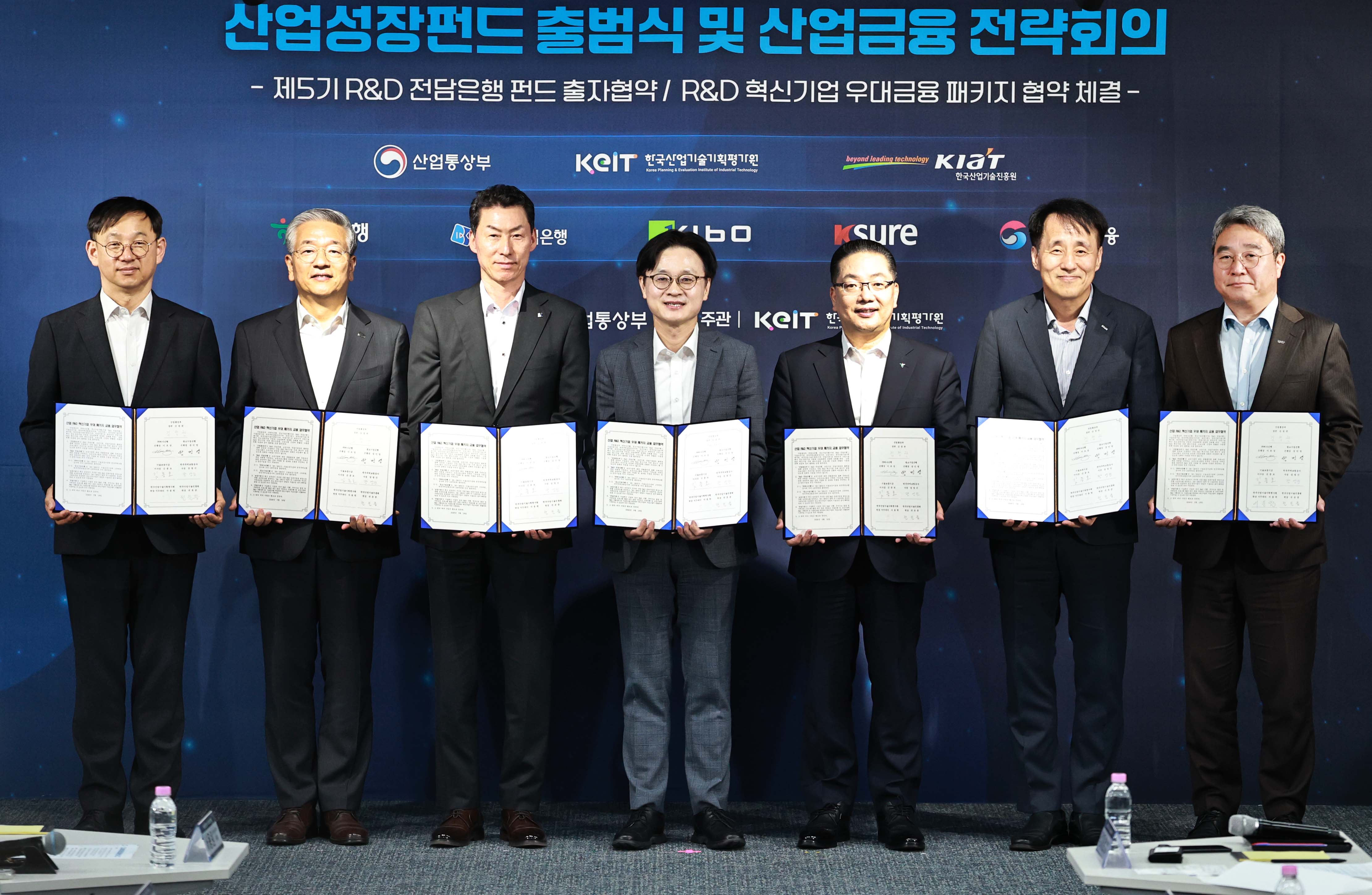
Minister JK (Jung-Kwan) Kim of the Ministry of Trade, Industry and Resources (MOTIR) chaired the Industrial Growth Fund Launch Ceremony and Industrial Finance Strategy Meeting at Korea Growth Investment Corporation in Yeouido, Seoul, on May 18, 2026. At the event, relevant institutions signed agreements to launch the third phase of the Industrial Growth Fund and establish a preferential financing package for R&D-driven innovative companies. The event brought together financial institutions, companies, venture capital firms and R&D institutions, including Hana Bank, Industrial Bank of Korea (IBK), Korea Technology Finance Corporation (KOTEC), Korea Growth Investment Corporation, TESOLLO INC., FRT Robotics., KOLON INVESTMENT, Enlight Ventures, Korea Trade Insurance Corporation (K-SURE), and Korea Planning & Evaluation Institute of Industrial Technology (KEIT). “Investment in innovative companies is a shared commitment by finance, industry and the government to move in the same direction and share both risks and outcomes,” Minister Kim said. “Expanded industrial finance will help Korea advance AI-manufacturing convergence and shared growth with regional economies.” date2026-05-18
-
Trade/Investment
Strong Industrial Finance to Support Innovative Companies and Industrial Ecosystems
The Ministry of Trade, Industry and Resources (MOTIR, Minister JK Kim) will launch a range of industrial finance programs, including investments, guarantees, and loans, to support technology development, commercialization, and growth by innovative companies and strengthen Korea’s industrial ecosystems. On May 18, 2026, MOTIR held the Industrial Growth Fund Launch Ceremony and the Industrial Finance Strategy Meeting, chaired by Minister Kim. At the event, relevant institutions signed agreements to launch the third phase of the Industrial Growth Fund and establish a preferential financing package for R&D-driven innovative companies. The Industrial Growth Fund will be created through anchor investments from MOTIR’s R&D partner banks and additional private capital. For its third phase from 2026 to 2028, Hana Bank and Industrial Bank of Korea have committed a record KRW 1.1 trillion in anchor investments. MOTIR plans to realign the fund’s investment focus with major industrial policy priorities, including manufacturing AI transformation (M.AX), balanced regional development, and new growth engines, while expanding its role as a platform for cooperation across industrial ecosystems. The first sub-fund will be the M.AX Industrial Transformation Innovation Fund, which will invest in companies pursuing the convergence of manufacturing and AI in areas such as humanoids, AI factories, future mobility, and autonomous ships. Based on KRW 100 billion in anchor investments, the fund aims to scale up to KRW 500 billion through private matching and other investments, with a call for fund managers scheduled for June. MOTIR will also launch regional industry vitality funds and sector-specific ecosystem funds in phases. A preferential financing package will also be made available to R&D-driven innovative companies over the next three years. Hana Bank and Industrial Bank of Korea will contribute a combined KRW 47 billion to the Korea Technology Finance Corporation (KOTEC) and Korea Trade Insurance Corporation (K-SURE), which will use the funds to provide approximately KRW 700 billion in guarantees and insurance to SMEs and middle-market companies, while companies receiving guarantees will also be eligible for low-interest loans. The package will be offered through KOTEC and K-SURE programs, with support scheduled to begin in July after the relevant institutions finalize detailed agreements. The preferential financing for R&D-driven innovative companies will be offered through two programs: (1) the 'Project-based R&D Commercialization Guarantee' by KOTEC and (2) the 'Export-Import Trade Finance for R&D Innovative Companies' by K-SURE. First, the 'Project-based R&D Commercialization Guarantee' evaluates the market potential of individual R&D projects and provides loan guarantees for the funds needed to commercialize the technology. Second, the 'Export-Import Trade Finance for R&D Innovative Companies' allows companies seeking to export or expand overseas based on MOTIR R&D outcomes to secure loans for manufacturing costs and the importation of raw and subsidiary materials. These two programs are scheduled to launch in July once the relevant institutions finalize detailed agreements. The government also plans to actively promote and provide guidance on these programs so that eligible companies can easily utilize them. At the strategy meeting, companies shared how fund investments had supported key stages of growth, including technology development, business expansion, and preparations for initial public offerings. They also called for broader support to help companies cross the “valley of death.” Investment firms emphasized that industrial finance should help share risk and provide direction for growth-stage companies, while financial institutions reaffirmed their commitment to supporting the real economy and date2026-05-18