-
Trade/Investment
MOTIR Discusses Regional Strategy to Attract Foreign Investment for the Five Mega-Regions and Three Special Self-Governing Provinces Initiative
The Ministry of Trade, Industry and Resources (MOTIR, Minister JK Kim) held the 2026 first-half workshop on attracting foreign investment for local governments and related agencies in Seoul on April 24, 2026. The event brought together around 200 officials responsible for foreign investment promotion from local governments and related institutions. The event was held to share region-led, industry-policy-aligned approaches to attracting strategic foreign investment, particularly from global leading companies that can support the government’s strategy to cluster and upgrade advanced industries. It also aimed to help local governments apply these approaches to their own regional investment strategies. The workshop is expected to provide practical support for attracting foreign investment by sharing real-world cases of foreign-invested companies connecting with regional industries and local talent, along with the key factors that shape investment decisions by global companies. Through its 2026 foreign investment promotion measures, MOTIR plans to strengthen policy support for the government’s regional strategic projects under the Five Mega-Regions and Three Special Self-Governing Provinces initiative, including expanded regional incentives and regulatory improvements. To this end, MOTIR, local governments and related institutions will work as one team to provide hands-on support for attracting foreign-invested companies. Nam Myung-woo, Director General for Cross-Border Investment Policy at MOTIR, said, “It is important that regional economies also benefit from the positive momentum of last year’s record-high USD 36.1 billion in foreign direct investment. We will work to attract promising companies strategically and significantly strengthen incentives for investment outside the capital region to support regional growth.” date2026-04-24
-
Trade/Investment
Roundtable on Expanding Win-Win Trade Finance and Signing Ceremony for Consumer Goods Supply Chain Guarantee Agreements
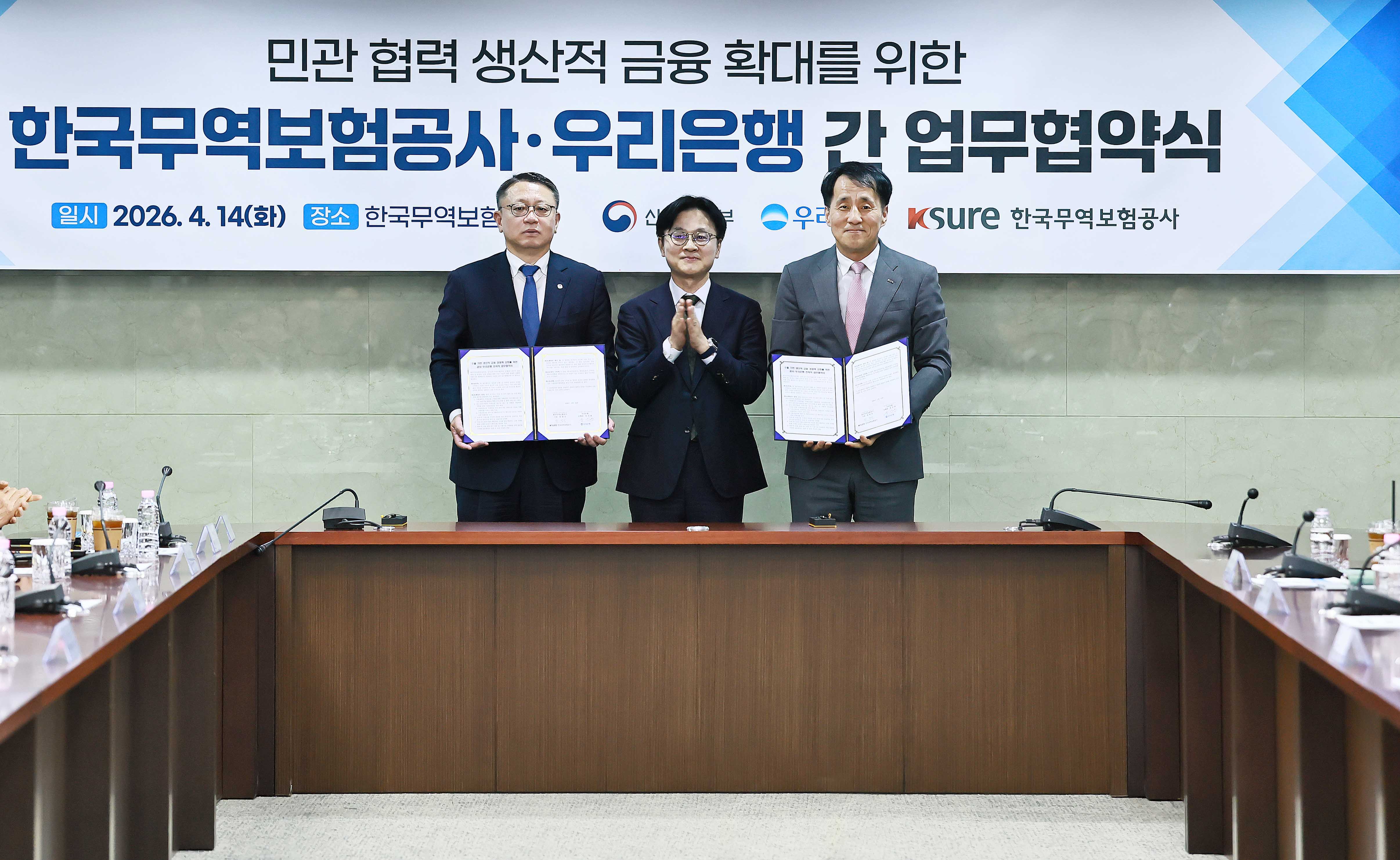
Minister JK (Jung-Kwan) Kim of the Ministry of Trade, Industry and Resources (MOTIR) attended a roundtable on expanding win-win trade finance and a signing ceremony for consumer goods supply chain guarantee agreements at the Korea Trade Insurance Corporation (K-SURE) in Seoul on April 14, 2026. The event brought together representatives from trade and industry groups, Woori Bank, Kolmar, MUSINSA and other export-related organizations and companies. “Win-win trade finance is more than a support program. It is a key safety net for Korea’s industrial ecosystem and supply chains,” Minister Kim said. “The government will work to expand this model quickly.” date2026-04-15
-
Trade/Investment
March 2026 Automobile Exports Reach $6.4 Billion
The Ministry of Trade, Industry and Resources (MOTIR, Minister JK Kim) announced that in March 2026, Korea’s automobile industry posted year-on-year increases in exports, domestic sales, and production. March automobile exports reached USD 6.4 billion, the second-highest value on record for the month, behind only the $6.5 billion recorded in March 2023. In particular, hybrid vehicle exports rose 79 percent year-on-year, driving overall export growth. In the first quarter of 2026, however, automobile export value edged down 0.2 percent. By region, first-quarter automobile exports increased mainly to Europe, including the European Union (up 14.2 percent), but fell in Asia (down 38.9 percent) and the Middle East (down 21.3 percent), likely reflecting the impact of the conflict in the Middle East. Domestic sales totaled 165,000 units in March, up 10.2 percent year-on-year, while first-quarter sales rose 5.3 percent to 409,000 units. Eco-friendly vehicles, including electric vehicles, accounted for 98,000 units, or about 59 percent of domestic sales. Production totaled 387,000 units in March, up 4.5 percent year-on-year, as major automakers raised output amid gains in exports and domestic sales. First-quarter production also rose 1.3 percent year-on-year to 1.026 million units, marking the fourth consecutive year that first-quarter output exceeded 1 million units. MOTIR is closely monitoring risks to parts procurement and logistics supply chains in light of the recent conflict in the Middle East. It will continue close consultations with industry and step up support to sustain growth in production and exports. date2026-04-15
-
Trade/Investment
MOTIR Reviews Supply Risks and Response Measures for Naphtha and Crude Oil
Minister JK (Jung-Kwan) Kim of the Ministry of Trade, Industry, and Resources (MOTIR) held a meeting on April 15, 2026, to review Korea’s supply conditions naphtha and crude oil and discuss response measures, as uncertainty in the Middle East persisted despite the U.S.-Iran ceasefire. Although tensions in the Middle East have eased for the time being, key risks remain, including uncertainty over passage through the Strait of Hormuz and broader disruptions to maritime shipping. Korea therefore needs to closely monitor supply risks and review response options, as 73 percent of its naphtha imports and 69 percent of its crude oil imports come from the Middle East. The meeting was attended by officials from relevant ministries, including the Ministry of Oceans and Fisheries (MOF) and the Ministry of Foreign Affairs (MOFA), as well as representatives from the shipping, refining and petrochemical industries. It brought together the full industrial chain, from crude oil transport and refining to the production of industrial, medical, and consumer goods. Participants reviewed import conditions for naphtha and crude oil, alternative shipping routes, and production and supply plans for petroleum products. They also shared their on-the-ground conditions, operational challenges, and policy suggestions. Minister Kim said, “We will do everything possible to minimize disruptions to people's daily lives and maintain industrial operations by diversifying supply sources for naphtha and crude oil and securing alternative logistics routes.” He added, “MOTIR will work closely with industry and relevant ministries and deploy all available policy tools to address on-the-ground difficulties without delay.” Korea will launch a KRW 674.4 billion program to support additional naphtha imports. The program will cover 50 percent of the difference between pre-war prices and actual import prices for naphtha contracted between April and June. To help ease short-term supply pressures, it will also apply to naphtha substitutes such as LPG and condensate, as well as basic petrochemical feedstocks including ethylene and propylene. Furthermore, the government will accelerate naphtha imports to help restore operating rates affected by naphtha shortages following the conflict and expand domestic supplies of petrochemical products. To minimize disruptions to people's lives, the government will work with petrochemical companies to prioritize feedstock supplies for health and medical products, key industries, and everyday necessities. The government will also expand freight-cost support for crude oil imports from the Americas, Africa, and Europe to diversify supply sources. Under the revised oil import surcharge refund program, it will fully offset the additional freight costs relative to Middle Eastern crude for imports from those regions during April-June, increasing refunds by an estimated KRW 127.5 billion. date2026-04-15
-
Trade/Investment
MOTIR to Increase Win-Win Trade Finance to KRW 10 Trillion in 2026
At a ministerial roundtable held on April 14, 2026, the Ministry of Trade, Industry and Resources (MOTIR, Minister JK Kim) announced plans to increase win-win trade finance to KRW 10 trillion by the end of 2026. The move comes amid heightened external uncertainty linked to the war in the Middle East. Formally known as the Export Supply Chain Strengthening Guarantee, the program is a public-private financing model that connects exporters, commercial banks, and policy finance institutions through partnerships between large enterprises and SMEs. Since Hyundai Motor and Kia joined the program in August 2025, HL Group, POSCO, and HD Hyundai Heavy Industries have also joined. Kolmar and MUSINSA joined on April 14, 2026, bringing the total amount mobilized under the program to KRW 1.7 trillion. Until then, the program had been adopted mainly by heavy industries such as the automotive, steel, and shipbuilding sectors, but it has now expanded to consumer goods as well. At the roundtable, Kolmar and MUSINSA each signed an agreement with Woori Bank under the program. Kolmar, which supports the K-beauty industry through the supply of cosmetic ingredients R&D, will contribute KRW 10 billion, providing KRW 174 billion in liquidity support for more than 160 partner companies, including SMEs and mid-sized firms. MUSINSA, a leading K-fashion company, will contribute KRW 5.75 billion, providing KRW 100 billion in liquidity support for more than 200 micro and SME partner companies. Given the large number of micro and small suppliers in consumer goods industries, the government will also strengthen tailored support measures, including online direct guarantees to accelerate access to small-ticket trade finance. The government will also use the supplementary budget to provide KRW 3 trillion in emergency trade finance for companies affected by the war in the Middle East. It will increase financing support for key importers in sectors facing heightened supply-chain pressures, including petrochemicals and energy; expand short-term export insurance for companies seeking alternative export markets; and provide emergency liquidity support for SMEs facing logistics disruptions and uncertainty surrounding raw material imports. Separately, Woori Bank signed an additional memorandum of understanding (MOU) with the Korea Trade Insurance Corporation (K-SURE) to expand the KRW 3 trillion productive finance program for exporters. Minister Kim said, “Win-Win trade finance is more than a support program. It is a key safety net for Korea’s industrial ecosystem and supply chains. By sharing responsibility for supporting partner companies, large enterprises and financial institutions help sustain Korea’s export competitiveness, and the government will work to expand this model quickly." date2026-04-15
-
Trade/Investment
March ICT Exports Top $40 Billion for First Time, Trade Surplus Hits Record High
The Ministry of Trade, Industry and Resources (MOTIR, Minister JK Kim) and the Ministry of Science and ICT (MSIT, Deputy Prime Minister and Minister Bae Kyung-hoon) announced on April 15, 2026, that Korea’s ICT exports in March reached USD 43.5 billion, up 112.0 percent year-on-year. Imports rose 32.2 percent from $12.2 billion to $16.2 billion, resulting in a trade surplus of $27.4 billion. In March 2026, ICT exports exceeded $40.0 billion for the first time, extending their growth streak to 14 consecutive months despite the conflict in the Middle East. The ICT trade surplus also reached a new record high, following the record set in February 2026. ICT products accounted for 50.5 percent of Korea’s total exports, which stood at $86.1 billion, reinforcing ICT’s role as a key driver of Korea’s economic growth. By product, exports increased for semiconductors (up 151.4 percent), mobile phones (up 57.0 percent), and computers and peripherals (up 174.1 percent), but decreased for displays (down 9.3 percent) and communication equipment (down 5.8 percent). Semiconductor exports surpassed $30.0 billion for the first time on strong memory demand amid global AI server investment and higher quarter-end shipments. Mobile phone exports rose on strong sales of newly launched premium models and stronger demand for high-value parts. Computers and peripherals also exceeded $3.0 billion for the first time, as solid demand and higher prices for server SSDs kept SSD exports on a triple-digit growth trajectory. Display exports, by contrast, declined as OLED exports fell on softer downstream demand. Communication equipment exports also fell due to weaker U.S. demand for automotive electronics equipment following increased local production. By destination, exports increased in all major markets: the United States (up 189.0 percent), China, including Hong Kong (up 141.0 percent), the European Union (up 89.9 percent), Taiwan (up 82.0 percent), Vietnam (up 48.0 percent), India (up 45.6 percent), and Japan (up 33.9 percent). ICT imports totaled $16.2 billion in March 2026, up 32.2 percent from $12.2 billion a year earlier, as imports increased across most major ICT categories: semiconductors (up 35.3 percent), displays (up 7.7 percent), mobile phones including parts (up 74.8 percent), and computers and peripherals (up 47.4 percent). date2026-04-14
-
Trade/Investment
Korea’s 2026 First-Quarter Foreign Direct Investment Rises 0.1% to $6.4 Billion
The Ministry of Trade, Industry and Resources (MOTIR, Minister JK Kim) announced that Korea’s foreign direct investment (FDI) notifications for the first quarter of 2026 rose 0.1 percent year-on-year to USD 6.4 billion, marking the second-highest first-quarter total on record. Actual inflows reached $7.1 billion, the highest first-quarter level on record. Despite a subdued global investment environment and unexpected geopolitical risks, including the conflict in the Middle East, Korea maintained FDI growth in the first quarter. This suggests that foreign investors remain confident in Korea’s investment environment. In particular, foreign investment continued in advanced manufacturing sectors such as semiconductors and secondary batteries, as well as in AI data centers and offshore wind. This indicates that the momentum from last year’s record $36.1 billion in annual FDI notifications has carried into 2026. By type, greenfield investment notifications fell 19.8 percent year-on-year to $3.7 billion amid global investment uncertainty, while M&A notifications rose 53.4 percent to $2.7 billion. By industry, manufacturing investment fell 47.6 percent year-on-year to $1.2 billion. Investment declined in electrical and electronics (down 30.1 percent to $370 million) and in machinery and medical precision equipment (down 75.6 percent to $40 million), but increased in chemicals (up 4.5 percent to $400 million) and non-metallic minerals (up 23.9 percent to $180 million). Meanwhile, services investment rose 21.5 percent year-on-year to $4.3 billion, the highest first-quarter level on record. Growth was led by finance and insurance (up 21.2 percent to $2.6 billion), distribution (up 43.0 percent to $570 million), and information and communications (up 183.6 percent to $240 million). By source country, investment from the United States increased 20.9 percent year-on-year to $1.0 billion, led by information and communications, chemicals, and distribution. Investment from the European Union totaled $1.4 billion (down 4.1 percent), with gains in chemicals and electricity and gas offset by declines in pharmaceuticals and finance and insurance. Investment from Japan fell to $350 million (down 71.1 percent), while investment from China declined to $270 million (down 19.4 percent). In response to external uncertainty, MOTIR will step up investment promotion in strategic sectors, expand regional investment incentives, and address difficulties faced by foreign-invested companies to improve the investment environment. date2026-04-03
-
Trade/Investment
March 2026 Exports Reach Record $86.1 Billion, Surpassing $80 Billion for the First Time
The Ministry of Trade, Industry and Resources (MOTIR, Minister JK Kim) announced that in March 2026, Korea’s exports rose 48.3 percent year-on-year to USD 86.1 billion, while imports increased 13.2 percent to $60.4 billion, resulting in a $25.7 billion surplus. Exports in March rose 48.3 percent to $86.1 billion despite the conflict in the Middle East, surpassing $80.0 billion for the first time. Average daily exports, adjusted for working days, increased 41.9 percent to $3.7 billion, also reaching a record high. By product, exports increased in 10 of Korea’s 15 key export items. Semiconductor exports rose to $32.8 billion (up 151.4 percent), posting the highest monthly figure on record and topping $30.0 billion for the first time. Automobiles edged up to $6.4 billion (up 2.2 percent), as gains in eco-friendly vehicles offset the impact of some logistics disruptions linked to the conflict in the Middle East. Petroleum products rose to $5.1 billion (up 54.9 percent), while petrochemicals increased 5.8 percent. Computers rose to $3.4 billion (up 189.2 percent), reaching the highest level on record, and secondary battery exports increased to $0.9 billion (up 36.0 percent). Among items outside the 15 key export categories, electrical equipment, cosmetics, and agricultural and fisheries products also reached record highs for March. By destination, exports increased in seven of Korea’s nine major markets. Exports to China rose 64.0 percent to $16.5 billion, extending their growth streak to five consecutive months. Exports to the United States rose to $16.3 billion (up 47.1 percent), led by semiconductors and computers. Exports to ASEAN increased to $13.8 billion (up 34.3 percent), while exports to the EU rose to $7.5 billion (up 19.3 percent). By contrast, exports to the Middle East fell 49.1 percent to $0.9 billion amid logistics disruptions linked to the conflict. Imports rose 13.2 percent year-on-year to $60.4 billion. Energy imports edged down to $9.4 billion (down 7.0 percent), while non-energy imports rose 17.9 percent to $51.0 billion. Crude oil imports fell 5.0 percent to $6.0 billion, as supply disruptions from the closure of the Strait of Hormuz reduced import volumes, more than offsetting the rise in unit prices. Among non-energy imports, semiconductors rose to $8.6 billion (up 34.8 percent) and semiconductor equipment to $2.9 billion (up 4.4 percent). The trade surplus in March reached $25.7 billion, up $21.0 billion from March 2025, marking the largest monthly surplus on record and extending Korea’s surplus streak to 14 consecutive months since February 2025. Minister JK (Jung-Kwan) Kim stated, “Despite challenging external conditions, including the conflict in the Middle East and the spread of protectionism, exports in March surpassed $80 billion for the first time, led by semiconductors and by broad-based gains in other key export items and promising categories, including consumer goods.” He noted that export uncertainty is rising as the conflict in the Middle East continues to push up oil prices and heighten supply chain risks. He added that the government will maintain a government-wide response system, closely monitor supply chains across energy, raw materials, and logistics, promptly implement stabilization measures, and help exporters address difficulties in marketing, logistics, and financing. It will also support diversification across export items and markets to sustain export momentum. date2026-04-01
-
Trade/Investment
MOTIR Holds First Foreign Investment Caravan of 2026
The Ministry of Trade, Industry and Resources (MOTIR, Minister JK Kim) held the first Foreign Investment Caravan of 2026 in Cheonan, South Chungcheong Province, on March 31, 2026. The Caravan is an on-site outreach program for foreign-invested companies aimed at encouraging follow-on investment. Through the program, MOTIR gathers input on business difficulties, addresses investment-related concerns, and provides information on available investment support policies. The nationwide Caravan delivered tangible results in 2025, reaching 129 foreign-invested companies and identifying new investment demand totaling USD 1.68 billion, along with 53 regulatory improvement tasks. Building on those results, MOTIR plans to hold four Caravans in 2026 across four major regions. To help translate consultations into actual investment, the ministry will identify high-potential target companies in advance and offer one-on-one tailored consultations. This year’s program is designed not only to answer routine questions and address business difficulties, but also to put in place a more hands-on support system that can lead to additional investment. The event brought together about 60 participants, including representatives of 22 foreign-invested companies in the Chungcheong region, such as Air Liquide, Corning, and Merck; officials from MOTIR, Chungcheongnam-do, Chungcheongbuk-do, and Daejeon Metropolitan City; and representatives from the Korea Trade-Investment Promotion Agency (KOTRA) and the Korea Industrial Complex Corporation (KICOX). Participants took part in three parallel programs: a briefing on support policies for foreign-invested companies, a roundtable on business difficulties, and one-on-one tailored consultations. “In line with the Five Mega-Regions and Three Special Self-Governing Provinces initiative, we will focus on strategically attracting competitive, high-potential companies in advanced industries, supply chains, AI transformation (AX), and green transformation (GX), while substantially strengthening incentives for investment in non-metropolitan regions to support regional growth,” said Nam Myung-woo, Director General for Cross-Border Investment Policy at MOTIR. “With uncertainty rising both at home and abroad, including from recent developments in the Middle East, close communication with companies on the ground is more important than ever.” Following the Chungcheong event, MOTIR will hold additional Caravans in the capital region and other parts of the country to step up its efforts to attract foreign investment to Korea. date2026-03-31
-
Trade/Investment
MOTIR Reviews Impact of Prolonged Middle East Conflict on Key Export Items and Delivery of Support Measures
The Korean government has stepped in directly to address difficulties facing key export industries, as it moves to minimize export disruptions from the prolonged conflict in the Middle East. Following the launch of a pan-government export support system on March 11, 2026, it is now taking a closer look at sector-specific impacts and stepping up tailored support, including logistics and liquidity assistance. The Ministry of Trade, Industry and Resources (MOTIR, Minister JK Kim) held a meeting with major exporters at the Korea Trade Insurance Corporation (K-SURE) on March 26, 2026, to review conditions across key sectors and the export outlook in the wake of the war in the Middle East. The meeting was chaired by Na Sung-hwa, Director General for International Trade Policy, and was attended by representatives from eight key industries: semiconductors, automobiles, machinery, petroleum products, petrochemicals, steel, biohealth, and displays. Companies voiced concern over rising freight rates and war-risk surcharges tied to uncertainty in the Strait of Hormuz, as well as possible delays in financing and payments and instability in raw material supplies. To address these concerns, the government will accelerate existing logistics and liquidity support and improve implementation on the ground. First, the government will continue rolling out emergency logistics vouchers. MOTIR is accepting applications through the end of March 2026 for KRW 8 billion in emergency vouchers to help cover international shipping costs, return shipping, war-risk surcharges, and rerouting charges. For companies with a high share of exports to the Middle East, the ministry is also operating a fast-track program that issues vouchers within three days of application. As of March 24, 44 companies had received support. The Ministry of SMEs and Startups (MSS) has also been running a KRW 10.5 billion emergency logistics voucher program since March 20, 2026. The government will also move quickly to provide KRW 24.2 trillion in emergency liquidity support through policy finance institutions. K-SURE has expanded working-capital guarantees for exporters to the Middle East and increased import insurance support for sectors facing urgent raw-material needs, including petrochemicals, from KRW 2.8 trillion in 2025 to KRW 3.4 trillion in 2026. The Financial Services Commission (FSC) is operating financial support programs worth KRW 20.3 trillion, while MSS is providing additional support through its emergency management stabilization funds. The government will further strengthen one-stop support for exporters affected by the Middle East crisis. The Korea Trade-Investment Promotion Agency (KOTRA), the Korea International Trade Association (KITA), and MSS’s regional export support centers will continue sharing local information and coordinating responses, while other ministries step up cooperation on logistics and liquidity issues. In addition, MOTIR will use the supply chain support center launched on March 23, 2026, in response to the situation in the Middle East, to closely monitor supply conditions for items highly dependent on the region and products exposed to knock-on effects, while providing focused support to resolve bottlenecks. The government also plans to expand support for exporters facing difficulties from the prolonged conflict through the supplementary budget now being prepared. “Swift action matters, but so does making sure support is delivered smoothly on the ground,” said Director General Na. “We will closely review each stage of implementation and make adjustments where needed so that measures such as the emergency export vouchers and trade insurance package deliver tangible support for exporters.” date2026-03-26