-
FTA/Economic Cooperation
KOTRA to Take Over Management of Industrial ODA in September 2026
The Ministry of Trade, Industry and Resources (MOTIR, Minister JK (Jung-Kwan) Kim) announced that the Korea Institute for Advancement of Technology (KIAT) and the Korea Trade-Investment Promotion Agency (KOTRA) signed an agreement on August 31, 2026, to transfer the responsibilities for the Industrial and Trade Cooperation Development Support Program (Industrial Official Development Assistance, or Industrial ODA). Under this agreement, KOTRA will begin managing Industrial ODA from September 1, 2026. This transfer of responsibilities is intended to advance Industrial ODA as a mutually beneficial model that supports economic growth in emerging economies and helps Korean companies to facilitate their business activities in overseas markets. Since the launch of Industrial ODA in 2012, KIAT has successfully established the program and built up management expertise. KOTRA will draw on these achievements and leverage its own overseas trade offices as strategic bases to significantly strengthen on-the-ground project implementation and support Korean companies’ business engagement in overseas markets. KOTRA expects to strengthen links and create synergy effects among ODA programs by managing Industrial ODA alongside the Knowledge Sharing Program (KSP) and the Economic Innovation Partnership Program (EIPP) led by the Ministry of Finance and Economy (MOFE). MOTIR also expects ODA to serve as a catalyst for Korean companies to explore emerging markets and to further strengthen supply chain cooperation with resource-rich countries. “The transfer of the program to KOTRA is more than a change in the managing agency. It represents a clear policy shift toward advancing national interests and business activities. We look forward to seeing KOTRA develop a new model of ODA,” said Bae Jun-hyoung, Director General for International Trade Relations at MOTIR. date2026-08-31
-
FTA/Economic Cooperation
Korea and China Hold 16th Round of FTA Follow-up Negotiations on Services and Investment
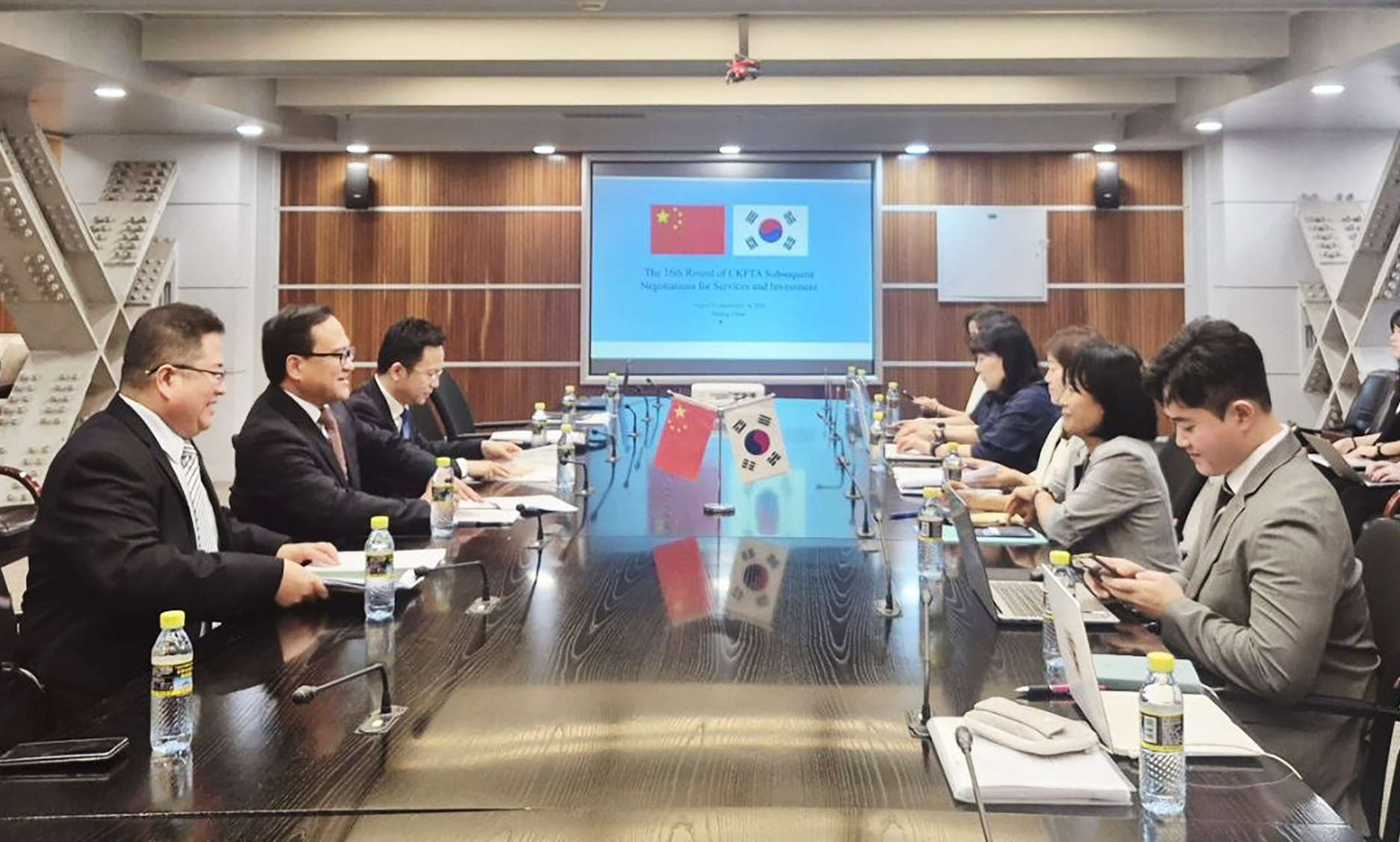
Kwon Hye-jin, Deputy Minister for Trade Negotiations at the Ministry of Trade, Industry and Resources (MOTIR, Minister JK Kim), attended the 16th round of follow-up negotiations on services and investment under the Korea–China Free Trade Agreement (FTA) in Beijing on August 31, 2026. Around 30 officials from the two countries took part. Deputy Minister Kwon led the Korean delegation, while Chen Chao, Director-General of the Department of International Trade and Economic Affairs at China’s Ministry of Commerce, headed the Chinese delegation. Following her opening remarks, Deputy Minister Kwon and Director-General Chen discussed market access and other issues in services, investment, and finance. “We will do our utmost to secure a lasting outcome that brings practical benefits to Korean companies,” Deputy Minister Kwon said. date2026-08-31
-
FTA/Economic Cooperation
Korea and Vietnam Hold 15th Industrial Joint Committee and 9th FTA Joint Committee
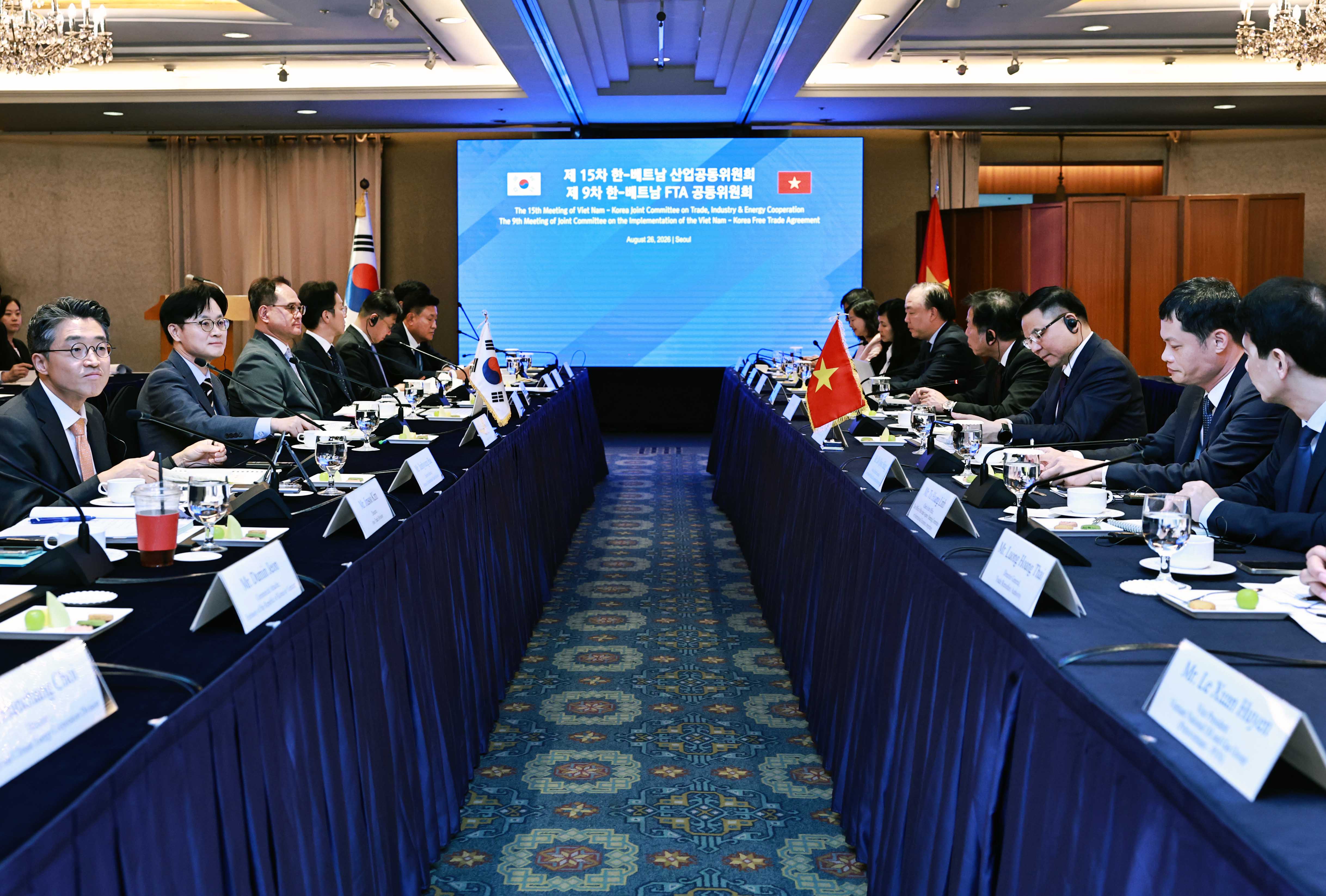
On August 26, 2026, Minister JK (Jung-Kwan) Kim of the Ministry of Trade, Industry and Resources (MOTIR) and Minister Le Manh Hung of Vietnam’s Ministry of Industry and Trade co-chaired the 15th Korea-Vietnam Industrial Joint Committee and the 9th Korea-Vietnam FTA Joint Committee at Lotte Hotel Seoul. Government delegations from both countries attended the meetings. Following his opening remarks, Minister Kim discussed with the participants ways to strengthen bilateral cooperation in the real economy. “Korea will broaden bilateral trade and investment into forward-looking sectors and work more closely with Vietnam to build advanced industrial ecosystems, cultivate talent in industrial technology, strengthen critical mineral supply chains, and enhance energy security,” Minister Kim said. date2026-08-27
-
FTA/Economic Cooperation
Korea and Vietnam Step Up Strategic Cooperation in Advanced and High-Potential Industries
Korea and Vietnam agreed to expand strategic cooperation by developing concrete initiatives in trade and investment, industrial technology, and energy security, as discussed at the two summits held in August 2025 and April 2026 since Korea’s current administration took office. The two countries plan to move forward with projects, including the start of construction on the Korea–Vietnam Critical Minerals Supply Chain Technology Center, cooperation to develop oil stockpiling facilities, and technology transfers through Korea’s technology-sharing model. On August 26, 2026, Minister JK (Jung-Kwan) Kim of the Ministry of Trade, Industry and Resources (MOTIR) and Minister Le Manh Hung of Vietnam’s Ministry of Industry and Trade co-chaired the 15th Korea–Vietnam Industrial Joint Committee and the 9th Korea–Vietnam FTA Joint Committee at Lotte Hotel Seoul. They discussed how to strengthen bilateral cooperation in the real economy. The 15th Korea–Vietnam Industrial Joint Committee At the Industrial Joint Committee, the two countries discussed specific measures to increase bilateral trade to USD 150 billion by 2030. In the trade subcommittee, they agreed to coordinate closely to simultaneously conclude the quarantine negotiations for Vietnam’s exports of lychees and passion fruit to Korea and Korea’s exports of satsuma mandarins and kiwifruit to Vietnam. They also agreed to further strengthen cooperation on digitalizing distribution and logistics and protecting intellectual property rights, including detecting and cracking down on counterfeits, as well as cooperation between the Korea Fair Trade Commission (KFTC) and the Vietnam Competition Commission (VCC). In the industrial technology subcommittee, the two sides agreed to step up efforts to resolve issues facing Korean companies in Vietnam and accelerate bilateral technology cooperation. Vietnam will work with local governments to help Korean manufacturers recruit workers, while Korea will actively support technology transfers from large Korean corporations operating in Vietnam to their Vietnamese partners through Korea’s technology-sharing model. The two countries also agreed to strengthen cooperation on quality standardization and help expand incentives for Korean companies operating in Vietnam’s automotive industry. In critical minerals in particular, the two countries agreed to expedite the necessary administrative procedures so that construction of the Korea–Vietnam Critical Minerals Supply Chain Technology Center can begin promptly. Vietnam said it would continue to coordinate with relevant agencies to clear investment hurdles for Korean companies, including those involving approval to establish a rare earth metals production plant. The two sides also agreed to continue discussing cooperation across the critical minerals supply chain, including how the two governments could help companies operating in Vietnam secure a stable supply of critical minerals. In the energy and resources subcommittee, Korea and Vietnam agreed to pursue long-term cooperation on resource supply chains, including jointly stockpiling crude oil and establishing an emergency response mechanism. They also agreed to support the smooth implementation of LNG power projects in Vietnam and continue strengthening policy cooperation on power grid infrastructure projects, nuclear power, and renewable energy. At the event, the two ministers witnessed Korea National Oil Corporation (KNOC) and PetroVietnam Oil Stockpile Company Limited (PVOS) sign an MOU to cooperate on developing an oil stockpiling facility in Vietnam. Vietnam is moving to build its first underground oil storage facility in response to recent disruptions to oil supplies from the Middle East. KNOC, which has successfully operated oil stockpiling facilities in Korea, agreed to provide technical consulting across all aspects of facility d date2026-08-27
-
FTA/Economic Cooperation
Korea-India Hold 13th Round of CEPA Upgrade Negotiations
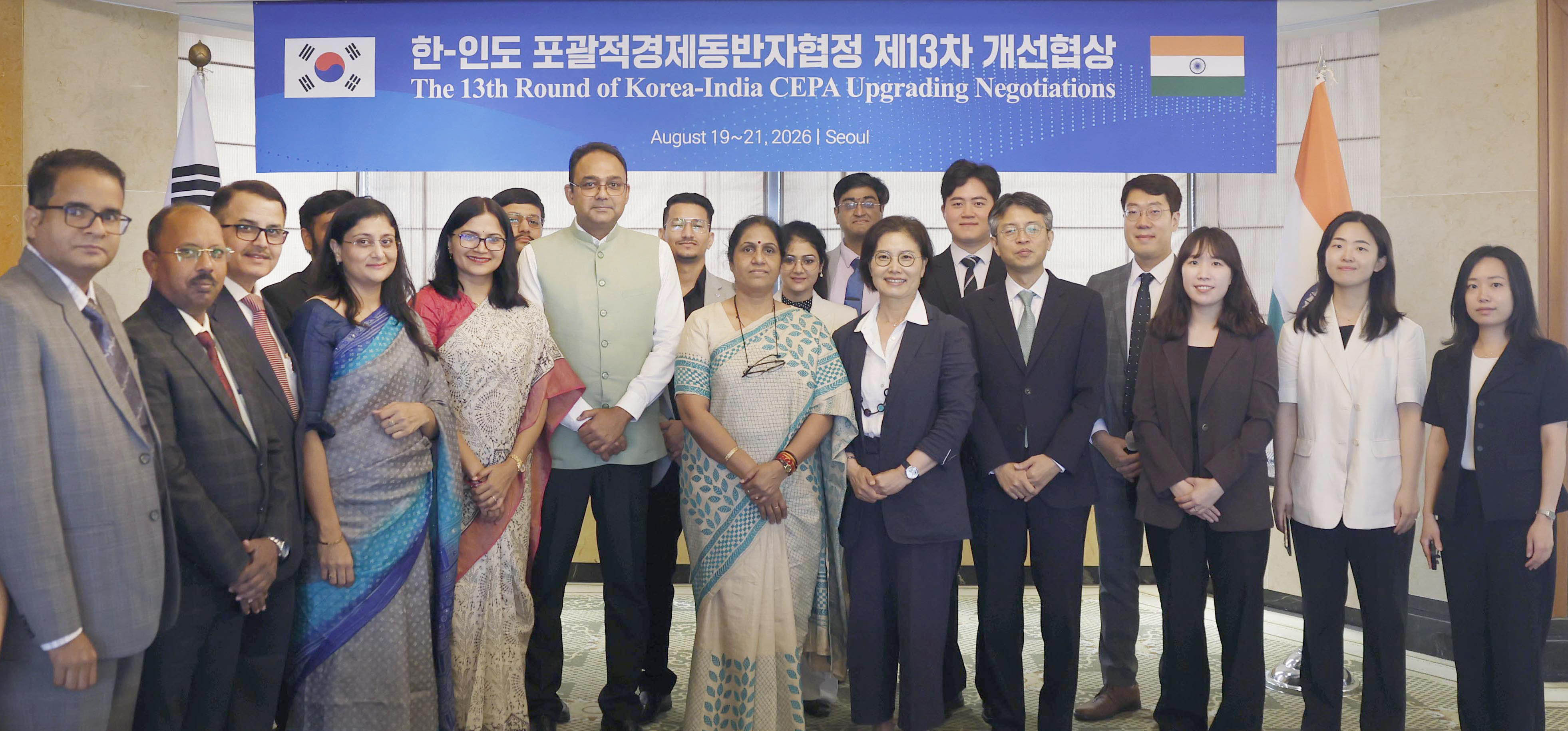
Lee Min-young, Acting Director General for Trade Agreement Negotiations at the Ministry of Trade, Industry and Resources (MOTIR, Minister JK Kim), attended the 13th round of negotiations to upgrade the Korea–India Comprehensive Economic Partnership Agreement (CEPA) in Seoul on August 19, 2026. The meeting brought together negotiating delegations from both countries, including Kapil Chaudhary, Joint Secretary at India’s Department of Commerce. The two sides discussed goods, services, rules of origin, technical barriers to trade, supply chains, and industrial cooperation. MOTIR said, “Through the upgrade negotiations, we will lay the foundation for economic cooperation that extends beyond traditional market access to supply chain and industrial cooperation between the two countries.” date2026-08-19
-
FTA/Economic Cooperation
Korea Steps Up CEPA Upgrade Talks with India, the World’s Largest Emerging Market
Korea is stepping up negotiations to upgrade the Korea–India Comprehensive Economic Partnership Agreement (CEPA) to expand bilateral trade and investment. India, the world’s most populous country, has about 1.43 billion people and a GDP of USD 4 trillion. The Ministry of Trade, Industry and Resources (MOTIR, Minister JK Kim) announced that the 13th round of negotiations to upgrade the Korea–India CEPA will be held in Seoul from August 19 to August 21, 2026. The upgrade talks began in 2016 but were temporarily suspended due to differences in the two countries’ positions. They resumed after the Korea–India summit in April 2026, with the 12th round taking place in New Delhi the following month. An Indian delegation will travel to Seoul for the 13th round, which will bring together approximately 60 government officials from both countries. Korea’s delegation will be headed by Lee Min-young, Acting Director General for Trade Agreement Negotiations at MOTIR, and India’s by Kapil Chaudhary, Joint Secretary at India’s Department of Commerce. The two sides will explore their respective interests regarding market access for key goods and services, rules of origin, and the scope for further market opening. They will also hold detailed discussions on new areas of cooperation, including supply chains and strategic industries. The two sides will also discuss the operational framework and key agenda items for the Korea–India Industrial Cooperation Committee, established following the April summit, including its subcommittee structure and schedule for future meetings. “India is an emerging market with the world’s largest population, yet Korea–India trade totaled only USD 25.6 billion in 2025. That was about one-tenth the value of Korea’s trade with ASEAN, whose economy is similar in size to India’s,” MOTIR said. “There is therefore considerable room to expand bilateral trade and investment. Through the upgrade negotiations, we will lay the foundation for economic cooperation that extends beyond traditional market access to supply chain and industrial cooperation between the two countries.” date2026-08-19
-
FTA/Economic Cooperation
Vice Minister Moon Meets with Tajikistan’s First Deputy Minister of Industry and New Technologies
Vice Minister Moon Shin-hak of the Ministry of Trade, Industry and Resources (MOTIR, Minister JK Kim) met with Isojon Qurbonzoda, First Deputy Minister of Industry and New Technologies of Tajikistan, at Government Complex Seoul on August 11, 2026. The two sides discussed industrial and economic cooperation projects for the first Korea-Central Asia Summit and bilateral cooperation on critical minerals. “We will further develop the cooperation initiatives discussed today and work to translate them into tangible results in industry, supply chains, and critical minerals at the Korea-Central Asia Summit in September,” Vice Minister Moon said. date2026-08-11
-
FTA/Economic Cooperation
MOTIR and Tajikistan Discuss Economic Cooperation Projects Ahead of Korea-Central Asia Summit
Vice Minister Moon Shin-hak of the Ministry of Trade, Industry and Resources (MOTIR, Minister JK Kim) met with Isojon Qurbonzoda, First Deputy Minister of Industry and New Technologies of the Republic of Tajikistan, in Seoul on August 11, 2026. The meeting provided an opportunity for discussions on industrial and economic cooperation projects for the first Korea-Central Asia Summit, scheduled for September 16, 2026, as well as ways to achieve tangible outcomes through cooperation in critical minerals. The two sides discussed establishing the C5+Korea Industry Ministers’ Meeting as a regular consultative channel among the industry ministers of Korea and the five Central Asian countries—Tajikistan, Kazakhstan, Uzbekistan, Turkmenistan and Kyrgyzstan. Discussions were also held on signing a memorandum of understanding (MOU) on mutually beneficial cooperation in industry and new technologies between Korea and Tajikistan, as well as ways to expand engagement and cooperation between business leaders from both countries through the Korea-Central Asia Business Summit, which will take place alongside the leaders’ summit. The talks also covered closer cooperation on critical mineral supply chains. Vice Minister Moon welcomed the inaugural Korea-Tajikistan Minerals Forum, highlighting Tajikistan’s abundant mineral resources, including gold, silver and antimony. The forum will be held in Seoul on August 12, 2026, ahead of the Korea-Central Asia Summit. Vice Minister Moon expressed hope that the forum would help identify practical projects by connecting Tajikistan’s resource potential with Korea’s expertise and technologies for mineral exploration and development, as well as Korea’s demand for minerals. The forum will bring together government officials and representatives of relevant institutions and companies from both countries to discuss critical minerals policies, opportunities for joint exploration, investment and financing and supply chain development. “Tajikistan and other Central Asian countries, with their abundant resources and growth potential, are important partners for Korea,” Vice Minister Moon said. “We will build on the initiatives discussed today to deliver tangible outcomes in the areas of industry, supply chains and critical minerals at the Korea-Central Asia Summit in September.” date2026-08-11
-
FTA/Economic Cooperation
Korea and Argentina Sign MOU on Critical Minerals Cooperation
Minister JK (Jung-Kwan) Kim of the Ministry of Trade, Industry and Resources (MOTIR) and Pablo Quirno Magrane, Argentine Minister of Foreign Affairs, International Trade and Worship, signed a memorandum of understanding (MOU) on critical minerals cooperation on July 31, 2026, during President Lee Jae Myung’s official visit to Argentina. date2026-08-06
-
FTA/Economic Cooperation
Meeting with Argentine Minister of Economy
Minister JK (Jung-Kwan) Kim of the Ministry of Trade, Industry and Resources (MOTIR) met with Luis Andrés Caputo, Minister of Economy of Argentina, on July 31, 2026, during President Lee Jae Myung’s official visit to Argentina. The two ministers discussed cooperation on critical minerals—a topic also addressed at the summit—as well as ways to expand Korea’s trade ties with Latin America, including by advancing negotiations on a trade agreement between Korea and MERCOSUR. date2026-08-06