-
FTA/Economic Cooperation
Korea and India Join Hands to Expand Cooperation in Advanced Industries
The Ministry of Trade, Industry and Resources (MOTIR, Minister JK Kim) hosted the Korea–India Business Partnership on April 20, 2026, at Bharat Mandapam in New Delhi, on the occasion of President Lee Jae Myung’s state visit to India. President Lee delivered congratulatory remarks at the forum, which brought together leading business figures from both countries. The Korean side included around 250 executives, among them Lee Jae-yong, Executive Chairman of Samsung Electronics; Chung Eui-sun, Executive Chairman of the Hyundai Motor Group; Koo Kwang-mo, Chairman of LG; Chang In-hwa, CEO of POSCO HOLDINGS; and Chung Ki-sun, Chairman & CEO of HD Hyundai. The Indian side included around 350 business leaders, including Anant Goenka, President of the Federation of Indian Chambers of Commerce and Industry (FICCI); Vijay Sankar, Chairman of the Sanmar Group; Ravikant Ruia, Vice Chairman of the Essar Group; and Jayant Acharya, CEO of JSW Steel. The two governments were represented by Minister Kim of MOTIR and India’s Minister of Commerce and Industry Piyush Goyal. Companies from the two countries signed a total of 20 private-sector MOUs on the sidelines of the forum in sectors with strong demand for bilateral cooperation, including shipbuilding, green mobility, steel, energy and digital technology. In shipbuilding, HD Korea Shipbuilding & Offshore Engineering (HD KSOE) signed an MOU with National Shipbuilding & Heavy Industries Park, Tamil Nadu (NSHIP, TN), and Sagarmala Finance Corp. Ltd. (SMFCL) to cooperate on key infrastructure and a joint venture for investment in a new shipyard in India. SMFCL is a non-banking financial company set up under India’s Ministry of Ports, Shipping and Waterways to support the shipbuilding sector. It plans to launch the Maritime Development Fund (MDF) by attracting outside investors. In green mobility, Hyundai Motor Company and TVS Motor Company signed an MOU to jointly develop eco-friendly three-wheeled electric vehicles. The two companies agreed to develop models tailored to the Indian market and work together to expand local adoption. In steel, POSCO HOLDINGS signed an MOU with JSW Group to form a joint venture for an integrated steel mill project in India with annual crude steel capacity of 6 million tons. In energy, GS Engineering & Construction signed an MOU with Ari Energy to repower aging wind farms in India by replacing old turbines with new, high-efficiency models. The projects are intended to increase power generation, efficiency and profitability. In digital technology, NAVER signed an MOU with Tata Consultancy Services (TCS) to expand digital transformation in the Indian market across AI, cloud and B2C services. The following day, MOTIR and the Korea Trade-Investment Promotion Agency (KOTRA, President Kang Kyung-sung) held another Korea–India Business Partnership event in New Delhi. The event brought together more than 40 Korean companies and over 100 Indian companies from manufacturing, Korean Wave-related industries and advanced sectors, and resulted in 14 deals worth about USD 48 million. The forum is expected to broaden and deepen industrial cooperation between Korea and India and help elevate the bilateral partnership to a new stage. Minister Kim said the government would provide full institutional support so that Korea–India economic cooperation can gain fresh momentum and create more business opportunities for companies in both countries. date2026-04-21
-
FTA/Economic Cooperation
Korea and India Upgrade Cooperation in Industry, Energy and Resources
The Ministry of Trade, Industry and Resources (MOTIR, Minister JK Kim) announced that, on the occasion of the Korea–India summit held during President Lee Jae Myung’s state visit to India on April 20, 2026, the two countries agreed to build stable supply chains for key energy resources, including naphtha. The two sides also signed four memoranda of understanding covering the establishment of an industrial cooperation committee, the resumption of negotiations on the Comprehensive Economic Partnership Agreement (CEPA), steel cooperation, and climate change mitigation. 1. Korea–India Joint Statement on Energy and Resource Security Cooperation MOTIR adopted an annex to the Korea–India Joint Statement on Energy and Resource Security Cooperation with India, Korea’s fifth-largest source of naphtha imports and the top export market for Korean base oils. The annex sets out cooperation to build stable supply chains across the resource value chain, including petroleum products, and marks Korea’s first bilateral resource-sector cooperation outcome reached with a partner government since tensions escalated in the Middle East. Under the annex, MOTIR will support Korean companies in consultations with India on naphtha supply and expand similar cooperation with other resource-rich countries. 2. Korea and India Sign MOU to Launch Industrial Cooperation Committee Minister JK Kim of MOTIR and India’s Minister of Commerce and Industry Piyush Goyal signed an MOU to launch a Korea–India Industrial Cooperation Committee, the first regular ministerial-level consultative body for bilateral economic cooperation. The committee will discuss cooperation projects and measures to address business concerns facing Korean companies in India across trade and investment, industrial cooperation, strategic resources, and clean energy. Key agenda items include licensing delays and unpaid state-level incentives. The committee will also cover concrete cooperation plans in sectors where companies from both countries see strong demand, including semiconductors, shipbuilding and nuclear power. 3. Korea and India Sign Joint Declaration to Accelerate CEPA Upgrade Talks Trade Minister Yeo Han-koo of MOTIR and India’s Minister of Commerce and Industry Piyush Goyal signed a joint declaration to accelerate negotiations to upgrade the Korea–India CEPA. The two sides agreed to resume upgrade talks, which had effectively stalled after the 11th round in July 2024, by holding the 12th round in May 2026 and regularizing follow-up negotiations. The two sides will work to create a more business-friendly trade environment through the existing negotiating tracks on goods, services, and rules of origin, while also pursuing new tracks on digital trade and supply chain cooperation. 4. Korea and India Sign Steel Cooperation MOU Minister JK Kim of MOTIR and India’s Minister of Steel H.D. Kumaraswamy signed a Korea–India Steel Cooperation MOU. The MOU is intended to strengthen cooperation with India, Korea’s fifth-largest export market for steel products, and support Korean steelmakers’ investment and business expansion in India, including POSCO Holdings’ planned integrated steel mill with an annual capacity of six million tons. The two countries will also launch a Korea–India public-private steel dialogue to discuss export-related difficulties and the transition to lower-carbon production processes. 5. Korea and India Sign Article 6.2 MoC under Paris Agreement Minister JK Kim of MOTIR and India’s Minister of Environment, Forest and Climate Change Bhupender Yadav signed a Korea–India Memorandum of Cooperation (MoC) under Article 6.2 of the Paris Agreement. The MoC establishes a bilateral framework for transferring emissions reductions generated by Korean companies’ projects in India to Korea, giving Korean companies a basis to ent date2026-04-21
-
FTA/Economic Cooperation
Korea and the EU Hold 13th FTA Trade Committee and First Strategic Dialogue
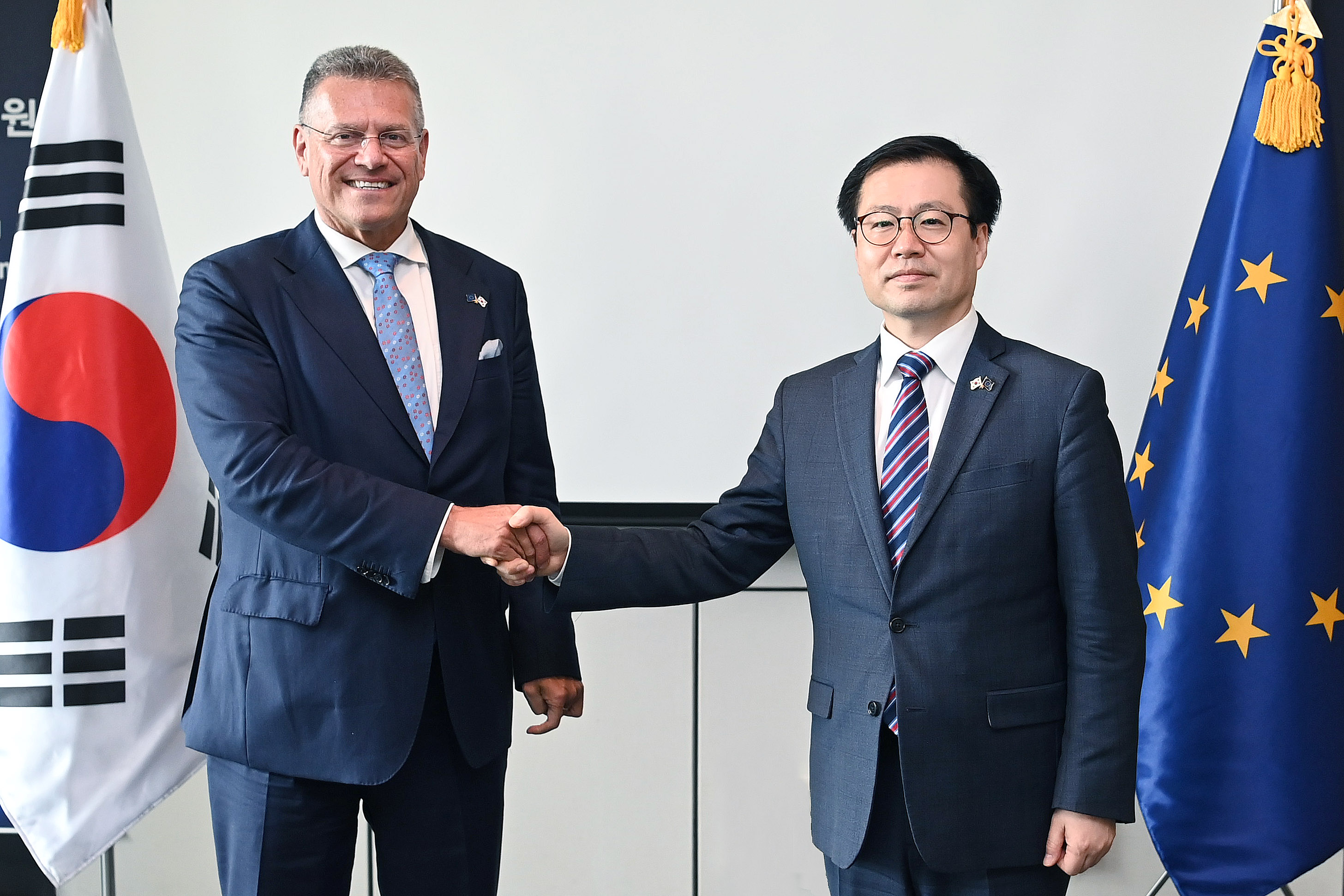
Trade Minister Yeo Han-koo of the Ministry of Trade, Industry and Resources (MOTIR, Minister JK Kim) attended the 13th Korea–EU FTA Trade Committee and the first Strategic Dialogue on Trade, Supply Chains and Technology at the Four Seasons Hotel Seoul on April 17, 2026, where he delivered opening remarks and discussed trade issues including steel and the Industrial Accelerator Act (IAA), as well as new trade agenda items such as critical minerals and semiconductors. The meetings were attended by Maroš Šefčovič, European Commissioner for Trade and Economic Security, and officials from Korea and the EU. Trade Minister Yeo said, “Today’s meetings mark an important turning point in broadening Korea–EU cooperation beyond traditional trade into a next-generation strategic partnership on economic security, supply chains, and advanced technologies. We will continue to use both high-level and working-level channels to improve predictability for Korean companies in the EU market and work closely with the EU toward a free and fair trade environment.” date2026-04-17
-
FTA/Economic Cooperation
Korea and EU Advance Strategic Economic Partnership on Supply Chains and Economic Security
Trade Minister Yeo Han-koo of the Ministry of Trade, Industry and Resources (MOTIR, Minister JK Kim) held the 13th Korea–EU FTA Trade Committee meeting and the first Strategic Dialogue on Trade, Supply Chains and Technology with Maroš Šefčovič, European Commissioner for Trade and Economic Security, in Seoul on April 17, 2026. The two sides noted that the Korea–EU FTA has served as a key platform for cooperation in goods, services, and investment over the past 15 years and agreed to broaden cooperation to supply chains, critical minerals, and advanced technologies amid growing economic security challenges. 1. Key Outcomes of the 13th Korea–EU FTA Trade Committee At the Trade Committee meeting, the two sides finalized the text of the Korea–EU Digital Trade Agreement (DTA), concluded in March 2026, and agreed to work closely toward its signature and entry into force. They also agreed to revise the motor vehicles and parts appendix (2-C-3), moving immediately on 26 items and continuing consultations on 11 others. The two sides agreed to begin MRA talks on telecommunications equipment, pharmaceuticals, and circular-economy packaging materials. In cosmetics, they agreed to set up a working group to address industry concerns and support trade and investment, with its first meeting planned for the second half of 2026. 2. Discussion on Key Trade Issues On key trade issues, Korea welcomed the text of the Industrial Accelerator Act (IAA), which would treat products from FTA partners on a par with EU-origin products. Korea also asked the EU for its attention and support in addressing concerns raised by the Korean government and industry regarding provisions that remain unclear. Korea expressed deep concern over the steel tariff-rate quota (TRQ) measure under consideration by the EU and asked that any such measure be designed in a manner consistent with the Korea–EU FTA and WTO rules. On geographical indications (GIs), Korea proposed interpretive guidance to ensure clear origin labeling and prevent consumer confusion. On the Carbon Border Adjustment Mechanism (CBAM), Korea welcomed recent simplification steps and called for the early adoption of key implementing rules, including provisions on carbon prices already paid in third countries. Korea also requested safeguards against double regulation for Korea, which already operates the Korea Emissions Trading Scheme (K-ETS), and support for the recognition of Korean verification agencies by EU accreditation bodies. 3. Key Outcomes of the First Korea–EU Strategic Dialogue At the Strategic Dialogue, the two sides discussed practical cooperation in response to a new trade environment increasingly shaped by economic security concerns. They recognized shared vulnerabilities in critical minerals and semiconductors and agreed to step up strategic communication and cooperation in those areas, while continuing cooperation in AI, advanced semiconductors, and key materials. On batteries, Korea noted that Korean battery companies are contributing to EU supply chains and job creation through large-scale investment and production in Europe, and called for a larger role in EU energy storage system (ESS) projects. Korea formally proposed discussions on a tentatively titled Korea–EU Strategic Economic Partnership, which would broaden cooperation beyond trade to economic security. Both sides agreed to continue discussions on the initiative. Trade Minister Yeo said, “Today’s meetings mark an important turning point in broadening Korea–EU cooperation beyond traditional trade into a next-generation strategic partnership on economic security, supply chains, and advanced technologies. We will continue to use both high-level and working-level channels to improve predictability for Korean companies in the EU market and work closely with the EU toward a free and fair trade environment date2026-04-17
-
FTA/Economic Cooperation
Third Round of Korea–Bangladesh CEPA Negotiations
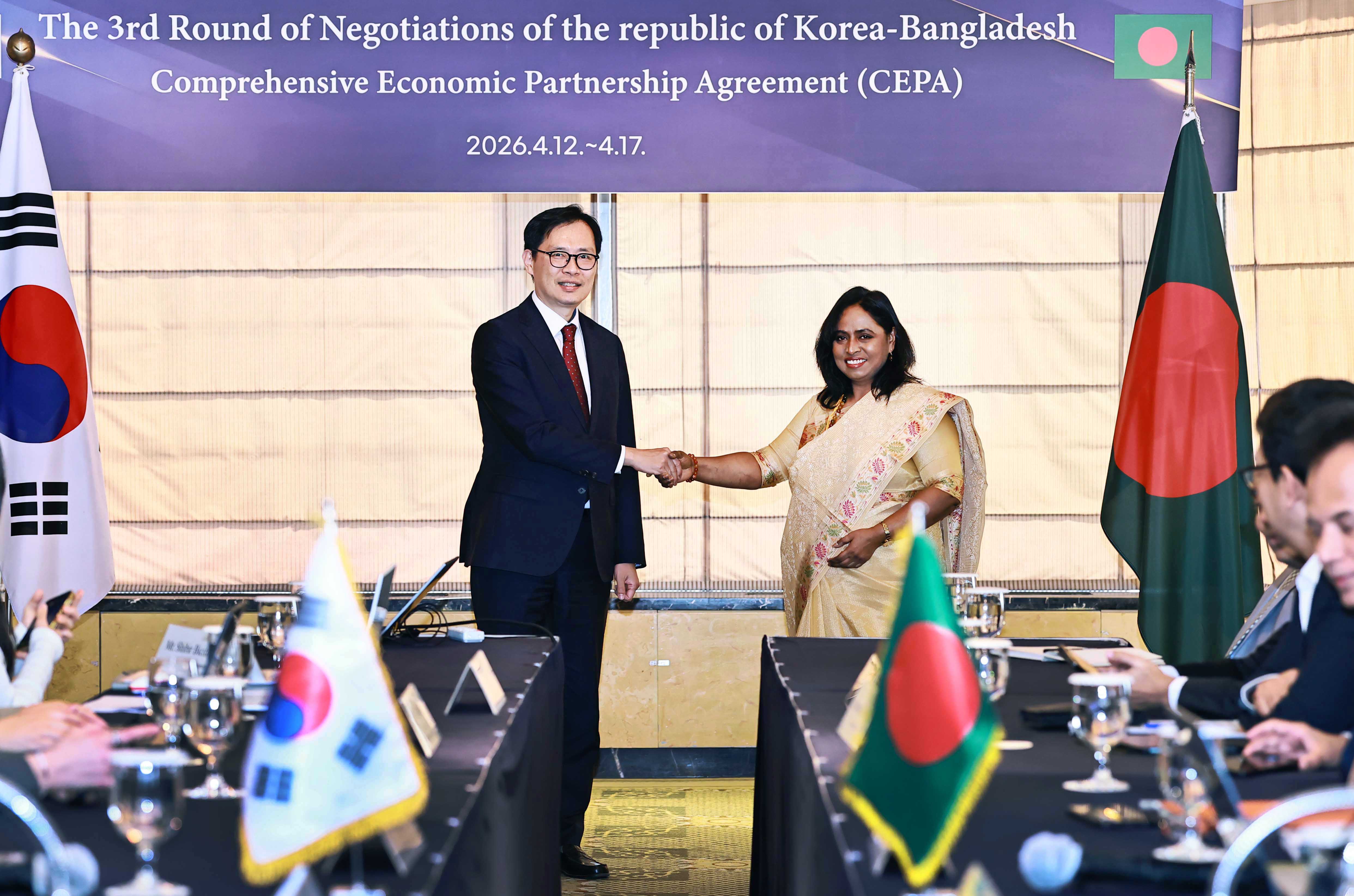
Park Geun-oh, Director General for Trade Agreement Policy at the Ministry of Trade, Industry and Resources (MOTIR, Minister JK Kim) and Korea’s chief negotiator, attended the opening session of the third round of official negotiations on the Korea–Bangladesh Comprehensive Economic Partnership Agreement (CEPA) on April 12, 2026, in Seoul. The meeting was joined by Ayesha Akther, Additional Secretary and Head of the Foreign Trade Agreement Wing at Bangladesh’s Ministry of Commerce and chief negotiator for the Bangladeshi side, as well as government delegates from both countries. “A CEPA with Bangladesh, a fast-growing emerging market of 170 million people, would help Korean companies compete more effectively in South Asia,” Park said. “We will work to conclude the negotiations early.” date2026-04-13
-
FTA/Economic Cooperation
Korea and Bangladesh Hold Third Round of CEPA Negotiations
With trade uncertainty rising at home and abroad and the need to diversify export markets growing, Korea will hold the third round of formal negotiations in Seoul from April 12 to 17, 2026, on a Comprehensive Economic Partnership Agreement (CEPA) with Bangladesh, the world’s eighth-most populous country and a key potential market in South Asia. The Office of Trade Negotiations at the Ministry of Trade, Industry and Resources (MOTIR, Minister JK Kim) said around 60 delegates from both sides will take part in the negotiations. The Korean delegation will be led by Park Geun-oh, Director General for Trade Agreement Policy at MOTIR, and the Bangladeshi delegation by Ayesha Akther, Additional Secretary and Head of the Foreign Trade Agreement Wing at Bangladesh’s Ministry of Commerce. Since launching negotiations in November 2024, the two sides have held two formal rounds, outlining their positions in each working group and identifying key issues. In the third round, they will build on the groundwork and hold in-depth talks in 13 areas, including goods market access, services, and rules of origin, to narrow differences over the draft agreement text. On the sidelines of the WTO ministerial conference held in Cameroon in March 2026, Trade Minister Yeo Han-koo met with Khandaker Abdul Muktadir, Bangladesh’s Commerce Minister, and agreed to push for an early conclusion of the CEPA with Bangladesh, a market of 170 million people. Director General Park said, “A CEPA with Bangladesh, a fast-growing emerging market of 170 million people, would help Korean companies compete more effectively in South Asia. We will work to conclude the negotiations early.” date2026-04-13
-
FTA/Economic Cooperation
Korea–China FTA: 14th Round of Subsequent Negotiations on Services and Investment
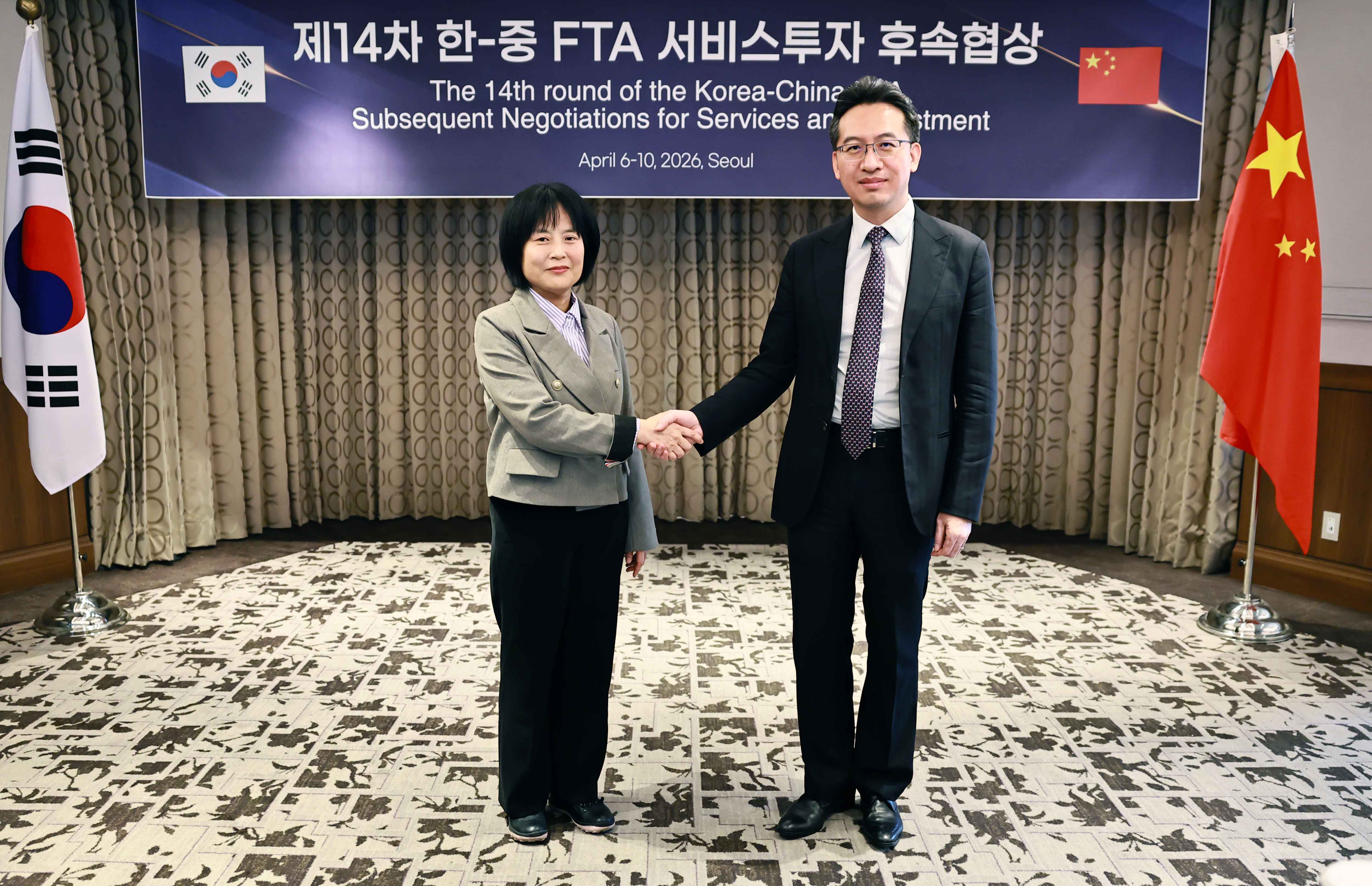
Kwon Hye-jin, Deputy Minister for Trade Negotiations at the Ministry of Trade, Industry and Resources (MOTIR), attended the 14th round of subsequent negotiations on services and investment under the Korea–China Free Trade Agreement (FTA) on April 8, 2026, at Lotte Hotel Seoul. The meeting brought together the Korean and Chinese delegations, including Lin Feng, Director General for International Trade and Economic Affairs at China’s Ministry of Commerce, to continue talks on services, investment and finance. Deputy Minister Kwon said, “We will accelerate the negotiations to deliver outcomes that can support Korean companies facing uncertainty at home and abroad. We will also ensure that the subsequent negotiations lay the groundwork for a freer and more open environment for services trade and investment." date2026-04-09
-
FTA/Economic Cooperation
Korea and China Hold 14th Round of FTA Subsequent Negotiations on Services and Investment
The 14th Round of Subsequent Negotiations on Services and Investment under the Korea–China Free Trade Agreement (FTA) is underway in Seoul from April 6 to 10, 2026. Around 40 officials from both sides are taking part, with the Korean delegation led by Kwon Hye-jin, Deputy Minister for Trade Negotiations at the Ministry of Trade, Industry and Resources (MOTIR, Minister JK Kim), and the Chinese delegation headed by Lin Feng, Director General for International Trade and Economic Affairs at China’s Ministry of Commerce. After the Korea–China FTA entered into force in 2015, the two sides launched follow-up negotiations on services and investment in March 2018 under the “Guidelines for Subsequent Negotiation”. Since then, they have held 13 formal rounds of negotiations and multiple intersessional meetings. At the Korea–China summit in January 2026, the two sides agreed to pursue meaningful progress in the Korea–China FTA follow-up negotiations within the year. The negotiations were discussed again at the Korea–China Trade Ministers’ Meeting on March 18, 2026 and substantive talks are expected to continue at the Korea–China FTA Joint Commission at the ministerial level, which is due to meet in the first half of 2026. With high-level channels between the two sides restored, the negotiating teams will build on this momentum and accelerate negotiations on the Agreement text and market access across the three working groups on services, investment, and finance. Deputy Minister Kwon said, “We will accelerate the negotiations to deliver outcomes that can support Korean companies facing uncertainty at home and abroad. We will also ensure that the subsequent negotiations lay the groundwork for a freer and more open environment for services trade and investment." date2026-04-08
-
FTA/Economic Cooperation
Korea and ASEAN Hold First Joint Committee Meeting on FTA Upgrade
The first joint committee meeting on upgrading the Korea–ASEAN Free Trade Agreement (FTA) was held by videoconference on April 8, 2026. About 40 representatives from both sides took part, led by Park Geun-oh, Director General for Trade Agreement Policy at Korea’s Ministry of Trade, Industry and Resources (MOTIR, Minister JK Kim), and Alpana Roy, Director-General for International Trade and ASEAN at Singapore’s Ministry of Trade and Industry. Since entering into force in 2007 as Korea’s fourth FTA, the Korea–ASEAN FTA has helped expand bilateral trade and investment. However, because the agreement still centers on market opening in goods and services, it has had limits in reflecting newer global trade rules in areas such as digital trade, supply chains and critical minerals. In October 2025, the two sides declared on the sidelines of the Korea–ASEAN Summit that they would begin negotiations to upgrade the agreement, formally launching the process. Ahead of full-scale subcommittee talks in June 2026, the two sides discussed the procedural framework for the negotiations, including the Joint Committee’s rules of procedure, the structure of the negotiating subcommittees and their operating guidelines. Park Geun-oh, Director General for Trade Agreement Policy at MOTIR, said, “With the global trade environment growing more uncertain amid rising protectionism and supply chain instability, we will focus the negotiations on new trade rules on digital trade, supply chains and critical minerals to support future sectors such as AI and electric vehicles.” date2026-04-08
-
FTA/Economic Cooperation
Trade Minister Yeo Meets with Delegation from French Business Group MEDEF
Trade Minister Yeo Han-koo of the Ministry of Trade, Industry and Resources (MOTIR, Minister JK Kim) met with a delegation from Mouvement des Entreprises de France (MEDEF) in Seoul on April 2, 2026, to step up engagement with major French companies and discuss ways to deepen Korea-France economic, investment, and industrial cooperation. The meeting was attended by François Jackow, chairman of MEDEF’s France–Korea Business Council, and 23 business representatives from 16 French companies, including Air Liquide, TotalEnergies, Veolia, and OPmobility. The participating companies represented a range of sectors, including industrial gases, energy, environmental services, and auto parts. Trade Minister Yeo said Korea and France need closer cooperation in strategic industries such as semiconductors, eco-friendly vehicles, and low-carbon supply chains, as energy transition and rapid technological changes are reshaping the global economy. He added that Korea and France can strengthen their competitiveness in global markets by combining their technological strengths and industrial bases, and noted that Korea would continue to improve the investment environment so that global companies can invest with confidence. date2026-04-02