-
Energy
TerraPower and SK Innovation Sign Term Sheet to Pursue Joint SMR Projects
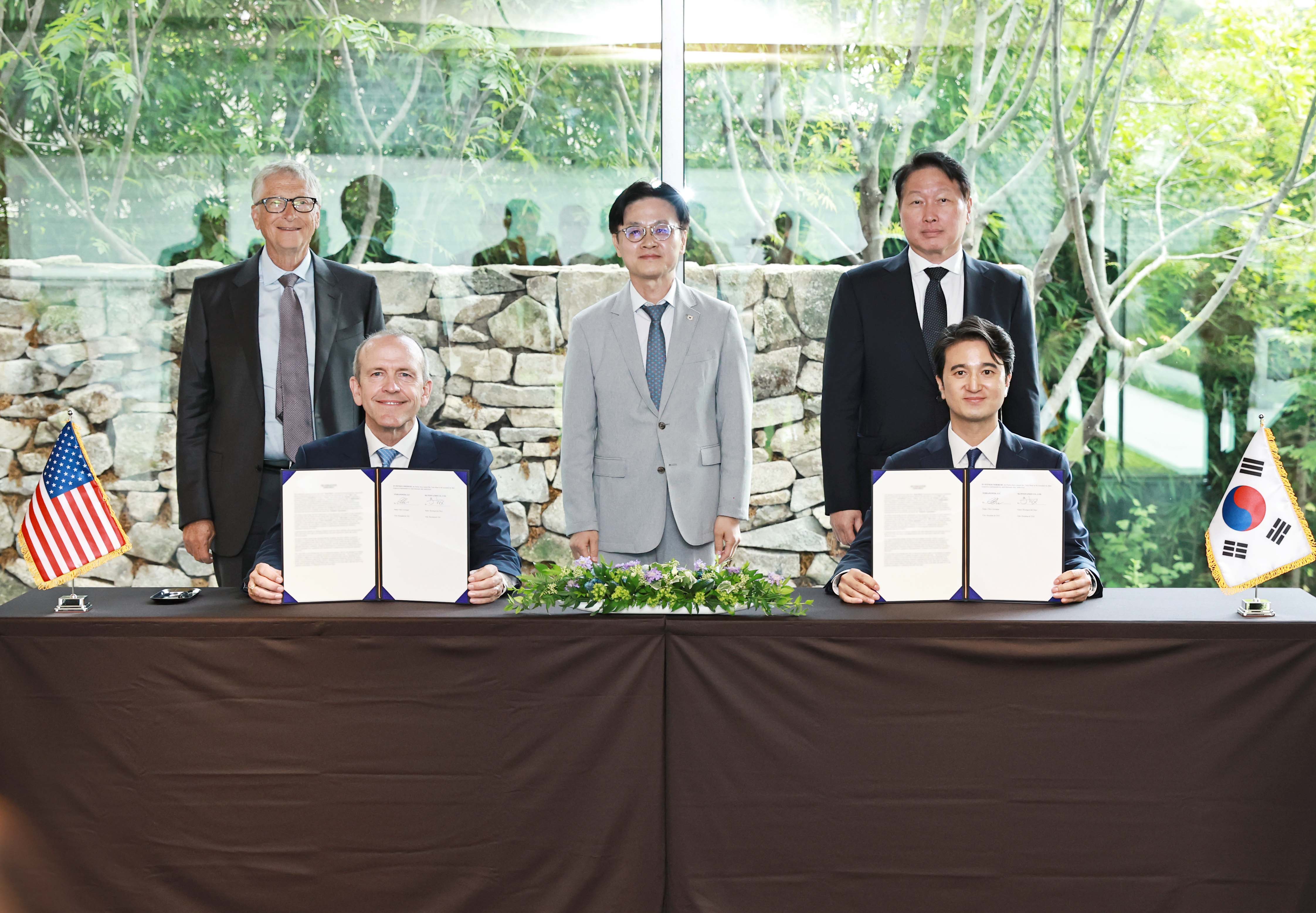
On August 14, 2026, TerraPower and SK Innovation signed in Seoul a term sheet for an agreement to pursue joint global projects. The signing was witnessed by Minister JK (Jung-Kwan) Kim of the Ministry of Trade, Industry and Resources (MOTIR), TerraPower Founder and Chairman Bill Gates, and SK Group Chairman Chey Tae-won. “With their ability to deliver projects on time and within budget, Korean companies can play a central role in turning TerraPower’s vision into reality,” said Minister Kim. date2026-08-18
-
Energy
SMR Cooperation with TerraPower Expands Export Supply Chains for Korean Nuclear Companies
On August 14, 2026, Minister JK (Jung-Kwan) Kim of the Ministry of Trade, Industry and Resources (MOTIR) met in Seoul with TerraPower Founder and Chairman Bill Gates, who arrived in Korea earlier that day. In the meeting, both Minister Kim and Chairman Gates discussed expanding Korean companies’ participation in TerraPower’s small modular reactor (SMR) projects, among other topics. Korean companies, including SK and HD Hyundai, have invested in TerraPower and established partnerships with the company. Several are also seeking roles in equipment supply, operations, construction, and other areas for projects that TerrraPower is pursuing both within the U.S. and abroad. In fact, TerraPower is building its Natrium SMR in Kemmerer, Wyoming, after receiving a construction permit from the U.S. Nuclear Regulatory Commission (NRC) in March 2026, and aims to begin commercial operation in 2031. At the meeting, Minister Kim stressed that overseas expansion requires the ability to deliver projects on time and within budget. “Korean companies have these capabilities and could play a central role in turning TerraPower’s vision into reality,” he said. He noted that making SMRs economically viable will require standardized designs to be deployed at scale. Combining TerraPower’s standard design with Korea’s reliable supply chain for high-volume production will be essential to such deployment. Minister Kim said Korea is an ideal partner because Korea boasts five decades of building and operating nuclear power plants at home and abroad, which has given Korea a “foundry-scale” ecosystem for nuclear manufacturing and construction. He added that Korea’s nuclear supply chain draws strength not only from large companies that can supply main equipment, but also from its sophisticated manufacturing ecosystem of nuclear SMEs and middle-market companies. He called for TerraPower to consider using Korea as a production hub and Korean companies as key suppliers. After the meeting, TerraPower and SK Innovation signed a term sheet for an agreement to pursue joint global projects, witnessed by Minister Kim, Chairman Gates, and SK Group Chairman Chey Tae-won. The term sheet opens opportunities for SK Innovation to help develop TerraPower’s SMR projects in the United States and other countries, and to participate in the company’s U.S. business. Demand for SMRs from big tech companies is rising rapidly as AI infrastructure expands and the number of data centers surges worldwide. More than 100 SMR designs are under development, and companies are forming cross-border alliances as they vie for a share of the emerging market. Amid these changes, Korean companies can also help diversify Korea’s nuclear exports by investing in SMR designs developed overseas, advancing projects, and engaging in overseas supply chains. With SMR supply chains still taking shape, MOTIR views this as the right opportunity for Korean companies to enter the market. The Ministry valued that the meeting not only helped large Korean companies but also nuclear SMEs and middle-market companies in their efforts to join overseas SMR supply chains. date2026-08-14
-
Trade/Investment
Korea’s ICT Exports Reach Record $53.36 Billion for July
The Ministry of Trade, Industry and Resources (MOTIR, Minister JK Kim) and the Ministry of Science and ICT (MSIT, Deputy Prime Minister and Minister Bae Kyung-hoon) announced on August 14, 2026, that Korea’s ICT exports reached USD 53.36 billion in July 2026, up 140.6 percent year-on-year from $22.17 billion. Imports rose 37.3 percent from $13.33 billion to $18.30 billion, resulting in a trade surplus of $35.06 billion. Supported by expanding AI investment worldwide, ICT exports remained above $50.0 billion for a second straight month and reached a record high for July. The ICT trade surplus also remained above $30.0 billion for a third consecutive month, sustaining its upward trend. ICT exports accounted for more than half, or 54.0 percent, of Korea’s total exports of $98.89 billion for a third straight month, underscoring the sector’s role as a key pillar of Korea’s exports. By product, exports increased across all major categories: semiconductors (up 178.8 percent), displays (up 0.5 percent), mobile phones (up 62.6 percent), computers and peripherals (up 353.9 percent), and telecommunications equipment (up 18.7 percent). Semiconductor exports grew by more than 100 percent for a seventh straight month, supported by continued growth in server memory exports amid rising demand for AI inference and expanded supplies of enterprise SSDs. Higher exports of OLED panels for finished products, such as smartphones and televisions, drove growth in display exports. Mobile phone exports rose as demand for new models and increased sales of high-value products lifted shipments of finished phones. Exports of computers and peripherals increased for a ninth straight month, led by higher parts exports and growing demand for SSDs used in AI servers. Telecommunications equipment exports rose on strong shipments of wireless communications equipment to Vietnam and automotive equipment to India. By destination, exports increased in all major markets: the U.S. (up 187.0 percent), China, including Hong Kong (up 194.7 percent), the EU (up 202.0 percent), Taiwan (up 26.3 percent), Vietnam (up 115.7 percent), India (up 128.2 percent), and Japan (up 39.3 percent). ICT imports totaled $18.30 billion in July 2026, up 37.3 percent from $13.33 billion a year earlier, as imports increased in several major categories, including semiconductors (up 57.6 percent), mobile phones (up 44.7 percent), and computers and peripherals (up 31.0 percent). date2026-08-14
-
Industry
Automobile Exports Hit Record High for July; Government and Industry Join Forces on Future-Vehicle Transition and Mutual Growth
The Ministry of Trade, Industry and Resources (MOTIR, Minister JK Kim) held an automobile industry roundtable on August 13, 2026, at the Korea Automobile & Mobility Association (KAMA), with Park Dong-il, Deputy Minister for Industrial Policy at MOTIR, in attendance. Participants included representatives of four automakers—Hyundai Motor, GM Korea, KG Mobility, and Renault Korea—and four industry and research organizations: KAMA; the Korea Auto Industries Cooperative Association (KAICA); the Korea Automotive Technology Institute (KATECH); and the Korea Institute for Industrial Economics and Trade (KIET). They discussed key issues, including automobile industry trends in July and the outlook for the second half of 2026, the transition to future vehicles, and how to foster mutually beneficial cooperation across the industry ecosystem. Automobile Industry Trends in July Korea’s automobile exports rose 7.0 percent year-on-year to USD 6.24 billion in July 2026, the highest July figure on record. Domestic sales and production also increased 0.5 percent and 11.3 percent, respectively, to 139,000 and 352,000 units. Eco-friendly vehicles led export growth, with their export value rising 25.5 percent year-on-year to $2.59 billion. Exports of electric and hydrogen vehicles increased 31.9 percent to $0.94 billion, while hybrid vehicle exports rose 22.2 percent to $1.65 billion. By contrast, exports of internal combustion engine vehicles fell 3.1 percent to $3.65 billion. By region, export growth was led by key markets, with North America up 18.0 percent year-on-year to $3.25 billion and the European Union up 23.5 percent to $0.88 billion. The increase appears to reflect more working days after major automakers moved their annual summer shutdowns from July in 2025 to August in 2026, along with solid global demand for eco-friendly vehicles and SUVs. Exports to the Middle East rose 12.7 percent to $0.43 billion, returning to year-on-year growth after eight months. Domestic sales in July rose 0.5 percent year-on-year to 139,000 units. Demand for eco-friendly vehicles remained solid, with sales reaching 84,000 units, or approximately 60 percent of the total. Sales of electric vehicles rose 47.5 percent to 36,000 units. Automobile production rose 11.3 percent year-on-year to 352,000 units, supported by additional working days after major automakers shifted their summer shutdowns. Key Roundtable Discussions Automakers called for policy support from the government, saying it is essential to maintain a stable domestic production base of at least 4 million vehicles a year to safeguard Korea’s automobile ecosystem as the rapid rise of foreign companies intensifies competition for survival in the global EV market. Participants also agreed that the parts industry needs to make an early transition to future vehicles in response to electrification and other changes reshaping the automobile industry, while building an ecosystem in which automakers and suppliers can grow together. Government and industry agreed to work together toward these goals. Deputy Minister Park said, “The global automobile industry is being reshaped by the transition to future vehicles and other changes. At this critical time, the government, automakers, and parts suppliers must work as one team to overcome the challenges.” He said MOTIR would remain in close contact with the industry, carefully monitor issues including production and export conditions, and provide hands-on support. He also asked automakers to strengthen labor-management communication and cooperation and take the lead in fostering mutually beneficial collaboration with parts suppliers as they shift their businesses toward future vehicles and undergo AI transformation (AX). ▶ View Video: https://www.youtube.com/shorts/0V6esjo3n_c date2026-08-14
-
Energy
MOTIR and NSSC Sign MOU on Regulatory Cooperation
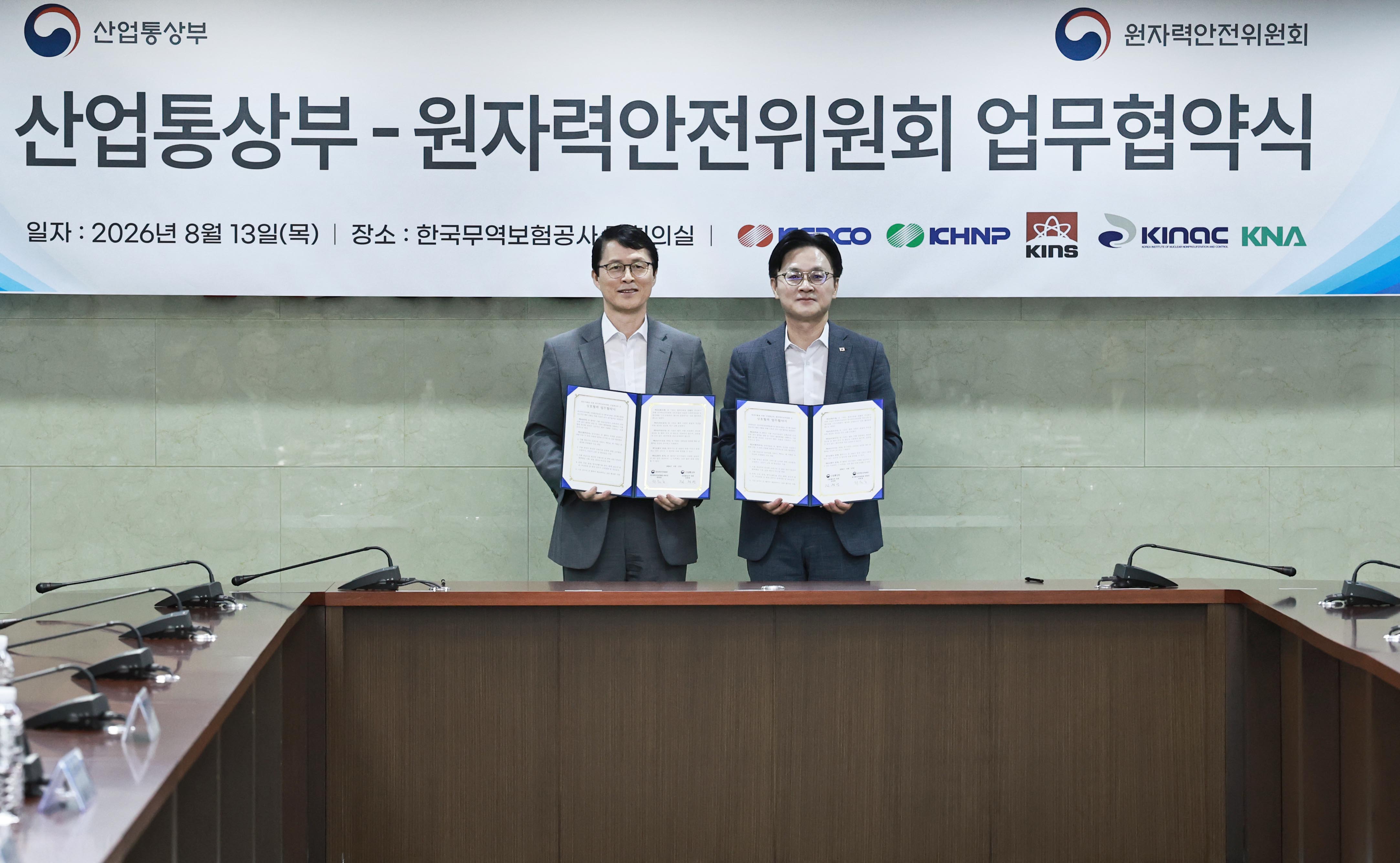
Minister JK (Jung-Kwan) Kim of the Ministry of Trade, Industry and Resources (MOTIR) and Chairperson Choi Won-ho of the Nuclear Safety and Security Commission (NSSC) signed an MOU on regulatory cooperation at the Korea Trade Insurance Corporation (K-SURE) in Seoul on August 13, 2026. Representatives from relevant organizations, including the Korea Electric Power Corporation (KEPCO), Korea Hydro & Nuclear Power (KHNP), Korea Institute of Nuclear Safety (KINS), and Korea Institute of Nuclear Nonproliferation and Control (KINAC), attended the ceremony. Minister Kim also witnessed the signing of a separate MOU among five organizations, including the Korea Nuclear Association for International Cooperation. “The agreement provides a formal basis for linking nuclear power exports with regulatory cooperation and pooling the expertise of the agencies and participating organizations,” said Minister Kim. “With NSSC, KINS, and KINAC as core Team Korea partners, we will address the diverse cooperation needs of countries introducing nuclear power, including Vietnam.” date2026-08-13
-
Energy
MOTIR and NSSC to Pair Nuclear Power Exports with Regulatory Cooperation
The Ministry of Trade, Industry and Resources (MOTIR, Minister JK Kim) and the Nuclear Safety and Security Commission (NSSC, Chairperson Choi Won-ho) signed a memorandum of understanding (MOU) on August 13, 2026, at the Korea Trade Insurance Corporation (K-SURE) in Seoul to support the successful overseas deployment of Korean-designed nuclear power plants. Amid continued global instability, including the Russia-Ukraine war and the closure of the Strait of Hormuz, and with climate action now a pressing international priority, nuclear power is drawing renewed attention for its ability to provide a reliable energy supply and contribute to carbon neutrality. As a result, plans to introduce new nuclear power plants are gaining momentum in the United States and Europe, as well as in Southeast Asian countries such as Vietnam and the Philippines. In response to these market developments, the Korean government is actively pursuing nuclear power exports, with a focus on promising Southeast Asian markets, including Vietnam. Countries introducing nuclear power for the first time must establish the necessary regulatory infrastructure alongside plant construction. This includes relevant laws, licensing procedures, technical standards, capable regulatory bodies, and a workforce specializing in nuclear safety and security. Entering these emerging markets therefore requires comprehensive cooperation that combines technology and project execution capabilities with Korea’s regulatory experience and expertise across the entire nuclear power plant lifecycle. Previously, MOTIR referred regulatory cooperation requests from potential buyer countries to NSSC, which handled them case by case with relevant technical organizations. The International Atomic Energy Agency (IAEA), however, advises buyer countries to develop their regulatory frameworks and licensing capacity before choosing a technology supplier. This has highlighted the need to link nuclear power exports with regulatory cooperation in a more systematic and sustainable manner. MOTIR and NSSC signed the MOU to jointly address potential buyer countries’ regulatory cooperation needs, providing systematic support as they establish their nuclear safety regulatory frameworks and strengthen their regulatory capacity. The two agencies will regularly share updates on overseas nuclear power projects, as well as information on each country’s regulatory environment and cooperation needs. Drawing on Korea’s experience regulating nuclear power plants from design and construction through operation, they will tailor cooperation to each potential buyer country’s circumstances and project stage. Five organizations—the Korea Electric Power Corporation (KEPCO), Korea Hydro & Nuclear Power (KHNP), Korea Nuclear Association for International Cooperation (KNA), Korea Institute of Nuclear Safety (KINS), and Korea Institute of Nuclear Nonproliferation and Control (KINAC)—also signed a separate MOU. Under the MOUs, MOTIR and NSSC will set the government’s overall direction for cooperation, while the participating organizations undertake projects tailored to each country’s needs. This is expected to integrate regulatory cooperation into overseas nuclear power projects from the outset and enable a systematic response to potential buyer countries’ regulatory needs. After the signing, MOTIR and NSSC held a consultation to share updates on major nuclear power projects in Vietnam, the Czech Republic, and the Philippines, as well as regulatory cooperation with the United Arab Emirates and the Czech Republic. They also discussed how to tailor nuclear power export and regulatory cooperation to conditions in each country. “This MOU is significant because it establishes a formal basis for systematically linking nuclear power exports with regulatory cooperation and pooling the expertise of both agencies and the date2026-08-13
-
Trade/Investment
JD Kick-Off Summit 2026 Held in Seoul
Kang Gam-chan, Deputy Minister for International Trade and Investment at the Ministry of Trade, Industry and Resources (MOTIR, Minister JK Kim) delivered congratulatory remarks at JD Kick-Off Summit at KOTRA headquarters in Seoul on August 12, 2026. Attendees included Yang Qikun, Vice Chairman of Jingdong Group (JD.com), and representatives from around 200 leading consumer goods companies. “The two recent Korea-China summits have helped create favorable conditions for Korean consumer goods to enter China’s domestic market,” Deputy Minister Kang said. “We will actively support Korean companies to facilitate their entry through major platforms such as JD.com.” date2026-08-12
-
Trade/Investment
JD.com, China’s Largest E-Commerce Platform, Steps Up Imports of Korean Consumer Goods
Jingdong Group (JD.com, Chairman: Liu Qiangdong), China’s largest e-commerce platform, has established a dedicated purchasing subsidiary in Korea and is stepping up imports of Korean products. The Ministry of Trade, Industry and Resources (MOTIR, Minister JK Kim) and the Korea Trade-Investment Promotion Agency (KOTRA, CEO and President Kang Kyung Sung) jointly hosted the JD Kick-Off Summit 2026 with JD.com at KOTRA headquarters in Seoul on August 12, 2026. The event featured a supplier briefing on direct purchasing and business consultations. Korea’s consumer goods exports to China peaked at approximately USD 9.3 billion in 2021 before declining throughout the COVID-19 pandemic. In the first half of this year, however, exports rose 8.7 percent year on year, supported by cooperation with local distribution networks and broader access to inland markets. To sustain this growth, the government is focusing on direct purchasing as an export model. Under this model, an overseas platform imports and distributes products locally without an intermediary. For exporters, it offers higher margins and more reliable payment. For overseas retailers, it reduces the risk of counterfeit products and unauthorized distribution. Yang Qikun, Vice Chairman of JD.com Group, visited Korea following the subsidiary’s establishment. “As the Korean Wave continues worldwide, demand for K-beauty products and Korean food is expected to grow,” he said. “We will continue to expand our direct purchases of Korean products.” Around 200 Korean consumer goods companies attended the event, where they learned about JD.com’s business model and held one-on-one business consultations with JD.com buyers. A signing ceremony was also held for an export contract worth USD 1.5 million. At the ceremony, a representative of Company A said the contract enabled the company to export to China without having to manage logistics or payment collection, adding that it would focus on producing quality products to further expand its customer base in China. Kang Gam-chan, Deputy Minister for International Trade and Investment at MOTIR, noted that the two recent Korea-China summits had helped create favorable conditions for Korean consumer goods to enter China’s domestic market. “We will actively support Korean companies to facilitate their entry into the Chinese market through major platforms such as JD.com,” he said. date2026-08-12
-
FTA/Economic Cooperation
Vice Minister Moon Meets with Tajikistan’s First Deputy Minister of Industry and New Technologies
Vice Minister Moon Shin-hak of the Ministry of Trade, Industry and Resources (MOTIR, Minister JK Kim) met with Isojon Qurbonzoda, First Deputy Minister of Industry and New Technologies of Tajikistan, at Government Complex Seoul on August 11, 2026. The two sides discussed industrial and economic cooperation projects for the first Korea-Central Asia Summit and bilateral cooperation on critical minerals. “We will further develop the cooperation initiatives discussed today and work to translate them into tangible results in industry, supply chains, and critical minerals at the Korea-Central Asia Summit in September,” Vice Minister Moon said. date2026-08-11
-
FTA/Economic Cooperation
MOTIR and Tajikistan Discuss Economic Cooperation Projects Ahead of Korea-Central Asia Summit
Vice Minister Moon Shin-hak of the Ministry of Trade, Industry and Resources (MOTIR, Minister JK Kim) met with Isojon Qurbonzoda, First Deputy Minister of Industry and New Technologies of the Republic of Tajikistan, in Seoul on August 11, 2026. The meeting provided an opportunity for discussions on industrial and economic cooperation projects for the first Korea-Central Asia Summit, scheduled for September 16, 2026, as well as ways to achieve tangible outcomes through cooperation in critical minerals. The two sides discussed establishing the C5+Korea Industry Ministers’ Meeting as a regular consultative channel among the industry ministers of Korea and the five Central Asian countries—Tajikistan, Kazakhstan, Uzbekistan, Turkmenistan and Kyrgyzstan. Discussions were also held on signing a memorandum of understanding (MOU) on mutually beneficial cooperation in industry and new technologies between Korea and Tajikistan, as well as ways to expand engagement and cooperation between business leaders from both countries through the Korea-Central Asia Business Summit, which will take place alongside the leaders’ summit. The talks also covered closer cooperation on critical mineral supply chains. Vice Minister Moon welcomed the inaugural Korea-Tajikistan Minerals Forum, highlighting Tajikistan’s abundant mineral resources, including gold, silver and antimony. The forum will be held in Seoul on August 12, 2026, ahead of the Korea-Central Asia Summit. Vice Minister Moon expressed hope that the forum would help identify practical projects by connecting Tajikistan’s resource potential with Korea’s expertise and technologies for mineral exploration and development, as well as Korea’s demand for minerals. The forum will bring together government officials and representatives of relevant institutions and companies from both countries to discuss critical minerals policies, opportunities for joint exploration, investment and financing and supply chain development. “Tajikistan and other Central Asian countries, with their abundant resources and growth potential, are important partners for Korea,” Vice Minister Moon said. “We will build on the initiatives discussed today to deliver tangible outcomes in the areas of industry, supply chains and critical minerals at the Korea-Central Asia Summit in September.” date2026-08-11