-
FTA/Economic Cooperation
Panel Discussion at the 19th Asia-Pacific Conference of German Business (APK)
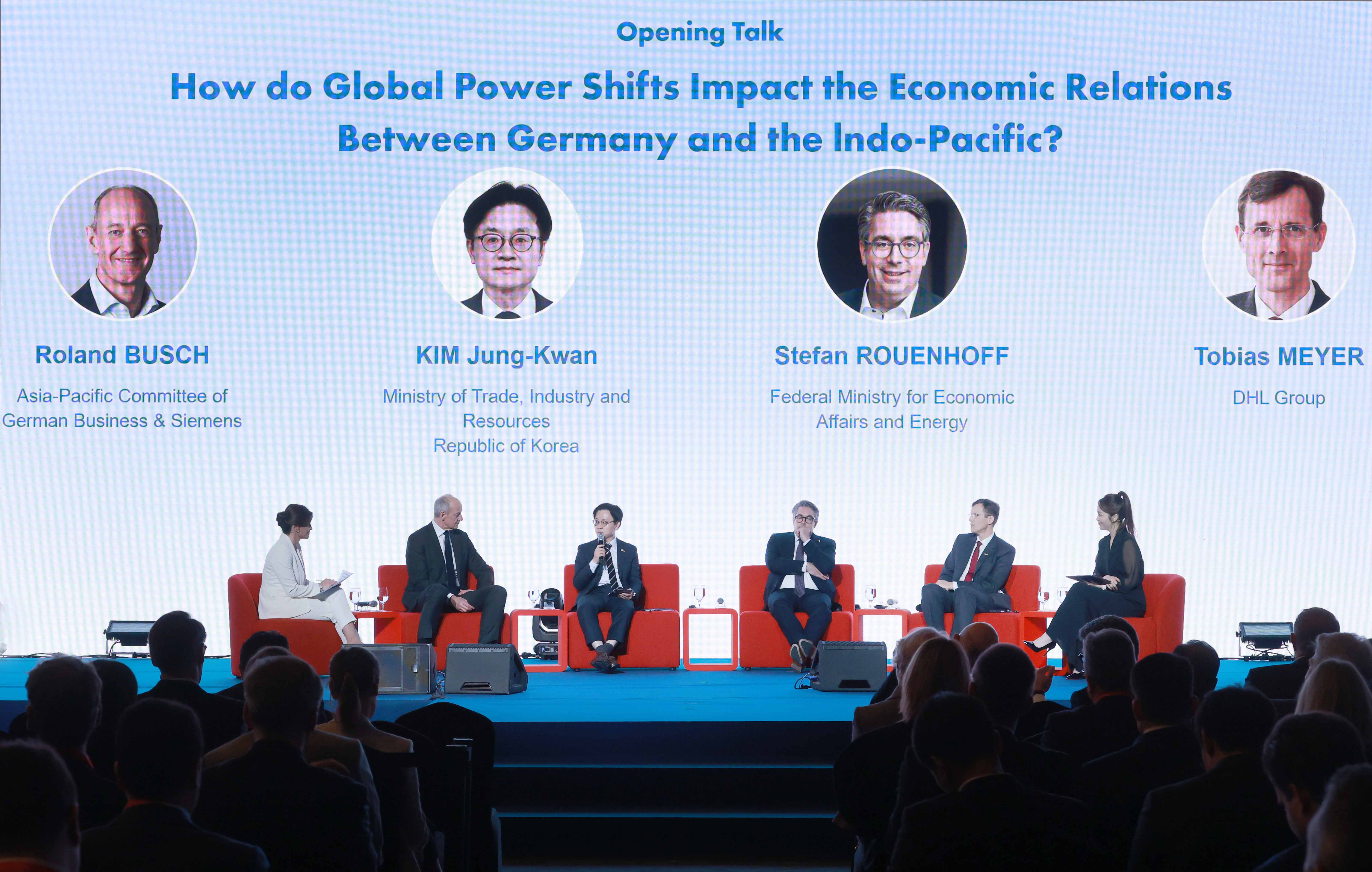
Minister JK (Jung-Kwan) Kim of the Ministry of Trade, Industry and Resources (MOTIR) participated in a panel discussion at the 19th Asia-Pacific Conference of German Business (APK) in Seoul on October 30, 2026. The discussion addressed how changes in the global economic order affect economic relations between Germany and the Indo-Pacific region and explored ways to expand industrial cooperation. Approximately 500 leading figures from Korea and Germany attended, including Stefan Rouenhoff, Parliamentary State Secretary at Germany’s Federal Ministry for Economic Affairs and Energy, and Roland Busch, President and Chief Executive Officer of Siemens AG and Chairman of the Asia-Pacific Committee of German Business (APA). At the conference, Minister Kim emphasized that Korea and Germany are key partners that must respond together to changes in the global economic order. date2026-10-30
-
FTA/Economic Cooperation
Korea and Germany Strengthen Cooperation on Economic Security and Advanced Industries
Minister JK (Jung-Kwan) Kim of the Ministry of Trade, Industry and Resources (MOTIR) attended the 19th Asia-Pacific Conference of German Business (Asien-Pazifik-Konferenz, APK) in Seoul on October 30, 2026. He outlined ways to strengthen industrial cooperation among Korea, Germany, and the Asia-Pacific region in response to changes in the global economic order. He then signed a Joint Declaration of Intent on a Framework for an Economic and High-Tech Partnership between Korea and Germany with Germany’s Federal Ministry for Economic Affairs and Energy. He also supported the signing of nine memoranda of understanding (MOUs) between Korean and German companies and institutions. That evening, MOTIR hosted Korea Night for approximately 600 business leaders from Korea, Germany, and the Asia-Pacific region to promote private-sector exchanges and expand economic cooperation. The APK is the German business community’s flagship event for cooperation with the Asia-Pacific region and was held in Seoul in 2026 in commemoration of its 40th anniversary. The conference was held in conjunction with German Chancellor Friedrich Merz’s visit to Korea, providing an opportunity to expand bilateral economic cooperation and explore new avenues for collaboration amid changes in the global trading environment. 1. APK Panel Discussion On the morning of October 30, Minister Kim participated in a panel discussion on how changes in the global economic order affect economic relations between Germany and the Indo-Pacific region. Other leading figures who participated in the discussion included Stefan Rouenhoff, Parliamentary State Secretary at Germany’s Federal Ministry for Economic Affairs and Energy, and Roland Busch, President and Chief Executive Officer of Siemens AG and Chairman of the Asia-Pacific Committee of German Business (APA). Participants discussed shifts in the global economic order and ways to expand industrial cooperation. Minister Kim noted that Korea and Germany, both heavily reliant on manufacturing and exports, face common challenges amid growing uncertainty in global supply chains. He attributed this uncertainty to intensifying U.S.-China strategic competition, rising protectionism, and the increasing treatment of critical minerals as strategic assets. To stabilize supply chains and enhance economic security, he therefore emphasized the need to expand cooperation with the Asia-Pacific region, which has resources and growth potential, and strengthen solidarity among trusted partners. In particular, Minister Kim highlighted the complementary strengths of Korean and German industries. He proposed expanding joint research and development and technological cooperation by combining Korea’s advanced manufacturing capabilities in sectors such as semiconductors and batteries with Germany’s expertise in precision machinery and industrial automation. This cooperation would cover strategic sectors such as AI for manufacturing, semiconductors, and critical minerals. Specifically, he introduced Korea’s Manufacturing AI Transformation (M.AX) policy and its experience conducting demonstrations in industrial settings, and outlined opportunities for bilateral cooperation in the use of industrial data and AI for manufacturing. 2. MOU Signing Ceremony MOTIR then signed the Joint Declaration of Intent on a Framework for an Economic and High-Tech Partnership between Korea and Germany with Germany’s Federal Ministry for Economic Affairs and Energy. The declaration is significant in that it establishes a comprehensive framework for expanding bilateral economic cooperation, which has centered on trade and investment, to include strategic areas such as economic security, supply chains, and advanced industries. Specifically, the two countries agreed to strengthen cooperation in the following areas: information sharing and early warning for critical mineral supply chains; r date2026-10-30
-
Industry
Meeting with Engineering Leaders Who Contributed to Korea’s Industrial Development
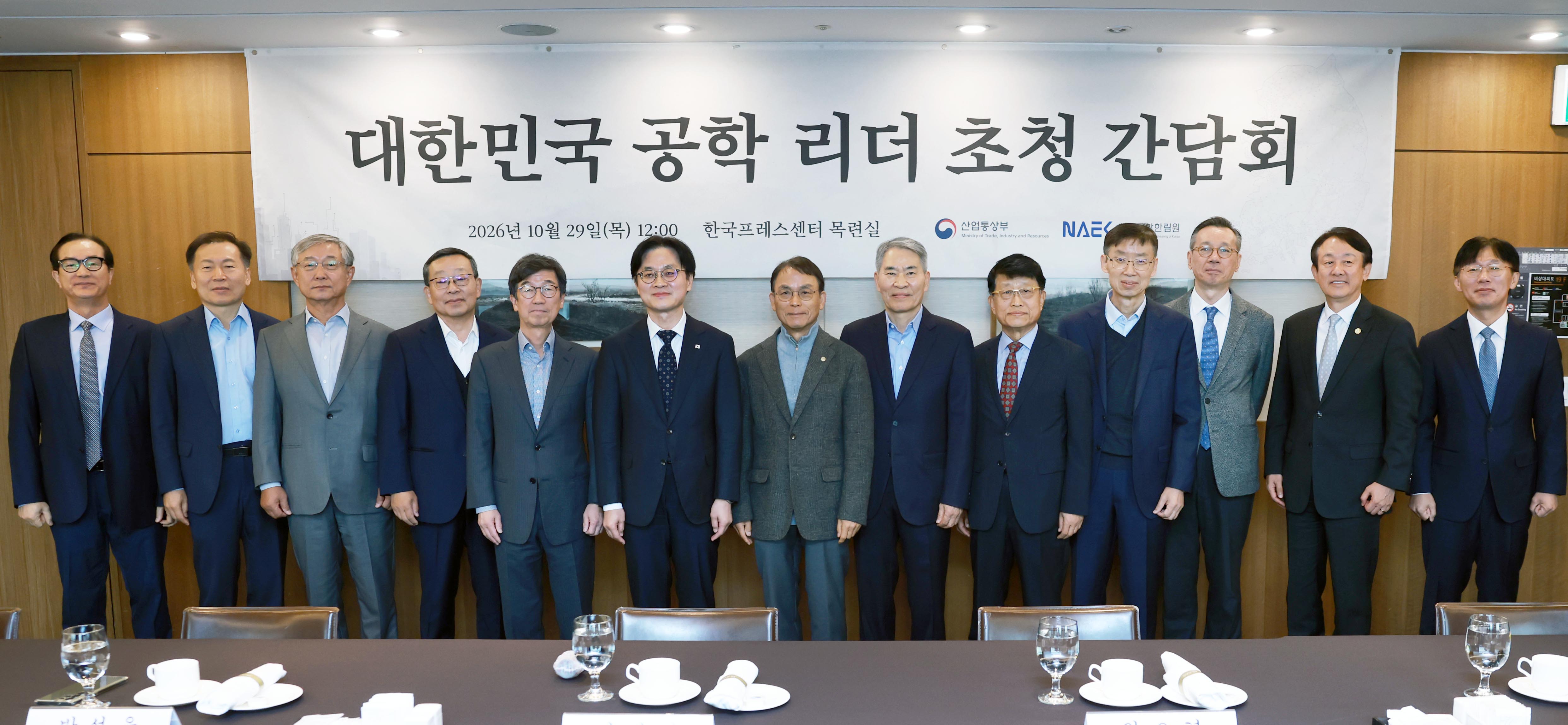
Minister JK (Jung-Kwan) Kim of the Ministry of Trade, Industry and Resources (MOTIR) chaired a meeting with veteran engineering leaders in Seoul on October 29, 2026. The meeting honored their dedication and contributions to Korea’s industrialization and technological advancement, including making Korea globally competitive in semiconductors, displays, automobiles, shipbuilding, steel, robotics, and other industries. Participants discussed future strategies for Korean industry amid rapid industrial change. Attendees included Chin Dae-je, former President of Samsung Electronics and former Minister of Information and Communication; Park Sung-wook, former Vice Chairman of SK hynix, who led the development of high-bandwidth memory (HBM) and advances in semiconductor technology; and Kwon Oh-Kyong, Endowed-Chair Professor at Hanyang University, who contributed to developing and commercializing key technologies for the world’s first AMOLED displays. In his opening remarks, Minister Kim credited the engineering community’s determination and dedication in pushing technological boundaries despite countless failures and challenges with Korea’s rise as a technological powerhouse. He sought the leaders’ advice on how Korean industry could take its next leap forward amid the AI revolution and global competition for technological leadership. date2026-10-30
-
Industry
MOTIR Meets Engineering Leaders to Discuss Korea’s Next Leap in the AI Era
The Ministry of Trade, Industry and Resources (MOTIR, Minister JK Kim) held a meeting at the Korea Press Center on October 29, 2026, with veteran engineering leaders who have led Korea’s industrial development. The meeting was held to mark the inaugural Engineers’ Day on October 30 and thank members of the engineering community for their dedication and contributions to Korea’s industrialization and technological advancement. Their work has made Korea globally competitive in semiconductors, displays, automobiles, shipbuilding, steel, robotics, and other industries. The ministry also sought to learn from their experience and hear their insights on the future of Korean industry amid rapid industrial change. Participants included Chin Dae-je, former President of Samsung Electronics and former Minister of Information and Communication, who led the development of DRAM chips including the world’s first 64-megabit, 256-megabit, and 1-gigabit chips; Park Sung-wook, former Vice Chairman of SK hynix, who led the development of high-bandwidth memory (HBM) and innovation in semiconductor technology; and Kwon Oh-kyong, Endowed-Chair Professor at Hanyang University, who contributed to developing and commercializing key technologies for the world’s first AMOLED displays. Other engineering leaders who attended included Yang Woong-chul, former Vice Chairman of Hyundai Motor Company, and Cho Sung-hwan, former CEO of Hyundai Mobis, both of whom led innovation in next-generation automotive technologies. Lee Chung-dong, former head of the Central Research Institute at Hyundai Heavy Industries, led advances in shipbuilding, including the development of ship control technologies. Cho Hyung-hee, Professor Emeritus at Yonsei University, developed key cooling technologies for gas turbines, while Shin Kyung-chul, Honorary Chairman of Yujin Robot, led advances in industrial robotics. Min Dong-joon, Professor Emeritus at Yonsei University, developed the theoretical basis for commercializing the FINEX ironmaking process. Rhee Byung-geon, former Vice Chairman of Chong Kun Dang Holdings, led the development of treatments for osteoarthritis and hemophilia. Before the luncheon discussion began, Minister Kim thanked members of the engineering community for pushing technological boundaries with determination and dedication despite countless failures and challenges, crediting them with Korea’s rise as a technological powerhouse. Amid the new challenges posed by the AI revolution and global competition for technological leadership, he asked the veteran engineering leaders who pioneered Korea’s industrialization for advice on how Korean industry should develop to take its next leap forward. During the luncheon discussion, participants held wide-ranging discussions on the direction Korean industry should take in the AI era, the engineering community’s role in accelerating industrial innovation, and how to create an environment where its members can focus on research and technology development. Minister Kim identified the Mega Projects, worth KRW 1,600 trillion in total, and Manufacturing AI Transformation (M.AX) as drivers of future growth and stressed the need to pool national capabilities to ensure their success. He called on the engineering community to actively provide input and contribute to policymaking and implementation. He also said that creating an environment where members of the engineering community are respected by society and fairly rewarded is essential to sustaining innovation. The government would take an active role in establishing the necessary institutional framework, he added. Based on the discussions at the meeting, MOTIR plans to pursue policies in earnest to enhance recognition of and respect for members of the engineering community and create an environment that supports innovative research and development. To mark the inaugural Engineers’ Day, the minis date2026-10-30
-
Industry
Opening Ceremony for Merck’s Asia-Pacific Bioprocessing Production Center
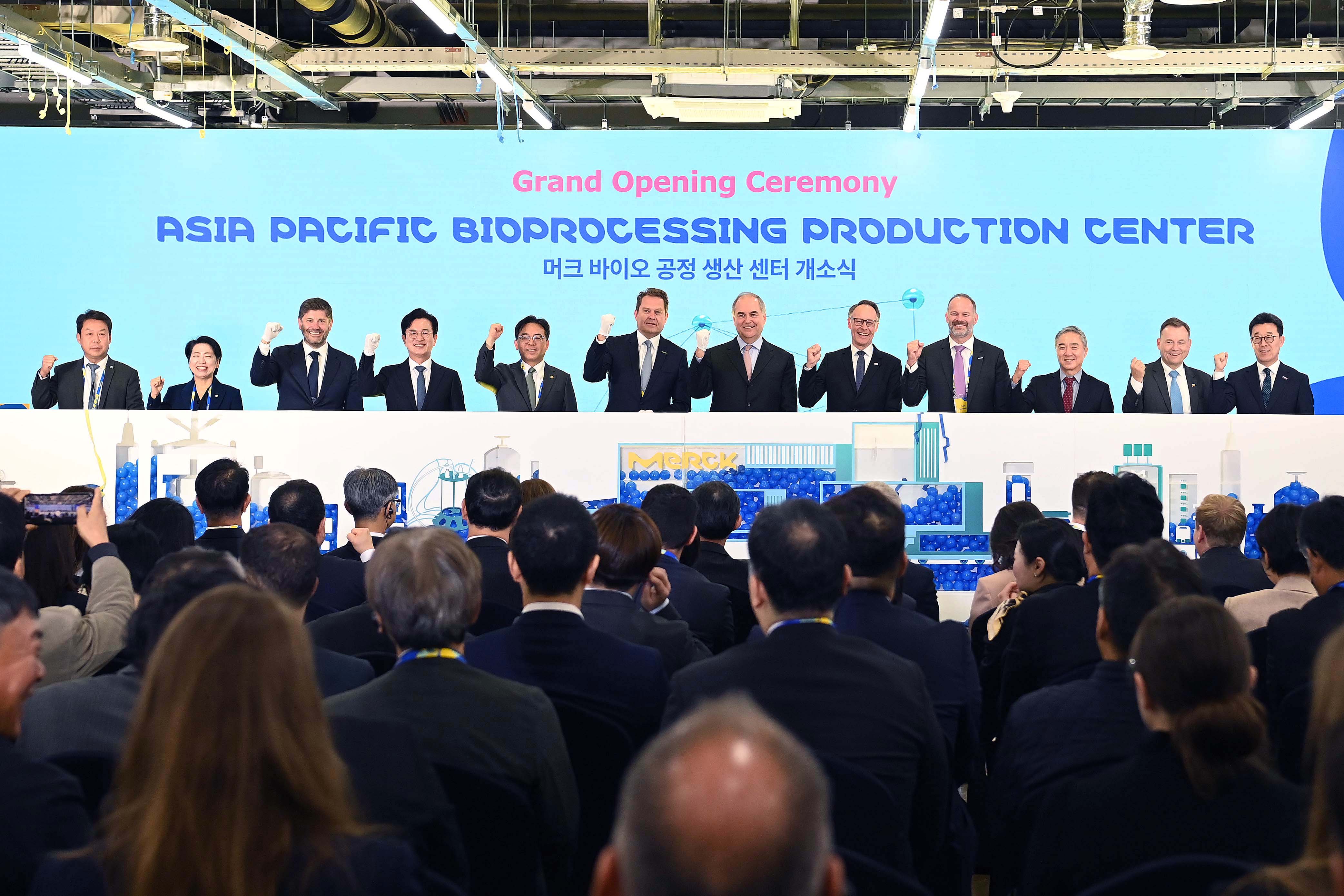
Minister for Trade Park Jung-sung of the Ministry of Trade, Industry and Resources (MOTIR, Minister JK Kim) attended the opening ceremony for Merck’s Asia-Pacific Bioprocessing Production Center on October 29, 2026, in the Dungok district of the International Science Business Belt in Yuseong-gu, Daejeon. He delivered congratulatory remarks, participated in the ceremony marking the center’s opening, and toured its main facilities. Approximately 250 people attended, including National Assembly member Hwang Junga; Heo Tae-jeong, Mayor of Daejeon Metropolitan City; Johannes Baillou, Chairman of the Executive Board of E. Merck KG; Jean-Charles Wirth, CEO of Merck’s Life Science business; and representatives of local governments, relevant institutions, and companies. Minister Park said the investment further broadens Korea-Germany economic cooperation and noted the significance of the opening coinciding with the German Chancellor’s visit to Korea and the Asia-Pacific Conference of German Business (APK 2026). He expressed hope that Merck would further develop its biotech business in Korea and continue to create new growth opportunities together with the country. date2026-10-29
-
Industry
Germany’s Merck Opens Manufacturing Hub for Bioprocessing Materials in Daejeon
Merck, a global chemical company based in Germany, held an opening ceremony on October 29, 2026, for its Asia-Pacific Bioprocessing Production Center in the Dungok district of Daejeon’s International Science Business Belt. The center represents Merck’s largest life science investment in the Asia-Pacific region. Merck plans to use the facility as a key hub to produce raw materials and supplies for biopharmaceutical manufacturing in Korea, including cell culture media and process liquids, for supply to Korean customers and export to the Asia-Pacific region. The center is also expected to contribute significantly to the local economy by employing approximately 300 people by 2028. In May 2023, the Ministry of Trade, Industry and Resources (MOTIR, Minister JK Kim) and Daejeon Metropolitan City signed a trilateral memorandum of understanding (MOU) on investment cooperation with Merck. They provided close support from the early stages of the investment, including identifying a site, securing permits and resolving business difficulties, making the project a successful example of attracting foreign investment. With this support, Merck recognized the growth potential of Korea’s bioindustry and decided to invest in the Asia-Pacific Bioprocessing Production Center to establish a supply chain hub for the region. Founded in 1668, Merck is a leading company in life science, healthcare, and electronic materials. It entered Korea in 1989 and now employs more than 1,900 people in the country. In life science, Merck has supported process development, provided technical assistance, and produced raw materials and supplies on a small scale for Korean biotech companies through its M Lab Collaboration Center and Life Science Operations Headquarters, both in Songdo. In his congratulatory remarks, Minister for Trade Park Jung-sung described the project as “a significant investment that further broadens economic cooperation between Korea and Germany.” He added, “The opening is particularly meaningful as it coincides with the German Chancellor’s visit to Korea and the Asia-Pacific Conference of German Business (APK 2026).” He also said, “I hope Merck will further develop its biotech business in Korea through the Bioprocessing Production Center and, as a foreign-invested company, continue to create new opportunities for growth together with Korea.” Approximately 250 people attended the ceremony, including Minister Park, Heo Tae-jeong, Mayor of Daejeon Metropolitan City, National Assembly member Hwang Jung-a, and other government officials; Johannes Baillou, Chairman of the Executive Board of E. Merck KG, and Jean-Charles Wirth, CEO of Merck’s Life Science business; and representatives of relevant companies and institutions. date2026-10-29
-
Trade/Investment
Major Retailer Sales Rise 4.5 Percent in September
The Ministry of Trade, Industry and Resources (MOTIR, Minister JK Kim) announced that total sales at 26 major retailers (15 offline retailers and 11 online retailers) rose 4.5 percent year-on-year in September 2026, with offline sales up 5.1 percent and online sales up 4.0 percent. With Chuseok falling earlier than last year, sales of holiday gift sets and items for ancestral rites remained strong during the holiday period. Sales growth was led by food (up 6.3 percent) and the services/other category (up 7.3 percent), including grocery shopping services. Offline sales increased across all retail formats, including hypermarkets (up 4.0 percent), department stores (up 8.4 percent), convenience stores (up 2.9 percent), and super supermarkets (SSMs, up 5.0 percent). Hypermarket sales grew for a second consecutive month, led by food (up 4.3 percent), home appliances and toys (up 5.8 percent), and clothing (up 11.2 percent). The earlier Chuseok holiday boosted sales of holiday foods, dishes for ancestral rites, and gifts. The number of transactions also edged up 0.5 percent after six consecutive months of declines. Department store sales of food, including holiday gift sets, rose 13.0 percent. Clothing sales also grew as more consumers shopped for autumn apparel, with women's casual wear up 15.2 percent and men's clothing up 8.7 percent. Convenience store sales of processed food rose 5.9 percent as more single-person households sought convenience foods during the holiday period. At SSMs, demand for items for Chuseok ancestral rites lifted food sales, led by agricultural, livestock, and fishery products (up 10.0 percent). Online food sales continued to grow, rising 6.7 percent, driven by holiday demand. Sales in the services/other category (up 10.6 percent) also increased as demand for grocery shopping services rose. In September 2026, online retailers accounted for 59.5 percent of total sales, followed by convenience stores (14.9 percent), department stores (14.4 percent), hypermarkets (9.1 percent), and SSMs (2.1 percent). date2026-10-28
-
FTA/Economic Cooperation
Korea and Indonesia Hold Second CEPA Joint Committee Meeting
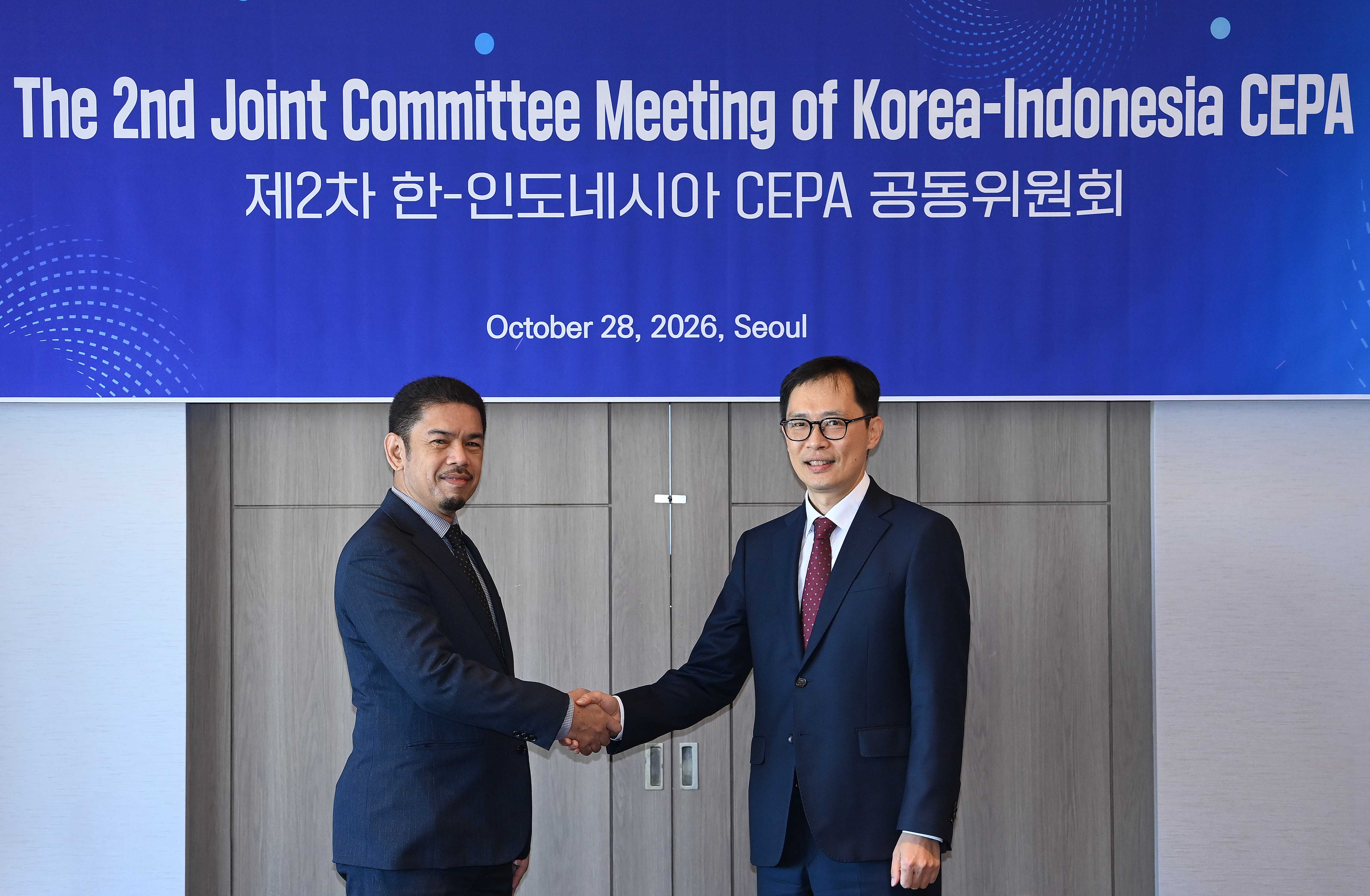
The Ministry of Trade, Industry and Resources (MOTIR, Minister JK Kim) held the second meeting of the Joint Committee under the Korea–Indonesia Comprehensive Economic Partnership Agreement (CEPA) in Seoul on October 28, 2026. The Korean delegation was led by Park Keun-oh, Director General for Trade Agreement Policy at MOTIR, and the Indonesian delegation by Johni Martha, Director General of International Trade Negotiations at Indonesia’s Ministry of Trade. The Korea–Indonesia CEPA entered into force in 2023 and is now in its fourth year of implementation. The Joint Committee first met in December 2023. This meeting, the first in three years, followed up on an agreement reached in the joint statement issued at the bilateral summit in April 2026. In the statement, the two countries agreed to hold regular Joint Committee meetings to ensure effective implementation of the CEPA and encourage businesses to make greater use of it. The two sides discussed key issues in implementing the CEPA, including progress in reviewing import approvals for Indonesian poultry meat products and Korean dairy products. They also reviewed progress in implementing the electronic system for exchanging certificates of origin and explored ways to cooperate to encourage businesses to make greater use of the agreement. Both sides agreed to maintain communication and cooperation on implementation and promote greater use of the CEPA to further develop bilateral trade and economic ties. date2026-10-28
-
Industry
Connecting Global Biotech: From Collaboration to Commercialization
The Ministry of Trade, Industry and Resources (MOTIR, Minister JK Kim) announced that BIOPLUS-INTERPHEX KOREA 2026 (BIX) will be held at COEX in Seoul from October 28 to 30, 2026. The event is hosted by the Korea Biotechnology Industry Organization (KoreaBIO, President Christopher Hansung Ko). BIX, a leading biotech event in Korea, will bring together around 300 companies this year under the theme “Connecting the Global Biopharma Value Chain.” Through exhibitions, conferences, business partnering, Open Stage presentations, and networking programs, participants will exchange information on technological and market trends across the biopharmaceutical industry, from research and development to manufacturing. They will also explore opportunities for cooperation between Korean and international companies. More than 30 conference sessions featuring presentations by over 90 experts from Korea and abroad will examine the latest technologies and business strategies in biotech. In particular, the sessions will cover key industry issues, including artificial intelligence (AI)-based drug discovery and development, next-generation therapeutic technologies, global investment and mergers and acquisitions (M&A), entry into overseas markets, and regulatory trends. Participants will also discuss international cooperation to link research and development with commercialization and production. This year’s BIX will be the largest to date, with major Korean biotech companies, including Samsung Biologics, Samsung Bioepis, Hanmi Pharmaceutical, and Binex, participating. The event will also draw many global suppliers of biopharmaceutical materials, components, and equipment, as well as contract development and manufacturing organizations (CDMOs), including Lonza, Sartorius, Thermo Fisher, and Merck. In particular, visitors to this year’s AI Bio M.AX Pavilion can explore technologies that integrate AI into biotechnology, as well as key materials, components, and equipment for the biotechnology industry. In his congratulatory remarks at the BIX opening ceremony, Lee Min-woo, Deputy Minister for Industry and Growth at MOTIR, said Korea has the world’s largest biopharmaceutical manufacturing capacity and is expanding its presence in global markets. He expressed hope that BIX would move beyond information sharing and exchanges and serve as a starting point for open innovation. date2026-10-28
-
FTA/Economic Cooperation
Second Meeting of the Korea-Indonesia CEPA Joint Committee
Park Keun-oh, Director General for Trade Agreement Policy at the Ministry of Trade, Industry and Resources (MOTIR, Minister JK Kim), led the Korean government delegation at the second meeting of the Joint Committee under the Korea-Indonesia Comprehensive Economic Partnership Agreement (CEPA). The meeting was held in Seoul on October 28, 2026. The Indonesian government delegation was led by Johni Martha, Director General of International Trade Negotiations at Indonesia’s Ministry of Trade. Director General Park delivered opening remarks. The two sides discussed key issues in implementing the CEPA, including the status of reviews on whether to allow imports of Indonesian poultry products and Korean dairy products. They also reviewed progress in implementing the electronic system for exchanging certificates of origin and explored cooperation to encourage businesses to make greater use of the agreement. date2026-10-28