-
Energy
Good-Price Gas Station Site Visit and Roundtable
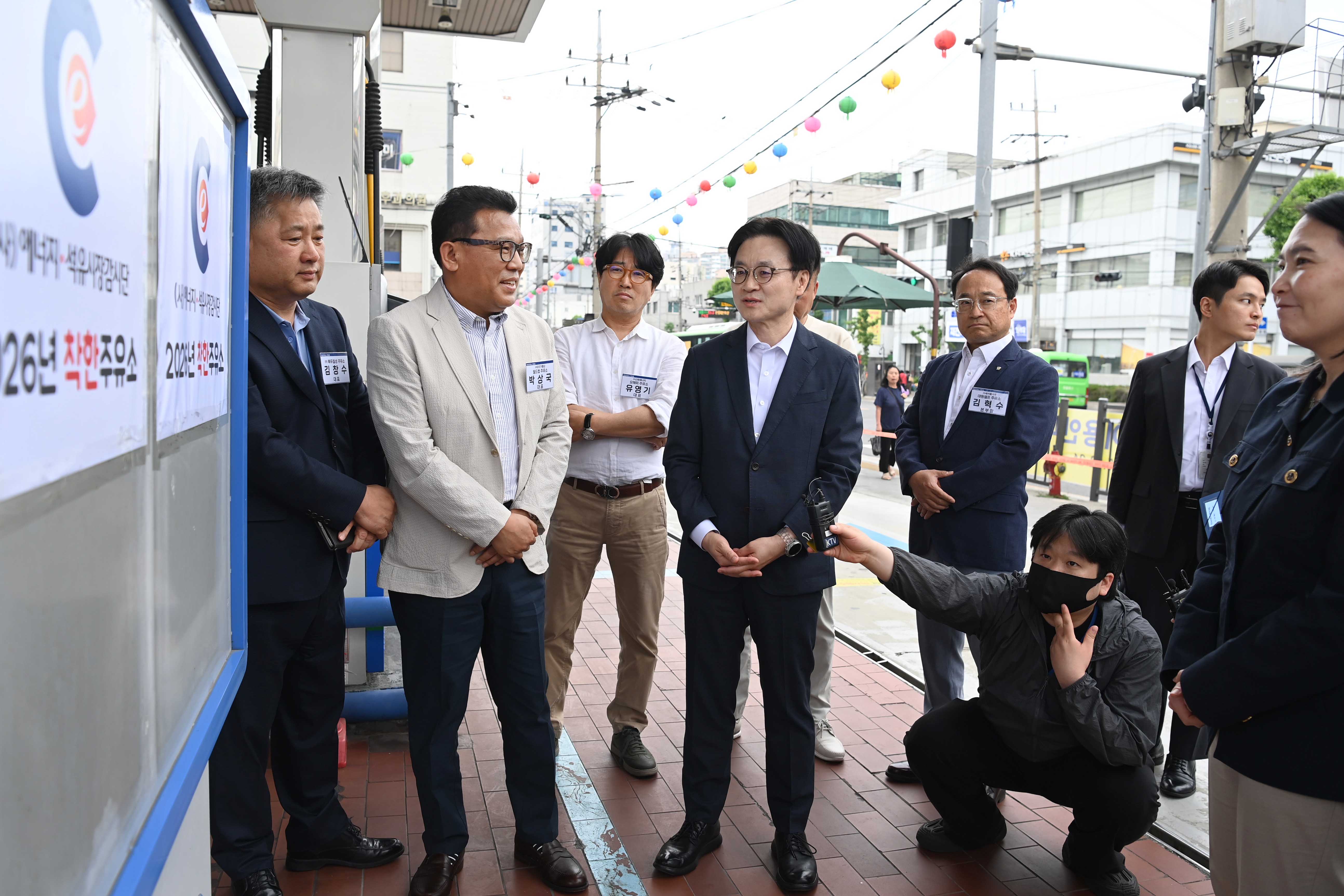
Minister JK (Jung-Kwan) Kim of the Ministry of Trade, Industry and Resources (MOTIR) visited Daewon Self-Service Gas Station, a designated Good-Price Gas Station in Guro-gu, Seoul, on May 19, 2026, and held a roundtable with operators of selected stations. Minister Kim recognized their role in stabilizing fuel prices and took note of concerns over the maximum price system for petroleum products. The roundtable was attended by representatives of Daewon Self-Service Gas Station, Tiger Trading World Cup Gas Station, Bukduchilseong Gas Station, Shinhwa Energy O Happy Gas Station and Gwanghwal Nonghyup Gas Station, among others. “Domestic fuel prices have remained stable largely thanks to the efforts of gas stations on the ground,” Minister Kim said, expressing appreciation to Good-Price Gas Stations and other operators and calling for joint efforts to navigate Middle East-related challenges. date2026-05-19
-
Energy
Minister JK Kim Visits Good-Price Gas Stations, Recognizes Efforts to Stabilize Prices
Minister JK (Jung-Kwan) Kim of the Ministry of Trade, Industry and Resources (MOTIR) visited Daewon Self-Service Gas Station, a designated Good-Price Gas Station in Guro-gu, Seoul, on May 19, 2026. He met with operators of selected stations, recognized their role in stabilizing fuel prices as Middle East-driven oil market volatility puts growing pressure on domestic prices, and took note of concerns raised by the operators over the maximum price system for petroleum products. Good-Price Gas Stations are recognized by Energy Consumer (E Consumer), a civic watchdog group that monitors energy and petroleum markets, for their contribution to fuel price stability following the March 13 launch of the maximum price system for petroleum products. The group designates stations every two weeks, selecting 10 in Seoul and Gyeonggi Province and five per region elsewhere. The 334 stations selected across four rounds sell fuel at about KRW 14 to 15 per liter below the national average, while the 24 stations selected at least twice sell at about KRW 19 to 21 less per liter. To encourage price-stabilization efforts by gas stations, MOTIR is stepping up public outreach and incentives for the Good-Price Gas Station initiative. A dedicated banner has been added to Opinet, the fuel price information service run by the Korea National Oil Corporation (KNOC), and users can now find nearby Good-Price Gas Stations on major navigation platforms, including TMAP, Naver Map and KakaoMap. Two stations have already been selected three times. Stations selected five times will be designated as “Exemplary Good-Price Gas Stations” and receive incentives, including dedicated online and offline marks and government awards. The maximum price system for petroleum products, together with E Consumer’s selection of Good-Price Gas Stations, has helped keep nationwide average pump prices stable, at around KRW 2,011 per liter for gasoline and KRW 2,006 for diesel. According to the Ministry of Finance and Economy (MOFE), the system eased upward pressure on consumer prices by 0.6 percentage point in March and 1.2 percentage points in April. In March, energy prices across the OECD rose 8.1 percent on average, while Korea's rose only 5.2 percent.. Diesel prices, which directly affect truck drivers and other transport workers, rose 26 percent in Korea from pre-conflict levels, lower than the increases of 44 percent in the United States and 37 percent in the United Kingdom. “Domestic fuel prices have remained stable largely thanks to the efforts of gas stations on the ground,” Minister Kim said. “I extend my sincere appreciation to Good-Price Gas Stations and other gas station operators, and hope the government, businesses and the public will work together to navigate the Middle East-related challenges.” He added, “I also hope the conflict in the Middle East ends as soon as possible and markets return to normal.” date2026-05-19
-
Energy
Anchor Firms and Partner Companies Team Up to Build Low-Carbon Industrial Supply Chains
The Ministry of Trade, Industry and Resources (MOTIR, Minister JK Kim) held a meeting at the Korea Chamber of Commerce and Industry (KCCI) on May 19, 2026, with consortia selected for MOTIR’s 2026 industrial supply chain carbon partnership program. As global carbon regulations increasingly target supply chains, green transformation (GX) has become critical to manufacturing competitiveness. Through the program, MOTIR will work with the lead companies of the eight consortia to help 31 partner SMEs and middle-market companies reduce emissions. Under the program, the government will cover up to 50 to 60 percent of partner companies’ costs for installing carbon-reduction equipment. It will also support consulting on emissions-reduction and product carbon footprint calculations, as well as third-party verification. Lead companies will provide cash support, help cover the required private-sector cost share through tools such as interest-free loans and interest subsidies, cover operating and management costs, and offer consulting and training to strengthen partner capabilities. The selected consortia can be grouped into four models. Hyundai Motor and Kia will use a cascading support structure, in which first-tier partner companies receive cash support and then pass support on to second-tier partner companies. Samsung Electronics, Samsung Display, LG Electronics, HL Mando and SK hynix will use overlapping partner-company networks to spread emissions-reduction results across supply chains. HD Korea Shipbuilding & Offshore Engineering will support partner companies’ operating and management costs and convert their emissions-reduction results into external projects for further use. POSCO will provide personnel and technology to help SME and middle-market customers improve process efficiency. Participating companies aim to cut greenhouse gas emissions by about 20,000 tons per year, encourage voluntary reductions throughout their supply chains, and identify and share best practices in win-win cooperation. The initiative will also help them respond promptly to tightening global carbon rules, including the EU Carbon Border Adjustment Mechanism (CBAM) and Battery Regulation, meet Science Based Targets initiative (SBTi) targets, address global customers’ supply-chain emissions requirements, secure product carbon footprint (PCF) data, and strengthen export competitiveness. “Carbon neutrality and industrial competitiveness are complementary goals that will shape the future of industry,” said Lee Min-woo, Director General for Industrial Policy at MOTIR. “Today’s supply-chain cooperation will help these industries maintain global leadership. The government and companies of all sizes should work together to navigate tightening global carbon rules and identify and scale successful green transformation models that support shared growth.” date2026-05-19
-
Trade/Investment
Industrial Growth Fund Launch Ceremony and Industrial Finance Strategy Meeting
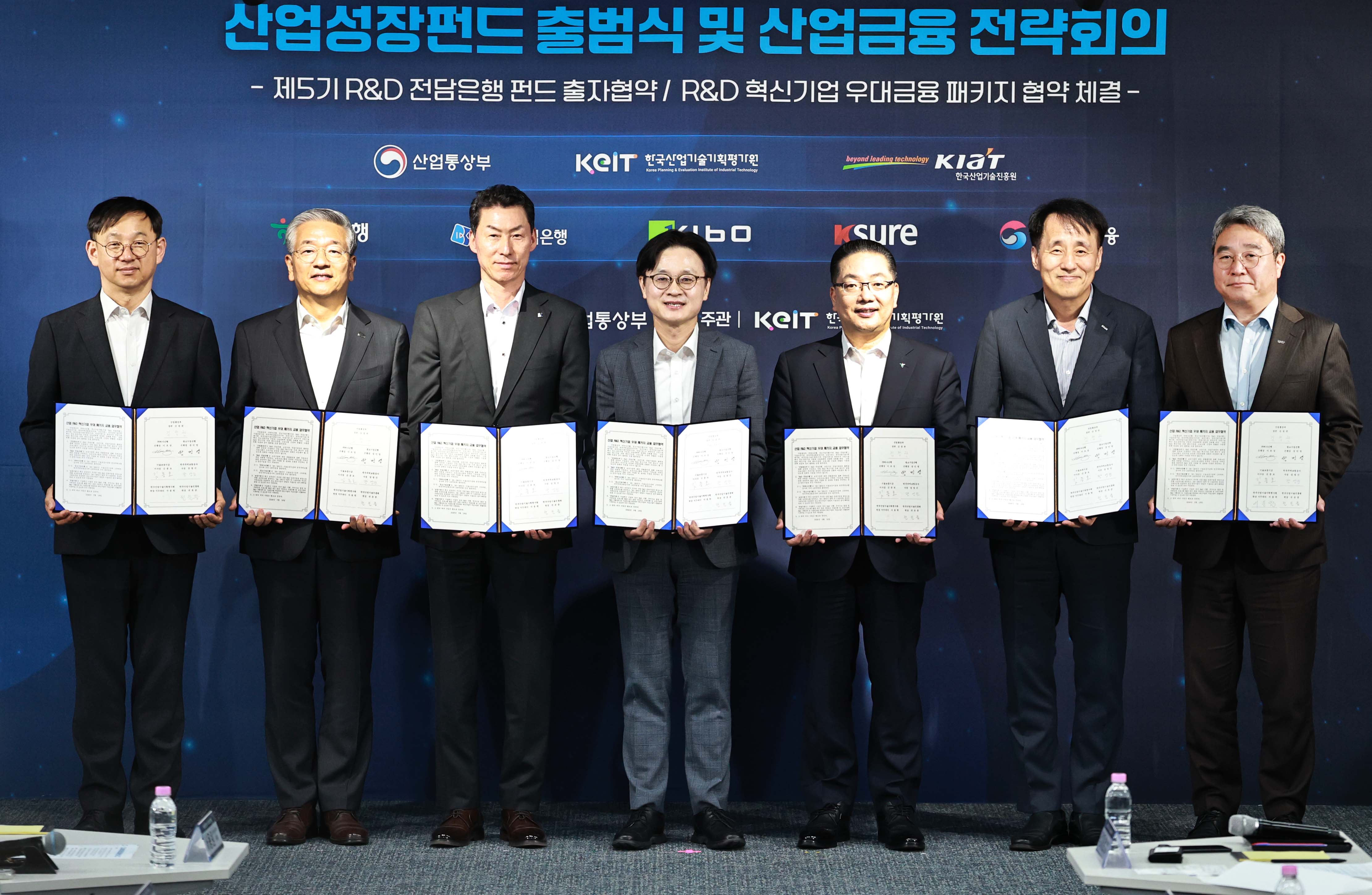
Minister JK (Jung-Kwan) Kim of the Ministry of Trade, Industry and Resources (MOTIR) chaired the Industrial Growth Fund Launch Ceremony and Industrial Finance Strategy Meeting at Korea Growth Investment Corporation in Yeouido, Seoul, on May 18, 2026. At the event, relevant institutions signed agreements to launch the third phase of the Industrial Growth Fund and establish a preferential financing package for R&D-driven innovative companies. The event brought together financial institutions, companies, venture capital firms and R&D institutions, including Hana Bank, Industrial Bank of Korea (IBK), Korea Technology Finance Corporation (KOTEC), Korea Growth Investment Corporation, TESOLLO INC., FRT Robotics., KOLON INVESTMENT, Enlight Ventures, Korea Trade Insurance Corporation (K-SURE), and Korea Planning & Evaluation Institute of Industrial Technology (KEIT). “Investment in innovative companies is a shared commitment by finance, industry and the government to move in the same direction and share both risks and outcomes,” Minister Kim said. “Expanded industrial finance will help Korea advance AI-manufacturing convergence and shared growth with regional economies.” date2026-05-18
-
FTA/Economic Cooperation
Meeting with the ASEAN Committee in Seoul
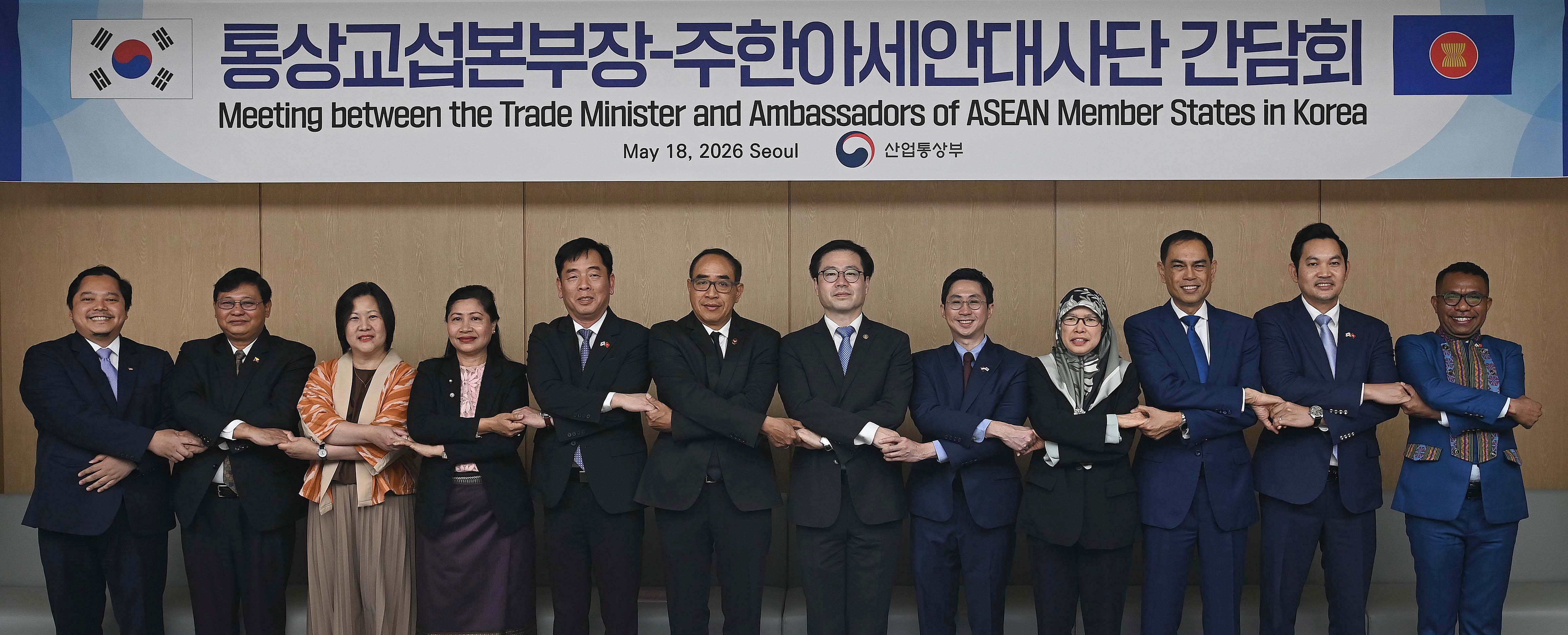
Trade Minister Yeo Han-koo of the Ministry of Trade, Industry and Resources (MOTIR, Minister JK Kim) attended a meeting with the ASEAN Committee in Seoul (ACS) at the Korea Chamber of Commerce and Industry (KCCI) in Seoul on May 18, 2026. The meeting was attended by ambassadors to Korea from ASEAN’s 11 member states, including Thailand, Cambodia, Indonesia and Laos. Participants exchanged views on practical cooperation in areas such as trade expansion, the Korea–ASEAN Free Trade Agreement (FTA) upgrade and supply chain cooperation. “ASEAN is one of Korea’s key economic and trade partners, and Korea will work to deliver substantive outcomes by 2027 through the Korea–ASEAN FTA upgrade, including new digital provisions, and stronger supply chain cooperation,” Trade Minister Yeo said. date2026-05-18
-
Energy
Korea Secures ISO Approval to Start Work on Standard for Decommissioning Nuclear Power Plants
The Korean Agency for Technology and Standards (KATS, President Kim Dae-ja) of the Ministry of Trade, Industry and Resources (MOTIR, Minister JK Kim) announced that Korea’s proposal to develop the world’s first international standard for decommissioning nuclear power plants, which was submitted in June 2023, has been approved by the International Organization for Standardization (ISO) as a new work item proposal (NP). After nearly three years of discussions by ISO Technical Committee 85 (TC 85, Nuclear energy, nuclear technologies and radiological protection), it received support from nine ISO member countries, including the United States, China and Japan. The approved proposal sets out general requirements for the decommissioning process, from basic terminology to planning, implementation and management, with Korea leading development of the standard as project leader. The draft will enter the member-country comment phase on May 19, 2026, with publication as an International Standard (IS) targeted for December 2027. KATS also plans to develop nine additional international standards in stages, covering specific technologies required for decommissioning. These will include nuclear power plant decommissioning planning, radioactive waste management, facility characterization, safety assessment, decommissioning work management, decontamination and dismantling, radiation protection and monitoring, application of clearance criteria, and site restoration. IAEA experts will also participate in the standardization process to improve alignment with international nuclear safety standards. KATS expects the Korea-led standards to serve as practical reference points for the global nuclear power plant decommissioning industry and help strengthen the competitiveness of Korean companies in overseas markets. “On nuclear power plant construction and operation, Korea has largely followed international standards,” said KATS President Kim Dae-ja. “This proposal marks a meaningful step, as Korea is now in a position to lead international standardization in decommissioning. To support the export competitiveness of K-nuclear power, we will also lead the development of de facto standards through organizations such as the American Society of Mechanical Engineers (ASME), alongside our work at ISO.” date2026-05-18
-
Trade/Investment
Strong Industrial Finance to Support Innovative Companies and Industrial Ecosystems
The Ministry of Trade, Industry and Resources (MOTIR, Minister JK Kim) will launch a range of industrial finance programs, including investments, guarantees, and loans, to support technology development, commercialization, and growth by innovative companies and strengthen Korea’s industrial ecosystems. On May 18, 2026, MOTIR held the Industrial Growth Fund Launch Ceremony and the Industrial Finance Strategy Meeting, chaired by Minister Kim. At the event, relevant institutions signed agreements to launch the third phase of the Industrial Growth Fund and establish a preferential financing package for R&D-driven innovative companies. The Industrial Growth Fund will be created through anchor investments from MOTIR’s R&D partner banks and additional private capital. For its third phase from 2026 to 2028, Hana Bank and Industrial Bank of Korea have committed a record KRW 1.1 trillion in anchor investments. MOTIR plans to realign the fund’s investment focus with major industrial policy priorities, including manufacturing AI transformation (M.AX), balanced regional development, and new growth engines, while expanding its role as a platform for cooperation across industrial ecosystems. The first sub-fund will be the M.AX Industrial Transformation Innovation Fund, which will invest in companies pursuing the convergence of manufacturing and AI in areas such as humanoids, AI factories, future mobility, and autonomous ships. Based on KRW 100 billion in anchor investments, the fund aims to scale up to KRW 500 billion through private matching and other investments, with a call for fund managers scheduled for June. MOTIR will also launch regional industry vitality funds and sector-specific ecosystem funds in phases. A preferential financing package will also be made available to R&D-driven innovative companies over the next three years. Hana Bank and Industrial Bank of Korea will contribute a combined KRW 47 billion to the Korea Technology Finance Corporation (KOTEC) and Korea Trade Insurance Corporation (K-SURE), which will use the funds to provide approximately KRW 700 billion in guarantees and insurance to SMEs and middle-market companies, while companies receiving guarantees will also be eligible for low-interest loans. The package will be offered through KOTEC and K-SURE programs, with support scheduled to begin in July after the relevant institutions finalize detailed agreements. The preferential financing for R&D-driven innovative companies will be offered through two programs: (1) the 'Project-based R&D Commercialization Guarantee' by KOTEC and (2) the 'Export-Import Trade Finance for R&D Innovative Companies' by K-SURE. First, the 'Project-based R&D Commercialization Guarantee' evaluates the market potential of individual R&D projects and provides loan guarantees for the funds needed to commercialize the technology. Second, the 'Export-Import Trade Finance for R&D Innovative Companies' allows companies seeking to export or expand overseas based on MOTIR R&D outcomes to secure loans for manufacturing costs and the importation of raw and subsidiary materials. These two programs are scheduled to launch in July once the relevant institutions finalize detailed agreements. The government also plans to actively promote and provide guidance on these programs so that eligible companies can easily utilize them. At the strategy meeting, companies shared how fund investments had supported key stages of growth, including technology development, business expansion, and preparations for initial public offerings. They also called for broader support to help companies cross the “valley of death.” Investment firms emphasized that industrial finance should help share risk and provide direction for growth-stage companies, while financial institutions reaffirmed their commitment to supporting the real economy and date2026-05-18
-
FTA/Economic Cooperation
Korea and ASEAN Discuss Ways to Deepen Economic and Trade Cooperation
Yeo Han-koo, Minister for Trade at the Ministry of Trade, Industry and Resources (MOTIR, Minister JK Kim) held talks with the ASEAN Committee in Seoul (ACS) at the Korea Chamber of Commerce and Industry (KCCI) on May 18, 2026, to discuss ways to deepen economic and trade cooperation between Korea and ASEAN. The meeting focused on practical ways to expand trade with ASEAN, Korea’s second-largest trading partner, upgrade the Korea–ASEAN Free Trade Agreement (FTA) and strengthen supply chain cooperation. The talks also reaffirmed the need for closer communication and coordination between the two sides as external uncertainties grow, including instability in the Middle East. Both sides first discussed ways to expand trade. They noted that ASEAN is one of Korea’s key economic and trade partners and a fast-growing market, and agreed to broaden two-way trade into more diverse sectors. They also reviewed negotiations to upgrade the Korea–ASEAN FTA. Since taking effect in 2007, the agreement has underpinned growth in two-way trade and investment. Minister Yeo said the FTA should reflect recent shifts in the global trade environment and be modernized with a broader framework, including digital provisions that were not part of the original agreement. He added that Korea will work to deliver substantive outcomes by 2027, which will mark ASEAN’s 60th anniversary, the 20th anniversary of the FTA’s entry into force and the 30th anniversary of Korea–ASEAN summit meetings. They also exchanged views on risks to global supply chains stemming from recent developments in the Middle East. Recognizing that Korea and ASEAN are linked as both suppliers and markets for each other, not through a one-way trade relationship, they agreed to keep strengthening supply chain cooperation in times of crisis. The Korean government will continue working with ASEAN, Korea’s key economic cooperation partner, to deliver practical outcomes in trade expansion, the Korea–ASEAN FTA upgrade and supply chain cooperation. date2026-05-18
-
Industry
KATS Certifies 28 New Technologies and Products to Drive Innovative Growth
The Korean Agency for Technology and Standards (KATS, Administrator Kim Daeja) under the Ministry of Trade, Industry and Resources (MOTIR, Minister JK Kim) will certify 28 new technologies and products on May 18, 2026, as future drivers of Korea’s innovation-led growth. They were selected from 411 technologies and products after a rigorous review, with competition reaching about 15 to 1. New Excellent Technology (NET) and New Excellent Product (NEP) certifications are granted to technologies first developed in Korea or technologies that significantly improve existing ones, as well as to commercialized products built around such technologies. Certified technologies and products receive public procurement support, including mandatory purchasing by public institutions and priority purchasing of technology-developed products. They also qualify for benefits such as preferential access to SME policy loans and additional points in government program applications, helping technology-driven SMEs grow through procurement, financing, and other support. For NET certification, KATS received applications for 170 technologies and selected 12 outstanding technologies across five fields: electrical and electronics, information and communications, nuclear power and renewable energy, chemistry and life sciences, and construction and environment. In the nuclear power and renewable energy field, KATS selected a passive hydrogen recirculation ejector for fuel cells that uses the Coandă effect. The technology supplies and recirculates hydrogen without additional power, improving fuel cell efficiency and reducing maintenance costs. It is expected to help localize key fuel cell components. For NEP certification, KATS received applications for 241 products and certified 16 across five fields: electrical and electronics, information and communications, machinery and materials, chemistry and life sciences, and construction and environment. One notable product is the Magbot robot automatic tool changer, which uses switching magnetic technology. It allows a single robot to change tools on its own and perform various processes. By consuming electricity only when tools are attached or detached, the product maximizes efficiency and is expected to support manufacturing automation and expand into construction, medical services, and other industries. “The newly certified technologies and products are expected to become tangible growth drivers for the Korean economy,” KATS Administrator Kim Daeja said. “The government will continue to expand support, including priority purchasing by public institutions and overseas expansion programs, to help these companies grow into global unicorns.” date2026-05-18
-
Trade/Investment
ICT Exports Reach $42.7 Billion in April, Post Highest Year-on-Year Growth Rate Record
The Ministry of Trade, Industry and Resources (MOTIR, Minister JK Kim) and the Ministry of Science and ICT (MSIT, Deputy Prime Minister and Minister Bae Kyung-hoon) announced on May 15, 2026, that Korea’s ICT exports in April reached USD 42.7 billion, up 125.9 percent year-on-year from $18.9 billion. Imports rose 33.3 percent from $12.1 billion to $16.2 billion, resulting in a trade surplus of $26.6 billion. In April 2026, ICT exports topped $40.0 billion for a second straight month for the first time and posted the highest year-on-year growth rate on record, despite the conflict in the Middle East. The ICT trade surplus also topped $20.0 billion for a third consecutive month for the first time. ICT products accounted for nearly half, or 49.7 percent, of Korea’s total exports, which stood at $85.9 billion, reinforcing ICT’s role as a key driver of Korea’s exports. By product, exports increased for semiconductors (up 173.3 percent), mobile phones (up 14.0 percent), computers and peripherals (up 430.0 percent), and communication equipment (up 9.9 percent), but decreased for displays (down 5.3 percent). Semiconductor exports stayed above $30.0 billion for a second straight month for the first time, supported by rising memory contract prices as demand continued to exceed supply amid continued investment in AI servers and other server infrastructure. Mobile phone exports increased on higher shipments of finished products and solid sales of high-value parts, including camera modules. Computers and peripherals posted an all-time high, supported by higher demand and prices for solid-state drives (SSDs) used in AI servers. Communication equipment exports returned to growth for the first time in three months on solid demand for components shipped to Vietnam and wired communications equipment shipped to Japan. By contrast, display exports declined as higher semiconductor prices weighed on downstream demand. By destination, exports increased in all major markets: the United States (up 294.2 percent), China, including Hong Kong (up 132.1 percent), the European Union (up 58.4 percent), Taiwan (up 89.4 percent), Vietnam (up 89.3 percent), India (up 86.5 percent), and Japan (up 42.5 percent). ICT imports totaled $16.2 billion in April 2026, up 33.3 percent from $12.1 billion a year earlier, as imports increased across most major ICT categories: semiconductors (up 53.2 percent), displays (up 15.1 percent), mobile phones including parts (up 10.6 percent), and computers and peripherals (up 27.0 percent). date2026-05-15