-
FTA/Economic Cooperation
Meeting with Piyush Goyal, Minister of Commerce and Industry of India
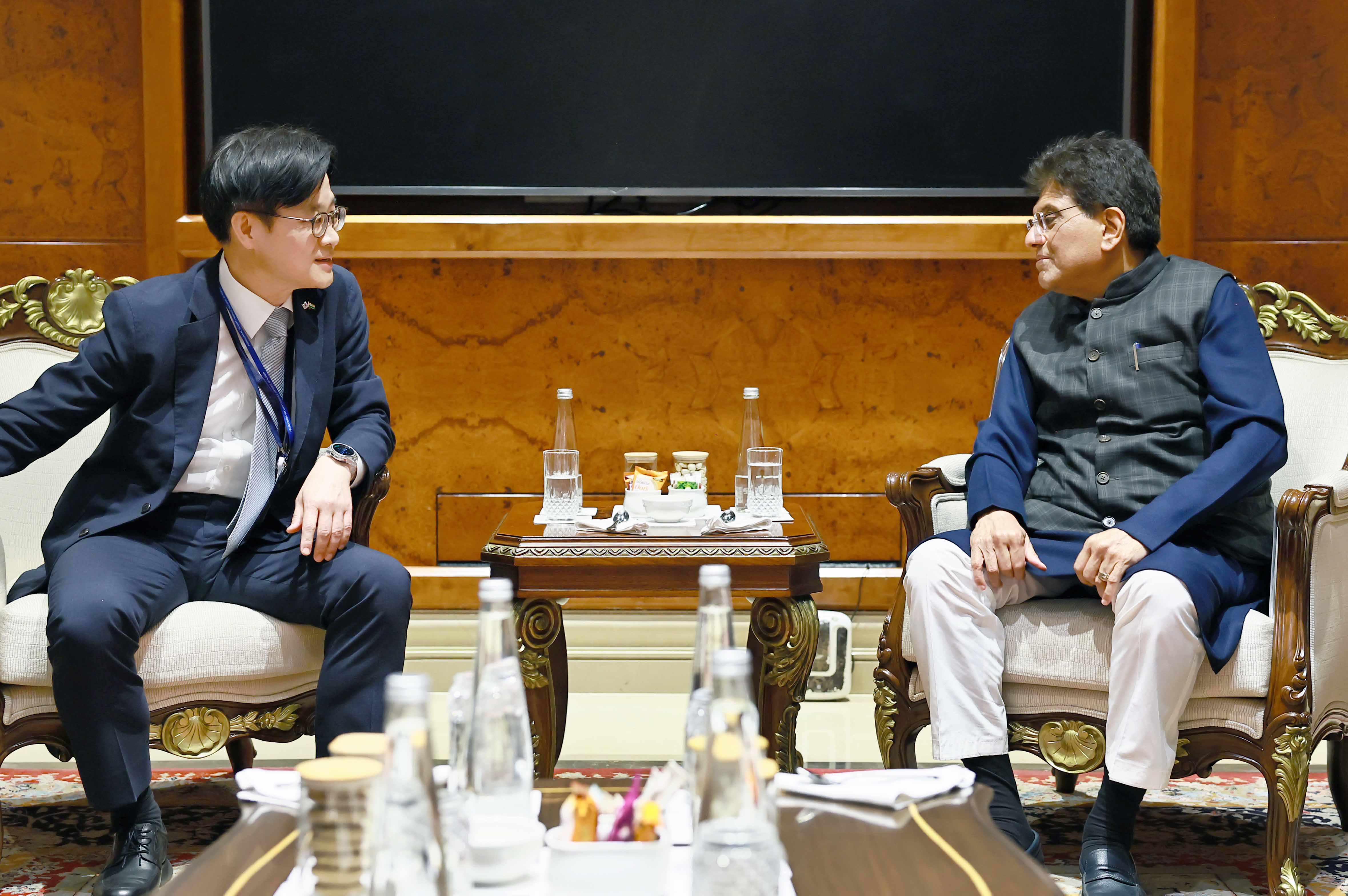
Minister JK (Jung-Kwan) Kim of the Ministry of Trade, Industry and Resources (MOTIR) met with Piyush Goyal, Minister of Commerce and Industry of India, on April 20, 2026, at Bharat Mandapam Convention Centre in New Delhi, on the occasion of President Lee Jae Myung’s state visit to India. During the meeting, the two ministers discussed follow-up measures to the Korea–India summit, including the Korea–India Industrial Cooperation Committee, and exchanged views on ways to expand industrial cooperation between the two countries. Minister Kim said the Korean government would provide the institutional support needed to give Korea–India economic cooperation fresh momentum and create more business opportunities for companies in both countries. date2026-04-24
-
FTA/Economic Cooperation
Korea and Poland Discuss Strengthening Supply Chain and Advanced Industry Cooperation
Deputy Minister for Trade Park Jung Sung of the Ministry of Trade, Industry and Resources (MOTIR, Minister JK Kim) met with Michał Jaros, Secretary of State at Poland’s Ministry of Economic Development and Technology, in Seoul on April 24, 2026, to discuss stronger Korea–Poland economic cooperation, with a focus on supply chains and advanced industries. The meeting took place shortly after the recent summit between the two countries and helped carry forward the momentum in bilateral relations built on the summit’s outcomes. Korea and Poland noted that bilateral trade and investment have grown steadily. Poland is one of Korea’s key trading partners in the European Union and the largest destination for Korean investment among the Visegrád Four, which also includes Hungary, Czechia and Slovakia. The two sides agreed to build on the industrial cooperation created by large-scale Korean battery investments, and work together to expand trade and achieve a more balanced trade structure. Korea emphasized that energy storage systems (ESS) are directly linked to energy security, and asked the Polish side to make greater use of batteries produced locally by Korean companies for ESS projects. MOTIR also requested Poland to consider making the battery industry eligible for support under its law on support for energy-intensive industries. Regarding the EU Battery Regulation, the ministry requested Poland’s continued support for predictable and reasonable implementing rules. As EU-level legislative discussions on the Industrial Accelerator Act (IAA) continue, the Korean government welcomed the principle of equal treatment for products from FTA partner countries. Korea also requested Poland’s cooperation to help ensure that the system is applied clearly and consistently at the EU level and that Korea’s views are taken into account. Korea and Poland also agreed that coordination is becoming more important as shifting global supply chains, intensifying strategic competition, and the energy transition bring economic and security issues more closely together. They noted that stable supply chains, technology cooperation and policy coordination will be increasingly important in strategic industries such as critical minerals, batteries and defense. “Korea and Poland have built a stable foundation for cooperation based on mutual trust,” Deputy Minister Park said. “We hope to continue expanding practical cooperation not only in strategic industries such as batteries, but also in supply chain stability and advanced technologies.” MOTIR will continue to strengthen cooperation with the Polish government to deliver concrete outcomes in key areas including supply chains, the energy transition and advanced industries. date2026-04-24
-
Industry
MOTIR Reviews Technology and Infrastructure Roadmap for Next-Generation Power Semiconductor Industry
The Ministry of Trade, Industry and Resources (MOTIR, Minister JK Kim) held the Next-Generation Power Semiconductor Forum at EL Tower on April 23, 2026, with officials from relevant ministries and experts from industry, academia and research institutes. At the forum, MOTIR presented progress on the Roadmap for Developing the Next-Generation Power Semiconductor Industry, a key implementation task under the Semiconductor Industry Strategy for the AI Era announced in December 2025. The roadmap has been under development for about four months since the task force was launched. The forum also brought together anchor companies and experts to discuss future directions for large-scale R&D projects and plans for a power semiconductor innovation belt in Korea’s southern region. The roadmap sets out a medium- to long-term blueprint for securing core technologies and stabilizing supply chains in the power semiconductor industry. It covers next-generation technology development, demonstration and mass-production infrastructure, and workforce training. Moving beyond fragmented support, MOTIR is planning large-scale R&D projects that will connect demand companies in electric vehicles, defense, power grids and data centers across the full value chain, from materials, devices and modules to system-level demonstration. MOTIR will also build power semiconductor infrastructure around key regional hubs. It will upgrade the public fab at the specialized power semiconductor complex in Busan and help private companies use demonstration data from public facilities in Pohang and Naju for product mass production. Furthermore, the ministry will link regional hub universities and use local demonstration facilities for hands-on training, helping train key talent for the power semiconductor innovation belt in Korea’s southern region and support growth in both the region and the industry. Choi Woo-hyuk, Director General for High Technology Industry at MOTIR, said, “As the restructuring of global power semiconductor supply chains accelerates, MOTIR will give priority to compound semiconductors as a key development area. Together with relevant ministries, we will build an ecosystem for the power semiconductor industry, centered on the power semiconductor innovation belt in Korea’s southern region.” date2026-04-23
-
FTA/Economic Cooperation
Korea and Vietnam Step Up Economic Cooperation in Nuclear Energy and Resource Security
The Ministry of Trade, Industry and Resources (MOTIR, Minister JK Kim) announced that Korea Electric Power Corporation (KEPCO) and the Vietnam National Industry- Energy Group (Petrovietnam, PVN) signed an MOU on potential cooperation in new nuclear power development on April 22, 2026, during President Lee Jae Myung’s state visit to Vietnam. The agreement was exchanged at a ceremony witnessed by the two leaders. The MOU creates a basis for the entry of Korean-designed nuclear power plants into Vietnam. The two companies began formal nuclear cooperation in August 2025, when they signed an MOU on workforce development in the nuclear sector during General Secretary To Lam’s visit to Korea. The latest agreement expands that cooperation to new-build nuclear projects. Going forward, KEPCO and PVN will work together on the nuclear supply chain and project viability analysis for the Ninh Thuan 2 nuclear power project. Ahead of the summit, Minister JK Kim held an official meeting with Vietnam’s newly appointed Minister of Industry and Trade Le Manh Hung. They discussed cooperation on the Ninh Thuan 2 nuclear power project and agreed to stay closely coordinated on resource security and to build a cooperation framework for supply chains for rare earths and other critical minerals. At a separate roundtable earlier that morning with Korean nuclear and energy companies operating in Vietnam, companies raised two main issues: improving the institutional framework for LNG project financing and securing rare earth supplies. Minister Kim asked for Vietnam’s interest and cooperation in addressing those concerns. He also requested support to allow more Korean companies to participate in the construction of Vietnam’s crude oil storage facilities. The two sides also agreed to hold the 15th Korea–Vietnam Joint Committee on Industry and the 9th Joint Committee on the Korea–Vietnam FTA in Seoul in the first half of 2026. MOTIR and Vietnam’s Ministry of Industry and Trade are scheduled to sign an MOU on export control cooperation in Hanoi on April 23, 2026. Vietnam introduced an export licensing regime for strategic items in October 2025, which has been of particular interest to Korean companies operating there. The MOU will establish a regular communication channel between the two countries’ export control authorities and facilitate prior information-sharing on new control measures. This is expected to reduce uncertainty for Korean companies in Vietnam and help stabilize supply chains in advanced industries. MOTIR will continue to strengthen economic ties with Vietnam, Korea’s third-largest partner in trade and investment and a key manufacturing base for Korean exports, while supporting business activity in both countries. date2026-04-23
-
FTA/Economic Cooperation
Korea Secures Record $82 Million in Export Deals with Vietnam, ASEAN’s Economic Engine
The Ministry of Trade, Industry and Resources (MOTIR, Minister JK Kim) and the Korea Trade-Investment Promotion Agency (KOTRA, President Kang Kyung-sung) held the Korea–Vietnam Business Partnership event at the National Convention Center (NCC) in Hanoi on April 23, 2026, on the occasion of President Lee Jae Myung’s state visit to Vietnam. The event was organized to support Korean small and medium-sized enterprises and middle-market companies entering the Vietnamese market, while broadening bilateral cooperation beyond manufacturing into advanced sectors such as bio and defense. It brought together more than 100 Korean companies and over 200 Vietnamese buyers across AI and semiconductors, bio and healthcare, content and consumer goods, and energy and environment. Participating companies signed 24 export deals worth approximately USD 82 million, the largest result since the Business Partnership program began in 2015. At the venue, Minister JK Kim visited the K-Lifestyle Showcase and the business support consultation center to encourage participating Korean companies. He noted that Vietnam is Korea’s third-largest trading partner and a key partner in supply chain cooperation, adding that the government would continue to support Korean companies in creating new business opportunities in Vietnam. The Korea–Vietnam Business Forum, jointly hosted by MOTIR and the Korea Chamber of Commerce and Industry (KCCI, Chairman Chey Tae-won), was also held later that day at the JW Marriott Hotel, with President Lee Jae Myung and Vietnamese Prime Minister Le Minh Hung in attendance. A total of 74 MOUs were exchanged at the forum across sectors including nuclear power, advanced industries and infrastructure. Doosan Enerbility signed an MOU with Vietnam’s PETROCONS on nuclear localization cooperation, establishing a basis for the introduction of nuclear power energy in Vietnam. Korea Electric Power Corporation (KEPCO) also revised its MOU with Vietnam Electricity (EVN) on power infrastructure cooperation to expand joint efforts on energy infrastructure development. In advanced industries, POSCO Future M received an Investment Registration Certificate (IRC) to build a plant for synthetic graphite anode materials, a key component of secondary batteries, in Thai Nguyen Province. Hyundai Motor Company and the Korea International Cooperation Agency (KOICA) signed an MOU with Vietnam’s Ministry of Education and Training to foster skilled workers for the automotive sector. Following the MOU signing ceremony, Samsung Electronics, SK Innovation, the Korea Institute of Science and Technology (KIST), and the Korea Institute for International Economic Policy (KIEP) discussed practical cooperation in areas such as Vietnam’s parts industry, AI and power infrastructure, science and technology, and talent development for advanced industries. MOTIR said it would continue follow-up discussions to ensure that the economic outcomes achieved during the state visit lead to tangible business opportunities for Korean companies, while maintaining close cooperation with the Vietnamese side. date2026-04-23
-
FTA/Economic Cooperation
Korea–Japan Explore Economic, Trade and Investment Cooperation Amid Complex Crisis
Trade Minister Yeo Han-koo of the Ministry of Trade, Industry and Resources (MOTIR, Minister JK Kim) attended the Korea–Japan New Economic Cooperation Seminar in the Age of Complex Crisis, jointly hosted in Tokyo on April 22, 2026, by the Korea Economic Research Institute (KERI) of the Federation of Korean Industries (FKI) and Keidanren Policy Research Institute of Japan. During the event, Trade Minister Yeo delivered a keynote address on directions for Korea–Japan cooperation to help the two countries address shared challenges. The seminar was organized to explore new directions for Korea–Japan economic cooperation amid rapid changes in the global environment. About 100 experts from both countries attended, including Chung Chul, President of KERI, and Masakazu Kubota, Vice Chair of Keidanren and Head of the Keidanren Policy Research Institute. In his keynote address, Trade Minister Yeo said Korea and Japan face a common set of challenges, including the situation in the Middle East, strategic competition between the United States and China, and demographic pressures stemming from low birth rates and aging populations. He stressed that, as like-minded middle powers, the two countries should pursue coordinated efforts in supply chains, energy and resources, AI, and trade agreements. He then held a series of meetings with Korean companies operating in Japan. With major companies including LG Electronics, SK, S-OIL and POSCO, he discussed ways to strengthen Korea–Japan cooperation in resources, supply chains, and materials, parts, and equipment amid global uncertainty. He also met with startups entering the Japanese market, including PoPoKii in retail, Doctornow in telemedicine, and Willog in digital logistics. The discussions focused on support for Korean companies expanding into Japan and related government measures in consumer goods and digital services. Trade Minister Yeo also carried out investment promotion activities targeting promising Japanese investors. As part of those efforts, MOTIR will host an investment declaration ceremony marking approximately KRW 120 billion in new commitments by Tekscend Photomask Corp., a leading global producer of photomasks for advanced semiconductor processes. Photomasks are key components in semiconductor lithography. Tekscend Photomask has been supplying 28–32nm photomasks from Icheon, Gyeonggi Province. Under the new investment, it plans to build a third plant to mass-produce advanced products for processes below 14nm. The plant is scheduled to begin mass production in 2028 and is expected to help advance Korea’s semiconductor supply chain and strengthen competitiveness in advanced processes. Trade Minister Yeo will also hold a roundtable with five Japanese companies that have continued to invest in Korea’s advanced strategic industries, including semiconductors and displays: Tekscend Photomask Corp., JSR Corporation, AGC Inc., Tokyo Electron Co., Ltd., and AlpsAlpine Co., Ltd. The roundtable will review the status of each company’s investment project and hear about difficulties on the ground. At the meeting, Trade Minister Yeo will reaffirm the Korean government’s commitment to supporting foreign-invested companies through stronger incentives and regulatory improvements amid global uncertainty. He will also highlight Korea’s competitiveness and appeal as an investment destination for advanced industries amid supply chain restructuring and call for continued investment and closer cooperation. date2026-04-22
-
Energy
Korea Provides Tailored Guidance on EU CBAM Full Implementation in 2026
The Korean government held its 11th joint briefing of 2026 on the EU Carbon Border Adjustment Mechanism (CBAM) at Trade Tower in Seoul on April 21, 2026, with the participation of the Ministry of Trade, Industry and Resources (MOTIR, Minister JK Kim), the Ministry of Climate, Energy and Environment (MCEE, Minister Kim Sung-whan), the Ministry of SMEs and Startups (MSS, Minister Han Seong-sook), and the Korea Customs Service (KCS, Commissioner Lee Myeong-ku). Some 200 executives and employees from SMEs exporting CBAM-covered products attended in person, and many other companies joined online. With the EU CBAM entering full implementation in 2026, Korean exporters have moved beyond emissions reporting to a phase in which they will begin bearing carbon costs directly. As free allocation in the EU is phased out, the number of CBAM certificates required for exports to the EU is also expected to increase. Maintaining export competitiveness will increasingly depend on accurately calculating the embedded emissions of products shipped to the EU and the applicable free-allocation benchmarks for each product category. The briefing was held to share key regulatory changes following the start of the definitive period, based on the EU CBAM implementing rules released in December 2025. The briefing provided a detailed guide tailored to the full implementation, covering an overview of the system, practical compliance measures such as examples of emissions and certificate calculations, and the latest verification trends. The government also operated on-site consulting booths for pre-registered companies and provided tailored advice on company-specific issues. Park Jung-sung, Deputy Minister for Trade at MOTIR, said, “As 2026 marks the year when CBAM begins to function as a real trade barrier, it is essential that Korean companies clearly understand the revised rules that apply under full implementation.” He added, “The government will reinforce its public-private response system by using all available policy tools, including help desk services and consulting support, so that Korean companies are not placed at a disadvantage in the EU market.” The government will continue to swiftly share regulatory updates and response guidance to help minimize the burden on Korean exporters, while consulting with the relevant EU authorities on possible improvements to the system. date2026-04-21
-
Industry
Government and Major Companies Launch K-New Deal Academy to Help Young Jobseekers Take the Next Step
The Ministry of Trade, Industry and Resources (MOTIR, Minister JK Kim), the Ministry of Employment and Labor (MOEL, Minister Kim Young-hoon), and the Korea Research Institute for Vocational Education and Training (KRIVET, President Ko Hye-won), the program’s coordinating institution, will accept applications from Wednesday, April 22 to Friday, May 22, 2026, for operations support centers and participating companies for the K-New Deal Academy. The K-New Deal Academy, introduced through the supplementary budget, is designed to help young jobseekers rebuild confidence, strengthen their skills, and enter the labor market. Under the program, major companies and other employers favored by young jobseekers will design and offer company-specific vocational training and other programs. Participating companies must be large corporations or other leading companies in their industries or regions, with competitiveness, recognition, and the capacity to run programs for young jobseekers. Companies may apply on their own or as part of a consortium. They may structure academy programs around their strengths and may offer, in addition to job training, other programs that would benefit young jobseekers. In reviewing proposals, the government will place particular weight on whether the programs are built around company-specific courses that reflect each company’s job capabilities, infrastructure, and organizational culture. The government will fund academy operating costs and provide allowances to participating young jobseekers. It also plans to provide additional support for academies open in non-metropolitan areas to encourage more young jobseekers outside the capital region to take part. Operations support centers will assist companies in running the academies and promoting the program. Eligible organizations must have the capacity to manage government-funded projects, as well as sufficient understanding and experience in vocational skills development programs. Applicants seeking to serve as operations support centers must recruit participating companies in advance and apply jointly with them. Companies seeking to run an academy must submit an academy operating plan. Organizations or institutions seeking to serve as operations support centers must submit an application for designation, together with the program operating plans of the companies wishing to participate, by 5:00 p.m. on Friday, May 22, 2026, by email to KRIVET at kndacademy@krivet.re.kr. An information session on the program will be held in Seoul on Wednesday, April 29, 2026. The public notice and detailed materials for the session are available on the websites of MOEL (http://www.moel.go.kr) and KRIVET (http://www.krivet.re.kr). Lee Min-woo, Director General for Industrial Policy at MOTIR, said, “Through the K-New Deal Academy, young jobseekers will be able to build experience for future careers without losing momentum, while companies will also be able to strengthen the job skills of their prospective talent pool. We hope companies will take an active part in helping create a virtuous cycle in which industry and talent grow together.” Pyeon Do-in, Director General for Vocational Skills Policy at MOEL, said, “The K-New Deal Academy is a meaningful opportunity to put the know-how and infrastructure of major companies directly to work in helping young people build their capabilities. We hope many large companies will take part with a sense of social responsibility and help young people build their futures.” date2026-04-21
-
FTA/Economic Cooperation
Korea and India Join Hands to Expand Cooperation in Advanced Industries
The Ministry of Trade, Industry and Resources (MOTIR, Minister JK Kim) hosted the Korea–India Business Partnership on April 20, 2026, at Bharat Mandapam in New Delhi, on the occasion of President Lee Jae Myung’s state visit to India. President Lee delivered congratulatory remarks at the forum, which brought together leading business figures from both countries. The Korean side included around 250 executives, among them Lee Jae-yong, Executive Chairman of Samsung Electronics; Chung Eui-sun, Executive Chairman of the Hyundai Motor Group; Koo Kwang-mo, Chairman of LG; Chang In-hwa, CEO of POSCO HOLDINGS; and Chung Ki-sun, Chairman & CEO of HD Hyundai. The Indian side included around 350 business leaders, including Anant Goenka, President of the Federation of Indian Chambers of Commerce and Industry (FICCI); Vijay Sankar, Chairman of the Sanmar Group; Ravikant Ruia, Vice Chairman of the Essar Group; and Jayant Acharya, CEO of JSW Steel. The two governments were represented by Minister Kim of MOTIR and India’s Minister of Commerce and Industry Piyush Goyal. Companies from the two countries signed a total of 20 private-sector MOUs on the sidelines of the forum in sectors with strong demand for bilateral cooperation, including shipbuilding, green mobility, steel, energy and digital technology. In shipbuilding, HD Korea Shipbuilding & Offshore Engineering (HD KSOE) signed an MOU with National Shipbuilding & Heavy Industries Park, Tamil Nadu (NSHIP, TN), and Sagarmala Finance Corp. Ltd. (SMFCL) to cooperate on key infrastructure and a joint venture for investment in a new shipyard in India. SMFCL is a non-banking financial company set up under India’s Ministry of Ports, Shipping and Waterways to support the shipbuilding sector. It plans to launch the Maritime Development Fund (MDF) by attracting outside investors. In green mobility, Hyundai Motor Company and TVS Motor Company signed an MOU to jointly develop eco-friendly three-wheeled electric vehicles. The two companies agreed to develop models tailored to the Indian market and work together to expand local adoption. In steel, POSCO HOLDINGS signed an MOU with JSW Group to form a joint venture for an integrated steel mill project in India with annual crude steel capacity of 6 million tons. In energy, GS Engineering & Construction signed an MOU with Ari Energy to repower aging wind farms in India by replacing old turbines with new, high-efficiency models. The projects are intended to increase power generation, efficiency and profitability. In digital technology, NAVER signed an MOU with Tata Consultancy Services (TCS) to expand digital transformation in the Indian market across AI, cloud and B2C services. The following day, MOTIR and the Korea Trade-Investment Promotion Agency (KOTRA, President Kang Kyung-sung) held another Korea–India Business Partnership event in New Delhi. The event brought together more than 40 Korean companies and over 100 Indian companies from manufacturing, Korean Wave-related industries and advanced sectors, and resulted in 14 deals worth about USD 48 million. The forum is expected to broaden and deepen industrial cooperation between Korea and India and help elevate the bilateral partnership to a new stage. Minister Kim said the government would provide full institutional support so that Korea–India economic cooperation can gain fresh momentum and create more business opportunities for companies in both countries. date2026-04-21
-
FTA/Economic Cooperation
Korea and India Upgrade Cooperation in Industry, Energy and Resources
The Ministry of Trade, Industry and Resources (MOTIR, Minister JK Kim) announced that, on the occasion of the Korea–India summit held during President Lee Jae Myung’s state visit to India on April 20, 2026, the two countries agreed to build stable supply chains for key energy resources, including naphtha. The two sides also signed four memoranda of understanding covering the establishment of an industrial cooperation committee, the resumption of negotiations on the Comprehensive Economic Partnership Agreement (CEPA), steel cooperation, and climate change mitigation. 1. Korea–India Joint Statement on Energy and Resource Security Cooperation MOTIR adopted an annex to the Korea–India Joint Statement on Energy and Resource Security Cooperation with India, Korea’s fifth-largest source of naphtha imports and the top export market for Korean base oils. The annex sets out cooperation to build stable supply chains across the resource value chain, including petroleum products, and marks Korea’s first bilateral resource-sector cooperation outcome reached with a partner government since tensions escalated in the Middle East. Under the annex, MOTIR will support Korean companies in consultations with India on naphtha supply and expand similar cooperation with other resource-rich countries. 2. Korea and India Sign MOU to Launch Industrial Cooperation Committee Minister JK Kim of MOTIR and India’s Minister of Commerce and Industry Piyush Goyal signed an MOU to launch a Korea–India Industrial Cooperation Committee, the first regular ministerial-level consultative body for bilateral economic cooperation. The committee will discuss cooperation projects and measures to address business concerns facing Korean companies in India across trade and investment, industrial cooperation, strategic resources, and clean energy. Key agenda items include licensing delays and unpaid state-level incentives. The committee will also cover concrete cooperation plans in sectors where companies from both countries see strong demand, including semiconductors, shipbuilding and nuclear power. 3. Korea and India Sign Joint Declaration to Accelerate CEPA Upgrade Talks Trade Minister Yeo Han-koo of MOTIR and India’s Minister of Commerce and Industry Piyush Goyal signed a joint declaration to accelerate negotiations to upgrade the Korea–India CEPA. The two sides agreed to resume upgrade talks, which had effectively stalled after the 11th round in July 2024, by holding the 12th round in May 2026 and regularizing follow-up negotiations. The two sides will work to create a more business-friendly trade environment through the existing negotiating tracks on goods, services, and rules of origin, while also pursuing new tracks on digital trade and supply chain cooperation. 4. Korea and India Sign Steel Cooperation MOU Minister JK Kim of MOTIR and India’s Minister of Steel H.D. Kumaraswamy signed a Korea–India Steel Cooperation MOU. The MOU is intended to strengthen cooperation with India, Korea’s fifth-largest export market for steel products, and support Korean steelmakers’ investment and business expansion in India, including POSCO Holdings’ planned integrated steel mill with an annual capacity of six million tons. The two countries will also launch a Korea–India public-private steel dialogue to discuss export-related difficulties and the transition to lower-carbon production processes. 5. Korea and India Sign Article 6.2 MoC under Paris Agreement Minister JK Kim of MOTIR and India’s Minister of Environment, Forest and Climate Change Bhupender Yadav signed a Korea–India Memorandum of Cooperation (MoC) under Article 6.2 of the Paris Agreement. The MoC establishes a bilateral framework for transferring emissions reductions generated by Korean companies’ projects in India to Korea, giving Korean companies a basis to ent date2026-04-21