-
Industry
MOTIR Reviews Measures to Help Korean Companies Respond to Revised U.S. Section 232 Tariffs on Steel and Aluminum
The Ministry of Trade, Industry and Resources (MOTIR, Minister JK Kim) announced that Trade Minister Yeo Han-koo chaired a public-private joint review meeting at the Korea Chamber of Commerce and Industry (KCCI) in Seoul on April 9, 2026, on revisions to U.S. tariffs under Section 232 of the Trade Expansion Act covering steel, aluminum, copper and derivative products. The meeting followed the U.S. government’s revision of how Section 232 tariffs are applied to steel and other covered products for goods cleared from 12:01 a.m. local time on April 6, 2026. It was held to explain the changes in detail, assess sector-specific implications, hear industry concerns, and discuss response measures for Korean companies, as confusion in the industry has grown since the revision took effect. At the meeting, Trade Minister Yeo said, “The latest revisions reflect, at least in part, concerns the government and industry have raised through high-level consultations, written communications and related procedures involving additional derivative products. While the overall administrative burden is expected to ease, some products may still be affected. Further changes also remain possible, as the U.S. Department of Commerce will conduct an additional review within 90 days of implementation. We therefore need to stay alert and continue our response.” He added, “We will carefully review the concerns raised today and convey them in consultations with the United States and through other channels. We will also take steps to minimize the burden on Korean companies, including by issuing a call for applications in April for an interest subsidy program for companies in the steel, aluminum, copper and derivative-product sectors to help reduce trade uncertainty and support business stability.” Participants said that although the tariff regime has been streamlined, compliance remains difficult in practice because the products covered and the criteria for applying the tariffs have changed. They noted that small and medium-sized enterprises and mid-sized companies could face unexpected disadvantages if they do not fully understand the revised rules. They also pointed to significant uncertainty over how the rules will be applied and enforced, given the rapid pace of recent changes in trade policy. MOTIR said it will strengthen information services and support for companies to minimize confusion. The ministry has already enabled companies to check the HS codes covered by the revised rules and the applicable tariff rates through the Korea Trade-Investment Promotion Agency (KOTRA)’s Trade Barrier 119 website. On April 17, 2026, KCCI will host a practical briefing on the key changes and response measures for companies, and similar sessions will later be held across the country. date2026-04-09
-
FTA/Economic Cooperation
Korea–China FTA: 14th Round of Subsequent Negotiations on Services and Investment
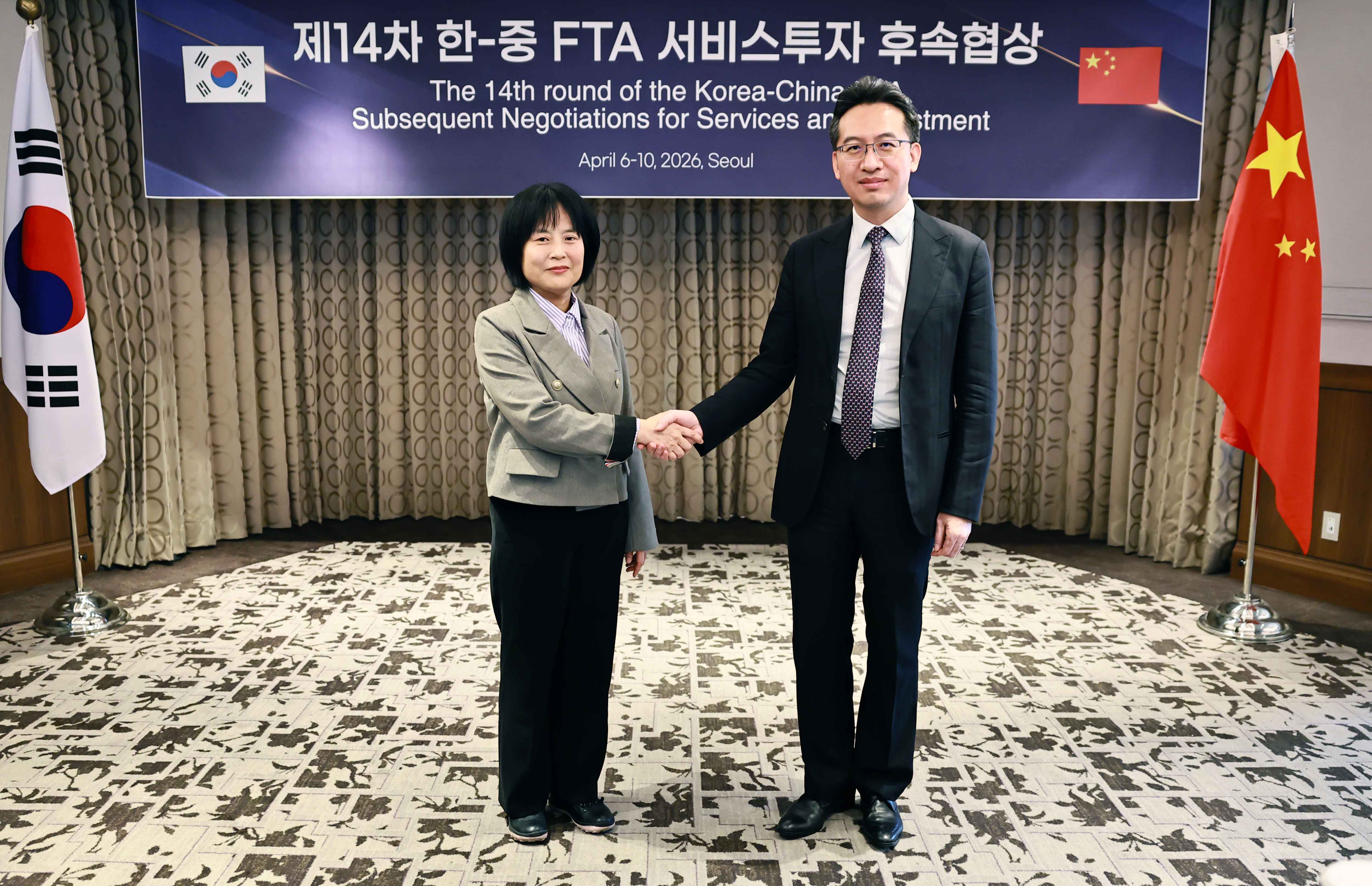
Kwon Hye-jin, Deputy Minister for Trade Negotiations at the Ministry of Trade, Industry and Resources (MOTIR), attended the 14th round of subsequent negotiations on services and investment under the Korea–China Free Trade Agreement (FTA) on April 8, 2026, at Lotte Hotel Seoul. The meeting brought together the Korean and Chinese delegations, including Lin Feng, Director General for International Trade and Economic Affairs at China’s Ministry of Commerce, to continue talks on services, investment and finance. Deputy Minister Kwon said, “We will accelerate the negotiations to deliver outcomes that can support Korean companies facing uncertainty at home and abroad. We will also ensure that the subsequent negotiations lay the groundwork for a freer and more open environment for services trade and investment." date2026-04-09
-
FTA/Economic Cooperation
Korea and China Hold 14th Round of FTA Subsequent Negotiations on Services and Investment
The 14th Round of Subsequent Negotiations on Services and Investment under the Korea–China Free Trade Agreement (FTA) is underway in Seoul from April 6 to 10, 2026. Around 40 officials from both sides are taking part, with the Korean delegation led by Kwon Hye-jin, Deputy Minister for Trade Negotiations at the Ministry of Trade, Industry and Resources (MOTIR, Minister JK Kim), and the Chinese delegation headed by Lin Feng, Director General for International Trade and Economic Affairs at China’s Ministry of Commerce. After the Korea–China FTA entered into force in 2015, the two sides launched follow-up negotiations on services and investment in March 2018 under the “Guidelines for Subsequent Negotiation”. Since then, they have held 13 formal rounds of negotiations and multiple intersessional meetings. At the Korea–China summit in January 2026, the two sides agreed to pursue meaningful progress in the Korea–China FTA follow-up negotiations within the year. The negotiations were discussed again at the Korea–China Trade Ministers’ Meeting on March 18, 2026 and substantive talks are expected to continue at the Korea–China FTA Joint Commission at the ministerial level, which is due to meet in the first half of 2026. With high-level channels between the two sides restored, the negotiating teams will build on this momentum and accelerate negotiations on the Agreement text and market access across the three working groups on services, investment, and finance. Deputy Minister Kwon said, “We will accelerate the negotiations to deliver outcomes that can support Korean companies facing uncertainty at home and abroad. We will also ensure that the subsequent negotiations lay the groundwork for a freer and more open environment for services trade and investment." date2026-04-08
-
FTA/Economic Cooperation
Korea and ASEAN Hold First Joint Committee Meeting on FTA Upgrade
The first joint committee meeting on upgrading the Korea–ASEAN Free Trade Agreement (FTA) was held by videoconference on April 8, 2026. About 40 representatives from both sides took part, led by Park Geun-oh, Director General for Trade Agreement Policy at Korea’s Ministry of Trade, Industry and Resources (MOTIR, Minister JK Kim), and Alpana Roy, Director-General for International Trade and ASEAN at Singapore’s Ministry of Trade and Industry. Since entering into force in 2007 as Korea’s fourth FTA, the Korea–ASEAN FTA has helped expand bilateral trade and investment. However, because the agreement still centers on market opening in goods and services, it has had limits in reflecting newer global trade rules in areas such as digital trade, supply chains and critical minerals. In October 2025, the two sides declared on the sidelines of the Korea–ASEAN Summit that they would begin negotiations to upgrade the agreement, formally launching the process. Ahead of full-scale subcommittee talks in June 2026, the two sides discussed the procedural framework for the negotiations, including the Joint Committee’s rules of procedure, the structure of the negotiating subcommittees and their operating guidelines. Park Geun-oh, Director General for Trade Agreement Policy at MOTIR, said, “With the global trade environment growing more uncertain amid rising protectionism and supply chain instability, we will focus the negotiations on new trade rules on digital trade, supply chains and critical minerals to support future sectors such as AI and electric vehicles.” date2026-04-08
-
Industry
MOTIR Selects 10 Middle Market Companies for World Class Plus Project
The Ministry of Trade, Industry and Resources (MOTIR, Minister JK Kim) announced on April 6, 2026, that it had selected 10 new projects under its World Class Plus Project program and two new projects under its technology innovation challenge program for middle market enterprises and public research institutes to help strengthen the technological competitiveness of Korea’s middle market companies. The World Class Plus Project supports middle market companies with the potential to become world-class firms, from technology development to overseas market entry. From 2011 through 2025, a total of 376 companies were selected under the program and have grown into key exporters that continue to play a leading role in Korea’s exports. In 2026, MOTIR selected 10 companies across sectors such as semiconductors and displays, future mobility, bioindustry, and energy storage systems (ESS). The ministry will support them in securing a technological edge in advanced industries and an early foothold in global markets in future-growth sectors such as bioindustry and ESS. Starting this year, the funding cap has been raised to up to KRW 4.0 billion over four years for companies in the capital region and up to KRW 5.0 billion for regional companies. The technology innovation challenge program links middle market companies with public research institutes to tackle technical hurdles in commercialization in new growth sectors. Under the program, two middle market companies will work with the Electronics and Telecommunications Research Institute (ETRI) and the Korea Institute of Industrial Technology (KITECH) to develop core technologies in construction machinery and autonomous ships. Lee Gyu-bong, Director General for Middle Market Enterprise Policy at MOTIR, stressed that technological innovation is more important than ever for Korean companies to sustain growth amid rising global uncertainty. He added that MOTIR will continue to support Korea’s middle market companies as they build on their technological strengths to compete in global markets. date2026-04-06
-
Trade/Investment
Korea’s 2026 First-Quarter Foreign Direct Investment Rises 0.1% to $6.4 Billion
The Ministry of Trade, Industry and Resources (MOTIR, Minister JK Kim) announced that Korea’s foreign direct investment (FDI) notifications for the first quarter of 2026 rose 0.1 percent year-on-year to USD 6.4 billion, marking the second-highest first-quarter total on record. Actual inflows reached $7.1 billion, the highest first-quarter level on record. Despite a subdued global investment environment and unexpected geopolitical risks, including the conflict in the Middle East, Korea maintained FDI growth in the first quarter. This suggests that foreign investors remain confident in Korea’s investment environment. In particular, foreign investment continued in advanced manufacturing sectors such as semiconductors and secondary batteries, as well as in AI data centers and offshore wind. This indicates that the momentum from last year’s record $36.1 billion in annual FDI notifications has carried into 2026. By type, greenfield investment notifications fell 19.8 percent year-on-year to $3.7 billion amid global investment uncertainty, while M&A notifications rose 53.4 percent to $2.7 billion. By industry, manufacturing investment fell 47.6 percent year-on-year to $1.2 billion. Investment declined in electrical and electronics (down 30.1 percent to $370 million) and in machinery and medical precision equipment (down 75.6 percent to $40 million), but increased in chemicals (up 4.5 percent to $400 million) and non-metallic minerals (up 23.9 percent to $180 million). Meanwhile, services investment rose 21.5 percent year-on-year to $4.3 billion, the highest first-quarter level on record. Growth was led by finance and insurance (up 21.2 percent to $2.6 billion), distribution (up 43.0 percent to $570 million), and information and communications (up 183.6 percent to $240 million). By source country, investment from the United States increased 20.9 percent year-on-year to $1.0 billion, led by information and communications, chemicals, and distribution. Investment from the European Union totaled $1.4 billion (down 4.1 percent), with gains in chemicals and electricity and gas offset by declines in pharmaceuticals and finance and insurance. Investment from Japan fell to $350 million (down 71.1 percent), while investment from China declined to $270 million (down 19.4 percent). In response to external uncertainty, MOTIR will step up investment promotion in strategic sectors, expand regional investment incentives, and address difficulties faced by foreign-invested companies to improve the investment environment. date2026-04-03
-
FTA/Economic Cooperation
Trade Minister Yeo Meets with Delegation from French Business Group MEDEF
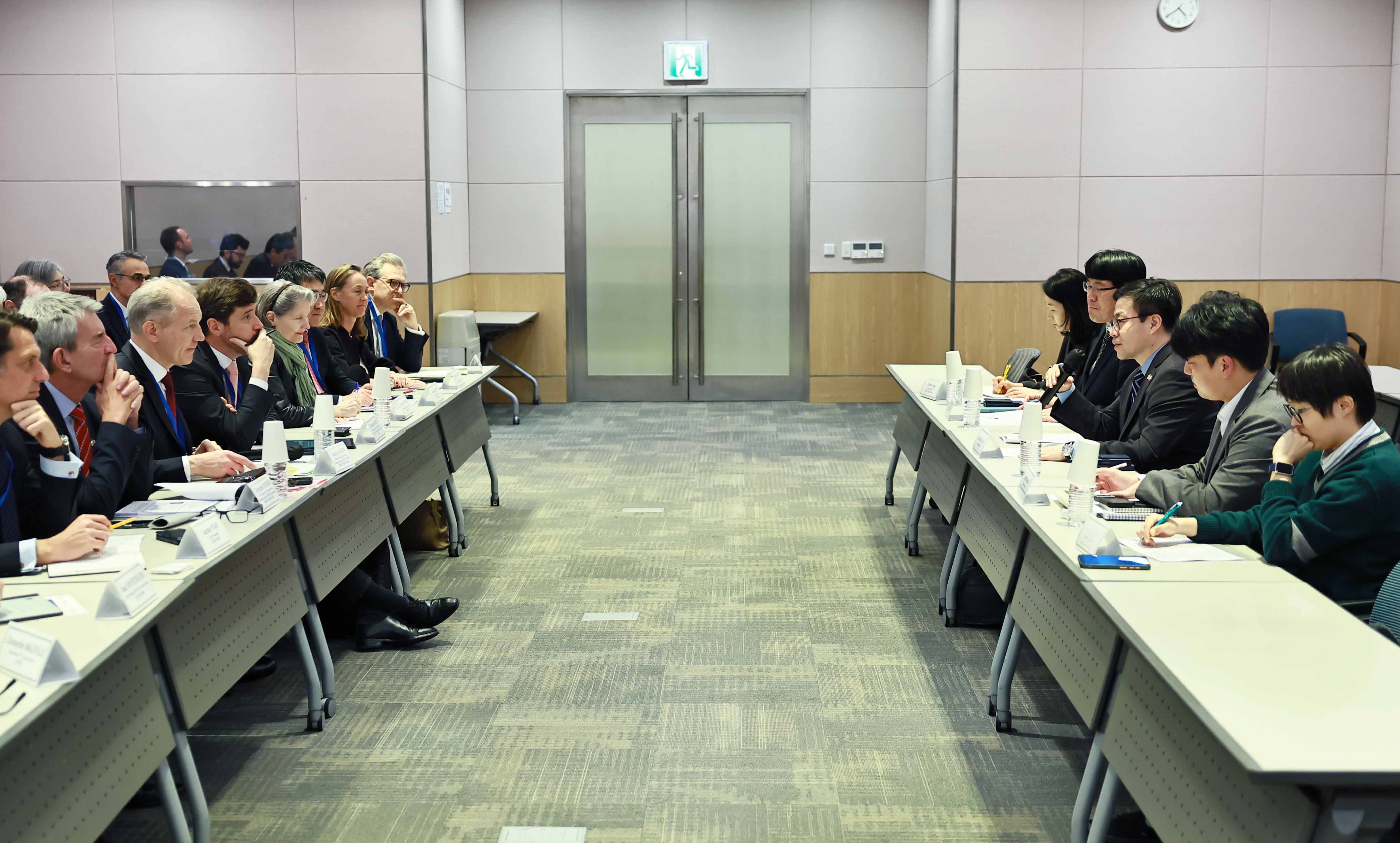
Trade Minister Yeo Han-koo of the Ministry of Trade, Industry and Resources (MOTIR, Minister JK Kim) met with a delegation from Mouvement des Entreprises de France (MEDEF) in Seoul on April 2, 2026, to step up engagement with major French companies and discuss ways to deepen Korea-France economic, investment, and industrial cooperation. The meeting was attended by François Jackow, chairman of MEDEF’s France–Korea Business Council, and 23 business representatives from 16 French companies, including Air Liquide, TotalEnergies, Veolia, and OPmobility. The participating companies represented a range of sectors, including industrial gases, energy, environmental services, and auto parts. Trade Minister Yeo said Korea and France need closer cooperation in strategic industries such as semiconductors, eco-friendly vehicles, and low-carbon supply chains, as energy transition and rapid technological changes are reshaping the global economy. He added that Korea and France can strengthen their competitiveness in global markets by combining their technological strengths and industrial bases, and noted that Korea would continue to improve the investment environment so that global companies can invest with confidence. date2026-04-02
-
FTA/Economic Cooperation
Meeting with Congressional Study Group on Korea (CSGK) of the U.S. House of Representatives
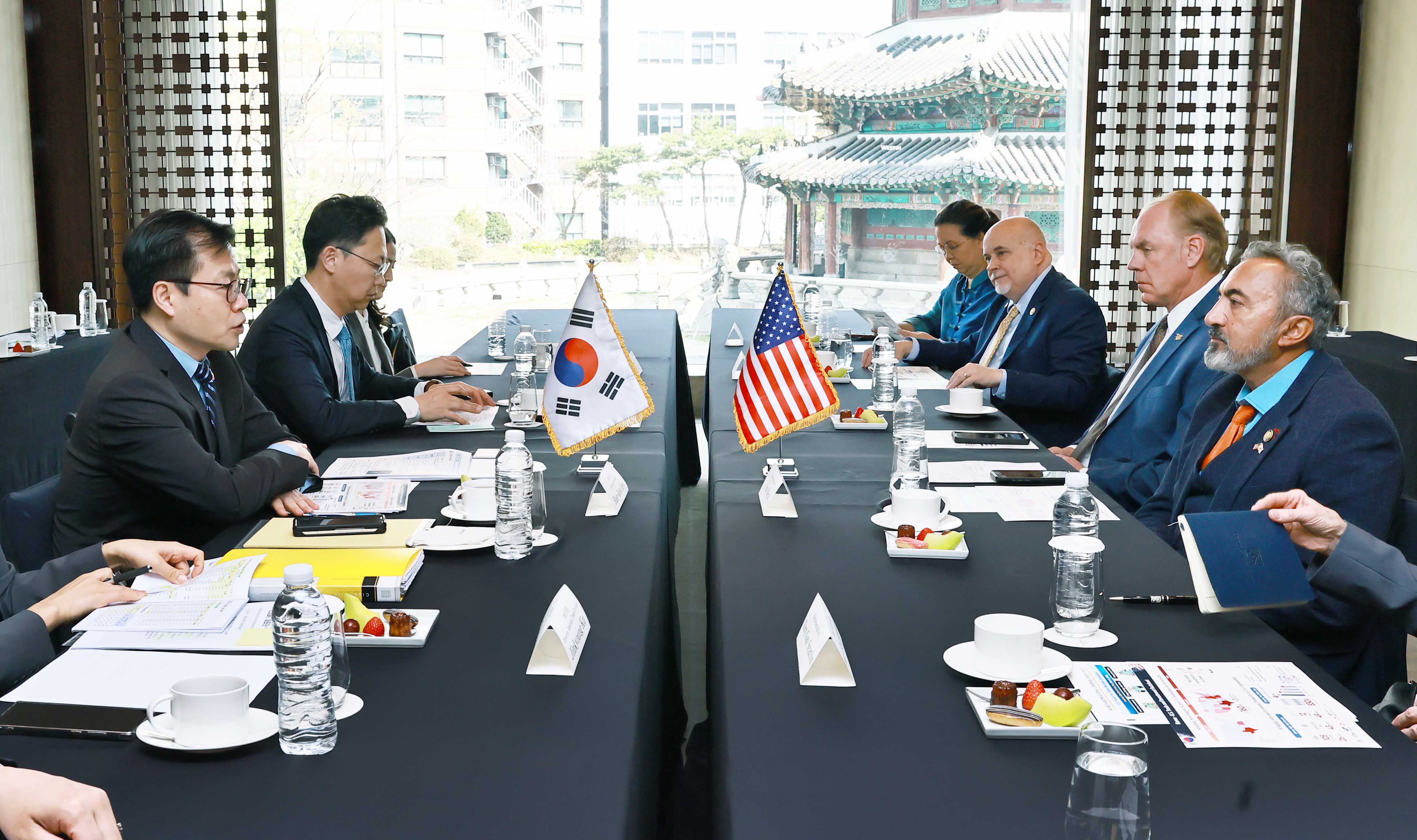
Trade Minister Yeo Han-koo of the Ministry of Trade, Industry and Resources (MOTIR, Minister JK Kim) met with a visiting delegation from the Congressional Study Group on Korea (CSGK) of the U.S. House of Representatives in Seoul on April 2, 2026. The U.S. delegation included Representatives Ami Bera, Ryan Zinke, Mark Pocan, Mary Gay Scanlon, Jill Tokuda, and Pat Harrigan, along with other delegation members. The meeting was arranged to exchange views on key issues with leading members of the U.S. Congress and to explore ways to strengthen bilateral cooperation. Trade Minister Yeo explained that the enactment of the Special Act for Korea–U.S. Strategic Investment Management has helped lay the groundwork for broader strategic investment cooperation, and asked for the CSGK’s continued interest and support to help deepen bilateral cooperation in areas of shared interest. date2026-04-02
-
FTA/Economic Cooperation
MOTIR Meets Major French Companies on Closer Investment and Industrial Cooperation to Deepen Korea-France Economic Ties
Trade Minister Yeo Han-koo of the Ministry of Trade, Industry and Resources (MOTIR, Minister JK Kim) met with a delegation from Mouvement des Entreprises de France (MEDEF), France’s largest business organization, in Seoul on April 2, 2026, to discuss ways to expand Korea–France economic cooperation. Against a global trade backdrop shaped by U.S.–China strategic competition, instability in the Middle East, and Russia-related geopolitical risks, the meeting focused on stepping up engagement with major French companies, deepening Korea–France investment and industrial cooperation, and expanding cooperation in advanced industries, energy, and supply chains. The meeting was attended by François Jackow, chairman of MEDEF’s France–Korea Business Council, and around 30 business representatives from about 20 French companies, including Air Liquide, TotalEnergies, Veolia, and OPmobility. The participating companies came from a range of industries, including industrial gases, energy, environmental services, and auto parts. At the meeting, the French companies shared their views on investment projects in Korea, Korea’s policies to support foreign investment, the current state and future direction of the energy sector, and energy security, opening broader discussions on expanding bilateral industrial cooperation. Trade Minister Yeo said, “As the global economy is being reshaped by the energy transition and rapid technological change, cooperation between Korea and France in strategic industries such as semiconductors, eco-friendly vehicles, and low-carbon supply chains is essential.” He added, “Korea and France can strengthen their competitiveness in global markets by combining their technological strengths and industrial bases.” He noted that Korea would continue to improve the investment environment so that global companies can invest with confidence. Building on the meeting and the Korea-France summit scheduled for April 3, 2026, MOTIR will broaden engagement with French companies and continue working toward tangible outcomes in key areas such as the energy transition, advanced industries, and supply chain cooperation. date2026-04-02
-
FTA/Economic Cooperation
Korea to Step Up EV and Nickel Ecosystem Cooperation with Indonesia, ASEAN’s Largest Economy
The Ministry of Trade, Industry and Resources (MOTIR, Minister JK Kim) and the Embassy of the Republic of Indonesia in South Korea hosted the Korea–Indonesia Business Forum at The Shilla Seoul on April 1, 2026. Held in conjunction with Indonesian President Prabowo Subianto’s official visit to Korea, the forum brought together about 300 participants from the governments, public institutions, and businesses of both countries. At the forum, the two sides discussed industrial ecosystem cooperation in electric vehicles and steel as a means to further deepen bilateral economic cooperation. They also exchanged views on strategies to expand cooperation into new areas such as bioindustry and consumer goods. Indonesia’s Ministry of Investment and Downstream Industry (BKPM), together with Korea’s POSCO, LG Energy Solution, and Hyundai Motor Company, presented plans to establish supply chains and build industrial ecosystems. Indonesia’s Danantara and JAPFA, along with Korea’s SK Plasma and CJ CheilJedang, also discussed strengthening cooperation in bioindustry and consumer goods. The forum included the exchange of nine memoranda of understanding (MOUs) and three letters of intent (LOIs) between Korean and Indonesian companies across industry, energy, construction, and finance. The exchange took place in the presence of Indonesia’s Coordinating Minister for Economic Affairs Airlangga Hartarto and Trade Minister Yeo Han-koo. “Through this business forum, Korea and Indonesia should expand trade and investment, deepen manufacturing cooperation, and strengthen critical mineral supply chains to generate mutually beneficial outcomes and grow together on that basis,” Trade Minister Yeo said. Korea’s innovation capabilities in advanced industries and Indonesia’s abundant resources make the two countries complementary economic partners. The Korea–Indonesia Comprehensive Economic Partnership Agreement (CEPA), which entered into force in 2023, has strengthened that partnership. Under the agreement, Indonesia eliminated tariffs on 93 percent of tariff lines and Korea on 95.5 percent. Since the CEPA entered into force, Korea’s semiconductor exports to Indonesia have risen 12.3 percent, from USD 453.0 million in 2023 to USD 509.0 million in 2025. Over the same period, Indonesia’s exports of ferroalloys and steel scrap to Korea rose 185.7 percent, from USD 98.0 million to USD 280.0 million. The Korean government will continue to monitor private-sector cooperation outcomes from the forum through a task force on summit-linked economic events. It will also support Korean companies so that the MOUs signed with Indonesian partners translate into tangible projects. date2026-04-02