-
FTA/Economic Cooperation
MOTIR Discusses Strengthening Korea–U.S. Economic and Trade Cooperation with the U.S. Congress
Trade Minister Yeo Han-koo of the Ministry of Trade, Industry and Resources (MOTIR, Minister JK Kim) held a roundtable with members of the Congressional Study Group on Korea (CSGK), in Seoul on April 2, 2026. Held during the CSGK’s visit to Korea, the roundtable focused on exchanging views on key issues with leading members of the U.S. Congress and exploring measures to strengthen bilateral cooperation. Trade Minister of MOTIR–CSGK Delegation Roundtable Overview Date and Venue: 10:00–10:45 a.m., Thursday, April 2, 2026, The Westin Josun Seoul Participants: (Korea) Trade Minister Yeo Han-koo and other MOTIR officials (U.S.) Six* members of the Congressional Study Group on Korea (CSGK) of the U.S. House of Representatives, and other delegation members * Representatives Ami Bera (D-CA), Ryan Zinke (R-MT), Mark Pocan (D-WI), Mary Gay Scanlon (D-PA), Jill Tokuda (D-HI), and Pat Harrigan (R-NC). Noting that Korea–U.S. ties have expanded beyond a traditional security alliance into substantive cooperation in economic and technological areas, the two sides held wide-ranging discussions on their respective policy priorities and on ways to expand cooperation in trade and investment. Trade Minister Yeo explained that the groundwork has been laid for broader strategic investment cooperation, including through the enactment of the Special Act for Korea–U.S. Strategic Investment Management. He also asked for the CSGK’s continued interest and support to help deepen bilateral cooperation in areas of shared interest. The Korean government will continue engaging key U.S. stakeholders to help maintain a stable Korea–U.S. trade environment and foster favorable business conditions for Korean companies in the U.S. market. date2026-04-02
-
Trade/Investment
March 2026 Exports Reach Record $86.1 Billion, Surpassing $80 Billion for the First Time
The Ministry of Trade, Industry and Resources (MOTIR, Minister JK Kim) announced that in March 2026, Korea’s exports rose 48.3 percent year-on-year to USD 86.1 billion, while imports increased 13.2 percent to $60.4 billion, resulting in a $25.7 billion surplus. Exports in March rose 48.3 percent to $86.1 billion despite the conflict in the Middle East, surpassing $80.0 billion for the first time. Average daily exports, adjusted for working days, increased 41.9 percent to $3.7 billion, also reaching a record high. By product, exports increased in 10 of Korea’s 15 key export items. Semiconductor exports rose to $32.8 billion (up 151.4 percent), posting the highest monthly figure on record and topping $30.0 billion for the first time. Automobiles edged up to $6.4 billion (up 2.2 percent), as gains in eco-friendly vehicles offset the impact of some logistics disruptions linked to the conflict in the Middle East. Petroleum products rose to $5.1 billion (up 54.9 percent), while petrochemicals increased 5.8 percent. Computers rose to $3.4 billion (up 189.2 percent), reaching the highest level on record, and secondary battery exports increased to $0.9 billion (up 36.0 percent). Among items outside the 15 key export categories, electrical equipment, cosmetics, and agricultural and fisheries products also reached record highs for March. By destination, exports increased in seven of Korea’s nine major markets. Exports to China rose 64.0 percent to $16.5 billion, extending their growth streak to five consecutive months. Exports to the United States rose to $16.3 billion (up 47.1 percent), led by semiconductors and computers. Exports to ASEAN increased to $13.8 billion (up 34.3 percent), while exports to the EU rose to $7.5 billion (up 19.3 percent). By contrast, exports to the Middle East fell 49.1 percent to $0.9 billion amid logistics disruptions linked to the conflict. Imports rose 13.2 percent year-on-year to $60.4 billion. Energy imports edged down to $9.4 billion (down 7.0 percent), while non-energy imports rose 17.9 percent to $51.0 billion. Crude oil imports fell 5.0 percent to $6.0 billion, as supply disruptions from the closure of the Strait of Hormuz reduced import volumes, more than offsetting the rise in unit prices. Among non-energy imports, semiconductors rose to $8.6 billion (up 34.8 percent) and semiconductor equipment to $2.9 billion (up 4.4 percent). The trade surplus in March reached $25.7 billion, up $21.0 billion from March 2025, marking the largest monthly surplus on record and extending Korea’s surplus streak to 14 consecutive months since February 2025. Minister JK (Jung-Kwan) Kim stated, “Despite challenging external conditions, including the conflict in the Middle East and the spread of protectionism, exports in March surpassed $80 billion for the first time, led by semiconductors and by broad-based gains in other key export items and promising categories, including consumer goods.” He noted that export uncertainty is rising as the conflict in the Middle East continues to push up oil prices and heighten supply chain risks. He added that the government will maintain a government-wide response system, closely monitor supply chains across energy, raw materials, and logistics, promptly implement stabilization measures, and help exporters address difficulties in marketing, logistics, and financing. It will also support diversification across export items and markets to sustain export momentum. date2026-04-01
-
FTA/Economic Cooperation
Korea, EU Step Up High-Level Coordination on Critical Minerals, Supply Chains and Regulatory Proposals
The Ministry of Trade, Industry and Resources (MOTIR, Minister JK Kim) held the inaugural Korea–EU special committee on emerging trade issues in Seoul on March 31, 2026, with Park Jung-sung, Deputy Minister for Trade at MOTIR, and Sabine Weyand, Director-General for Trade and Economic Security at the European Commission, as chief delegates. This was the first meeting under a new vice minister-level consultative body created in response to a rapidly changing trade environment amid global supply chain realignment and growing protectionism. The two sides discussed key issues including critical minerals, supply chain resilience, advanced technologies, and security. On critical minerals, Korea and the EU noted that both have limited production bases and remain heavily dependent on external supply chains, leaving them structurally vulnerable. They agreed to expand strategic dialogue and continue discussions on specific areas for cooperation. The two sides shared their assessments of recent developments in the Middle East and their respective response systems. They underscored the importance of close Korea–EU coordination for an effective response and agreed to stay in close contact on related issues. Korea briefed the EU on developments and its position in areas the EU had expressed interest in, including its supply chain management system, technology security framework, and cooperation on semiconductor and connected-vehicle security and safety. Korea also set out its position on major industrial policies and regulations currently under discussion in the EU. Korea welcomed the March 4, 2026, final text of the Industrial Accelerator Act (IAA), which treats content originating in FTA partner countries as equivalent to EU origin. Korea noted, however, that some provisions remain unclear and that concerns raised by the Korean government and industry have yet to be fully addressed. Korea noted that it had already submitted a document on March 20, 2026, setting out its questions and requests, and asked the EU to take them into account so that the measure can be introduced in a way that strengthens bilateral cooperation. On the tariff-rate quotas (TRQs) the EU is considering on steel imports, Korea acknowledged the need to address global steel overcapacity, but stressed that any measure should remain consistent with the Korea–EU FTA and WTO rules and should not unduly restrict market access for Korean companies. The two sides said the meeting had strengthened the basis for cooperation on key issues including critical minerals, supply chains, and economic security. They agreed to pursue tangible outcomes through follow-up channels, including the Korea-EU Next-Generation Strategic Dialogue at the ministerial level, scheduled for April 2026. date2026-04-01
-
FTA/Economic Cooperation
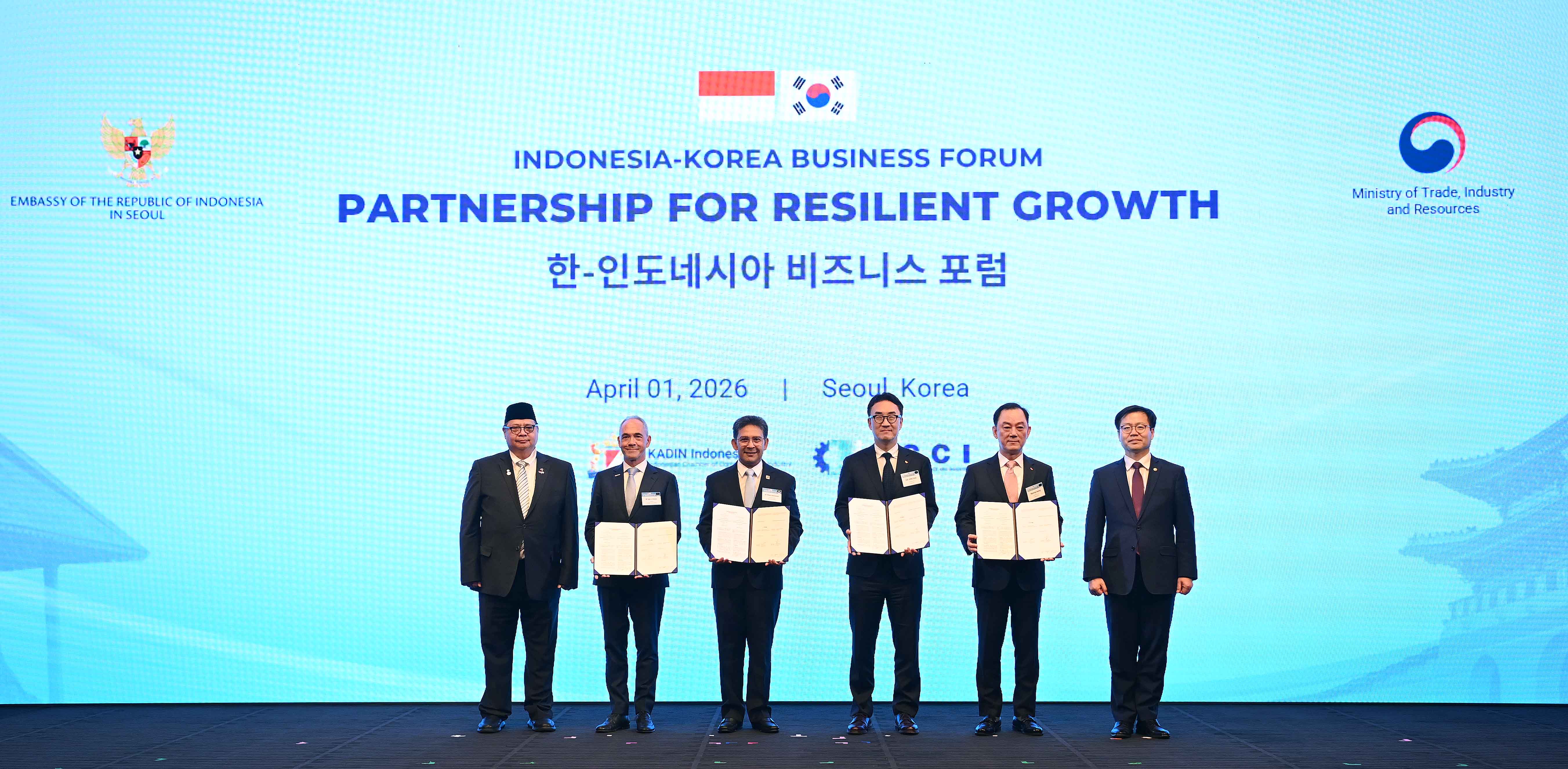
Korea–Indonesia Economic Cooperation 2.0 MOU Signing Ceremony
Trade Minister Yeo Han-koo of the Ministry of Trade, Industry and Resources (MOTIR, Minister JK Kim) attended the Korea–Indonesia Economic Cooperation 2.0 memorandum of understanding (MOU) signing ceremony, held on the sidelines of the Korea–Indonesia Business Forum in Seoul on April 1, 2026. The ceremony was attended by Airlangga Hartarto, Indonesia’s Coordinating Minister for Economic Affairs, and other officials from the two governments. “Through this business forum, Korea and Indonesia should expand trade and investment, deepen manufacturing cooperation, and strengthen critical mineral supply chains to generate mutually beneficial outcomes and grow together on that basis,” Trade Minister Yeo said. date2026-04-01
-
FTA/Economic Cooperation
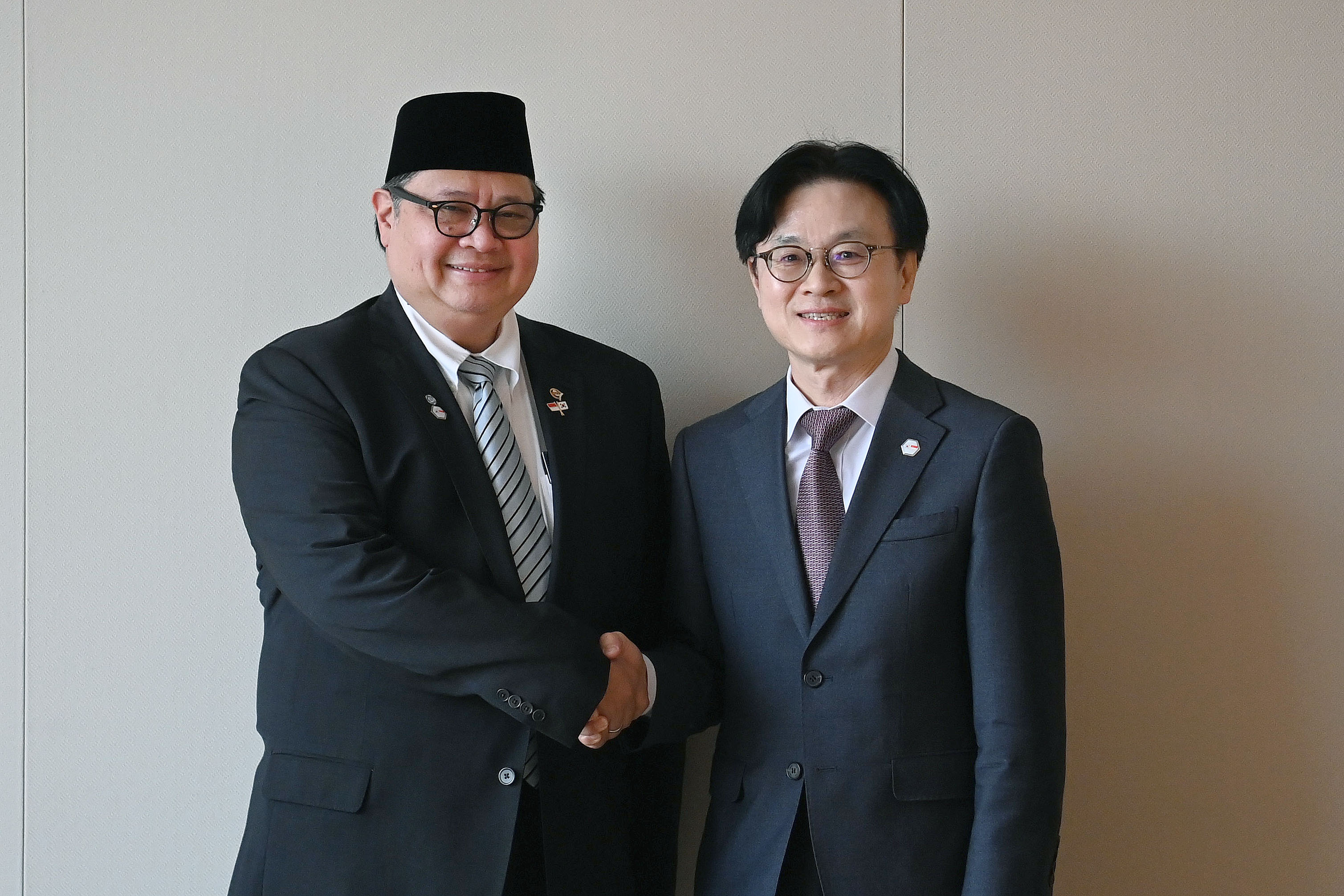
Minister JK Kim Meets with Indonesia’s Coordinating Minister for Economic Affairs
Minister JK (Jung-Kwan) Kim of the Ministry of Trade, Industry and Resources (MOTIR) met with Airlangga Hartarto, Indonesia’s Coordinating Minister for Economic Affairs, at The Shilla Seoul in Seoul on April 1, 2026. The two sides discussed ways to strengthen energy cooperation, including LNG, and measures to address difficulties faced by Korean companies operating in Indonesia. date2026-04-01
-
FTA/Economic Cooperation
Korea–Canada Energy Security Leadership Dialogue
Minister JK (Jung-Kwan) Kim of the Ministry of Trade, Industry and Resources (MOTIR) attended the Korea–Canada Energy Security Leadership Dialogue in Seoul on March 31, 2026, where he delivered opening remarks and discussed stable energy and resource supplies, diversification of energy sources, and stronger global partnerships with Maninder Sidhu, Canada’s Minister of International Trade. The dialogue was also attended by Canadian Ambassador to Korea Philippe Lafortune and representatives from major Korean and Canadian energy and resource companies. “Amid growing global uncertainty, Korea and Canada can build more resilient supply chains by bringing together Canada’s resource strengths and Korea’s manufacturing capabilities,” Minister Kim said. “The two countries should deepen cooperation in LNG, critical minerals and nuclear power.” date2026-03-31
-
FTA/Economic Cooperation
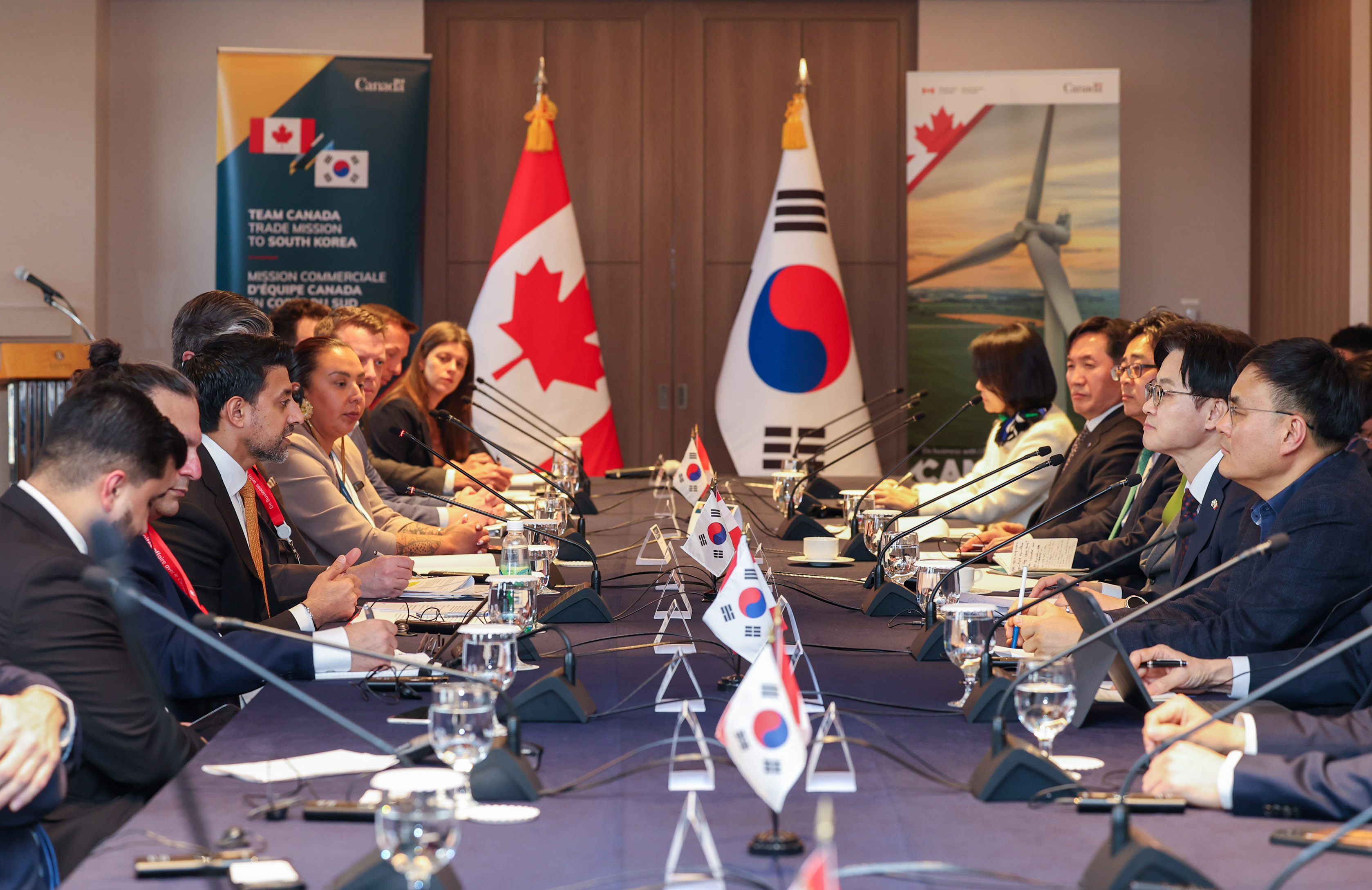
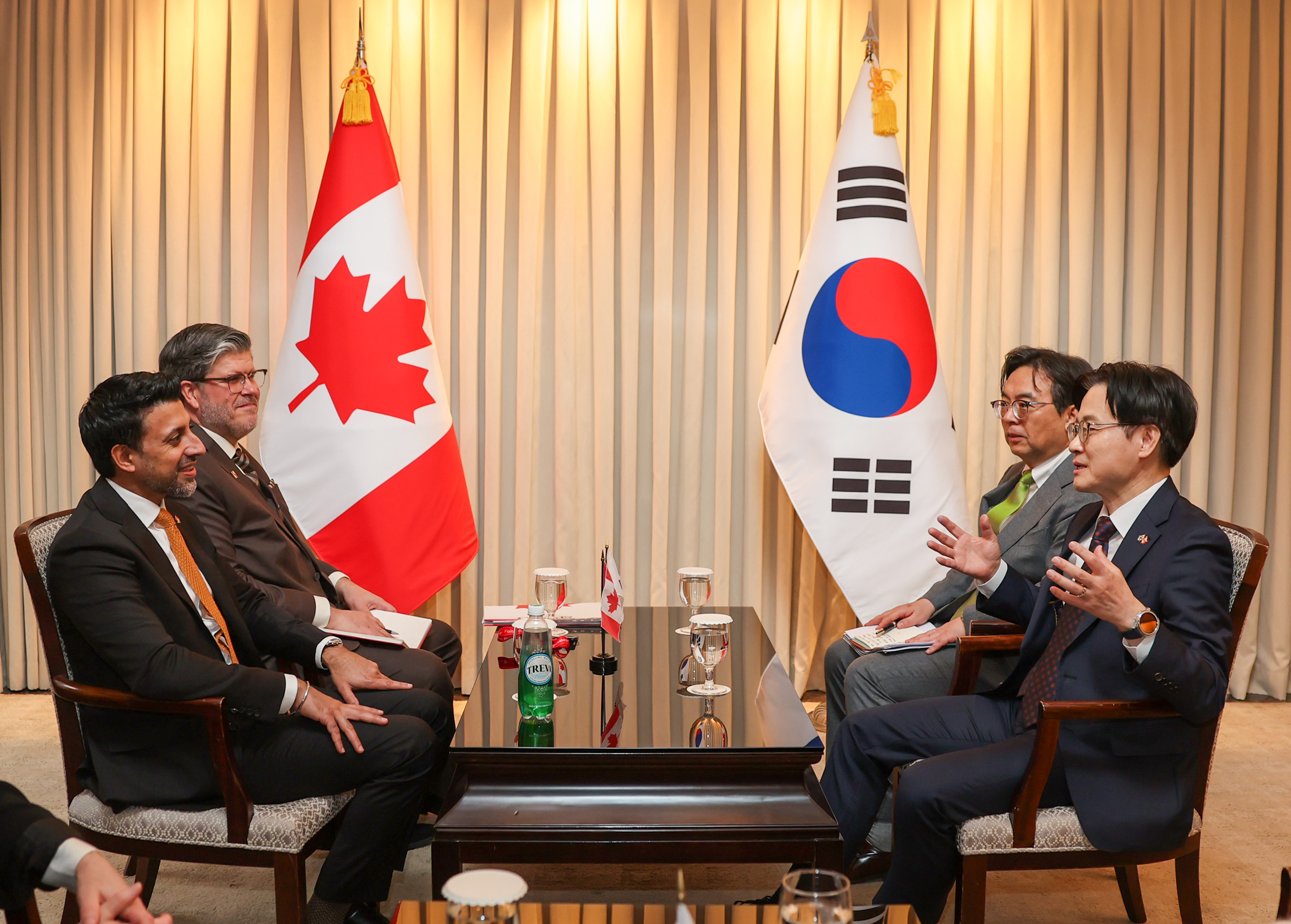
Minister JK Kim Meets with Canada’s Minister of International Trade
Minister JK (Jung-Kwan) Kim of the Ministry of Trade, Industry and Resources (MOTIR) met with Maninder Sidhu, Canada’s Minister of International Trade, in Seoul on March 31, 2026, to discuss the current state of bilateral trade and broader economic cooperation. The meeting was also attended by Canadian Ambassador to Korea Philippe Lafortune and representatives of major Korean and Canadian energy and resource companies. “In a new era of uncertainty, if a resource-rich country like Canada and a manufacturing powerhouse like Korea combine their respective strengths, they can build resilient supply chains capable of weathering global crises,” Minister Kim said. “Korea and Canada should expand cooperation in energy and resources, including LNG, critical minerals and nuclear power.” date2026-03-31
-
FTA/Economic Cooperation
Korea and Canada Step Up Cooperation in Strategic Industries
Minister JK (Jung-Kwan) Kim of the Ministry of Trade, Industry and Resources (MOTIR) held the Korea–Canada Energy Security Leadership Dialogue in Seoul on March 31, 2026, on the occasion of the visit to Korea this week by the Team Canada Trade Mission, led by Maninder Sidhu, Canada’s Minister of International Trade. The meeting focused on ways to stabilize energy and resource supply chains between the two countries and expand cooperation in strategic industries. Participants included Minister Kim, Minister Sidhu, Canadian Ambassador to Korea Philippe Lafortune, and representatives from major energy and resource companies from both countries. The two ministers shared the view that Korea and Canada should deepen cooperation centered on stable energy and resource supplies, diversification of energy sources, and stronger global partnerships at a time of growing uncertainty in global energy and resource supply chains amid the recent conflict in the Middle East. They also shared the understanding that Korea and Canada are complementary partners capable of driving new growth through strategic industrial cooperation, including in resources and minerals. Minister JK Kim said, "In a new era of uncertainty, if a resource-rich country like Canada and a manufacturing powerhouse like Korea combine their respective strengths, they can build resilient supply chains capable of weathering global crises," and proposed that the two countries strengthen cooperation in energy and resources, including LNG, critical minerals, and nuclear power.” Minister Kim also stressed that proactive cooperation would be essential to maximizing the two countries’ potential in future strategic industries, and said that Canada’s submarine program could provide a powerful new impetus for deeper bilateral cooperation in those sectors. In this regard, he reiterated that Hyundai Motor’s project linking hydrogen production, refueling, and mobility—leveraging Canada’s hydrogen resource potential—could serve as a mutually beneficial model for strategic industrial cooperation between the two countries, and asked for Canada’s favorable consideration. Meanwhile, Trade Minister Yeo Han-koo is set to attend a reception for the Team Canada Trade Mission on April 1, 2026. The event will bring together some 500 leading figures from the two countries’ business communities to explore opportunities to expand mutually beneficial cooperation in key business sectors. On the sidelines of the event, he also plans to meet again with Minister Sidhu, following their bilateral meeting on March 28, 2026, at the 14th WTO Ministerial Conference, to continue follow-up discussions on the outcomes of the ministerial conference as well as bilateral and multilateral trade issues, including Korea–Canada economic and trade matters. Trade Minister Yeo will also note that this visit marks the Team Canada Trade Mission’s first return to a country it previously visited, coming two years after its April 2024 visit to Korea—underscoring the strong interest and commitment from industry in both countries toward Korea–Canada industrial cooperation. He will also express the government’s commitment to actively supporting efforts to deliver tangible outcomes in strategic industries such as defense and automobiles through high-level communication channels. date2026-03-31
-
FTA/Economic Cooperation
Korea, Uzbekistan Discuss Expanding Economic Cooperation
Park Jung-sung, Deputy Minister for Trade at the Ministry of Trade, Industry and Resources (MOTIR, Minister JK Kim), met with Ilzat Kasimov, Deputy Minister of Investment, Industry and Trade of Uzbekistan, in Seoul on March 31, 2026, to discuss expanding bilateral economic cooperation in industry and supply chains. The talks came ahead of the Korea–Central Asia Summit, amid growing momentum in Korea–Central Asia cooperation. The two sides shared the view that cooperation in industry, trade and investment should be expanded. They also agreed to continue developing specific agenda items through existing channels, including the Korea–Uzbekistan Joint Committee on Trade and Economic Cooperation. In addition, they discussed the need to expand cooperation on critical minerals in response to shifts in global supply chains. The Korean side noted the need to support the smooth operations of Korean companies in Uzbekistan. The Uzbek side expressed hope for increased investment by Korean companies and noted the potential for cooperation across a range of sectors, including manufacturing and infrastructure. “Uzbekistan is a key economic partner for Korea in Central Asia,” Deputy Minister Park said. “Building on the momentum in Korea–Central Asia cooperation, we will continue to broaden cooperation in industry, supply chains and investment.” Deputy Minister Park also asked for the Uzbek government’s attention and cooperation in helping Korean companies operate smoothly and address business difficulties. date2026-03-31
-
Trade/Investment
MOTIR Holds First Foreign Investment Caravan of 2026
The Ministry of Trade, Industry and Resources (MOTIR, Minister JK Kim) held the first Foreign Investment Caravan of 2026 in Cheonan, South Chungcheong Province, on March 31, 2026. The Caravan is an on-site outreach program for foreign-invested companies aimed at encouraging follow-on investment. Through the program, MOTIR gathers input on business difficulties, addresses investment-related concerns, and provides information on available investment support policies. The nationwide Caravan delivered tangible results in 2025, reaching 129 foreign-invested companies and identifying new investment demand totaling USD 1.68 billion, along with 53 regulatory improvement tasks. Building on those results, MOTIR plans to hold four Caravans in 2026 across four major regions. To help translate consultations into actual investment, the ministry will identify high-potential target companies in advance and offer one-on-one tailored consultations. This year’s program is designed not only to answer routine questions and address business difficulties, but also to put in place a more hands-on support system that can lead to additional investment. The event brought together about 60 participants, including representatives of 22 foreign-invested companies in the Chungcheong region, such as Air Liquide, Corning, and Merck; officials from MOTIR, Chungcheongnam-do, Chungcheongbuk-do, and Daejeon Metropolitan City; and representatives from the Korea Trade-Investment Promotion Agency (KOTRA) and the Korea Industrial Complex Corporation (KICOX). Participants took part in three parallel programs: a briefing on support policies for foreign-invested companies, a roundtable on business difficulties, and one-on-one tailored consultations. “In line with the Five Mega-Regions and Three Special Self-Governing Provinces initiative, we will focus on strategically attracting competitive, high-potential companies in advanced industries, supply chains, AI transformation (AX), and green transformation (GX), while substantially strengthening incentives for investment in non-metropolitan regions to support regional growth,” said Nam Myung-woo, Director General for Cross-Border Investment Policy at MOTIR. “With uncertainty rising both at home and abroad, including from recent developments in the Middle East, close communication with companies on the ground is more important than ever.” Following the Chungcheong event, MOTIR will hold additional Caravans in the capital region and other parts of the country to step up its efforts to attract foreign investment to Korea. date2026-03-31